Home
Ideas + Action for a Better City
         Join SPUR
a member-supported nonprofit organization 
Main Menu
  • About
    • Our Mission
    • Equity Platform
    • Staff
    • Contact Us
    • Board of Directors
    • Work With Us
    • Impact Stories
    • Annual Reports
    • Financial Statements
    • About the Urban Center
    • Visit the Member Lounge
    • Rent Our Facility
    • Get Our Newsletters
  • Join or Give
    • Individual Membership
    • Business Membership
    • Donate to SPUR
    • Planned Giving
  • Events
    • Events Calendar
    • Exhibitions
    • Silver SPUR Awards
    • Good Government Awards
  • Policy Areas
    • Planning
    • Housing
    • Transportation
    • Sustainability + Resilience
    • Economy
    • Governance
  • Initiatives
    • SPUR Voter Guide
    • SPUR Regional Strategy
    • Cutting Red Tape
    • Guadalupe River Park
    • Belonging in the Bay
    • Rising Together
    • Ocean Beach Master Plan
    • The Resilient City
  • Regional Strategy
  • Publications
  • Search

Primary tabs

  • General
  • Advanced Publications Search Toggle tabs as a menu
Publication Type
Topic
Geography
Date Range
a Muni bus driving on Geary Boulevard

The Proposed Parcel Tax That Would Help Sustain Muni Service and Rider Approval

News / January 29, 2026
Faster and more frequent service is earning San Francisco Muni its highest customer rating in decades, but without an additional $307 million in revenue by 2027, it could be forced to cut more than a third of its transit service. SPUR and partners have advised the city on a big piece of the solution: a proposed local parcel tax expected to generate $160 million annually. SPUR digs into the details of the tax.
photo of workshop attendees listening to a presentation

How San Francisco’s Family Zoning Plan Got Passed

News / January 28, 2026
In December, the San Francisco Board of Supervisors adopted the city’s most ambitious zoning reform in decades. The Family Zoning Plan allows dense multifamily housing to be built in most neighborhoods in order to help address the city’s housing crisis. SPUR led advocacy efforts to ensure the plan met state mandates and addressed housing inequality, as well as facilitating public engagement throughout the process. Here’s what went into getting the plan passed — and what it will do for the city.

SPUR and Nuestra Casa Comment on SAFER Bay Area Draft Environmental Impact Report

Advocacy Letter / January 23, 2026
The SAFER Bay Project is a multi-benefit regional effort led by the San Francisquito Creek Joint Powers Authority to protect communities, critical infrastructure, and habitat along the San Mateo County shoreline from flooding and projected sea-level rise through integrated engineered and nature-based flood protection. SPUR, Nuestra Casa, and other partners have been following and participating in this effort for years. The Draft Environmental Impact Report was released for public comment in December and was due end of January. We identified areas for improvement in the project, focused on groundwater rise and contamination issues.

SPUR supports San Jose's "Housing Day" Legislation

Advocacy Letter / January 23, 2026
SPUR supports San Jose's proposed housing incentive programs, including the expansion of Downtown Residential Incentive Program, the Multifamily Housing Incentive Program extension, and updates to the Inclusionary Housing Ordinance. We believe that these actions will unlock stalled housing developments, support housing production in Downtown San José, and deliver naturally occurring affordability for middle-income households without deep subsidies, relieving displacement pressures elsewhere in the city.

SPUR Comments on Zero-Emission Space and Water Heater Standard

Advocacy Letter / January 21, 2026
A broad coalition of environmental, health, labor, and building experts including SPUR urges the California Air Resources Board to strengthen its proposed Zero-Emission Space and Water Heater Standard, warning that the current draft falls short of California’s climate, air quality, equity, and affordability goals. Our letter calls for earlier and stricter limits on sales of polluting equipment aligned with the state’s Scoping Plan, more accurate treatment of equipment size and emissions, limits on credit multipliers, and stronger penalties for noncompliance. It also emphasizes the need for better data, streamlined permitting, workforce and consumer support, and targeted assistance for low-income households to ensure a faster, fairer transition to clean heating.
New prototype maps at El Cerrito Del Norte BART station

Three Years of Progress Toward a More Integrated Transit System

News / January 21, 2026
Three years after establishing a regional network management structure to coordinate Bay Area transit, customers are beginning to experience real changes. A recent SPUR forum highlighted progress in implementing transit priority treatments, simplifying fare systems and signage, and increasing accessibility for individuals with disabilities. But sustaining these initiatives and transit operations more generally requires new funding.

SPUR Supports SB 222, the Heat Pump Access Act

Advocacy Letter / January 15, 2026
The Bay Area Air District, SPUR, and the Building Decarbonization Coalition Action Fund urge support for SB 222, the Heat Pump Access Act, which would modernize and standardize permitting to make heat pump installations faster and more affordable statewide. Inconsistent, costly, and slow local permitting is a major barrier to meeting California’s climate goals, driving up installation costs and sometimes pushing homeowners toward unpermitted work. SB 222 would streamline approvals, cap excessive local requirements, enable automated permitting, and protect consumers while still allowing jurisdictions to recover reasonable costs.
portraits of Sarah Atkinson and Colleen Corrigan

How Cities Can Band Together to Reduce Wildfire Risks and Costs: Q&A with Sarah Atkinson and Colleen Corrigan

News / January 13, 2026
In the wake of the devastating Los Angeles fires in January 2025, SPUR examined wildfire mitigation in the Bay Area and to explore opportunities to improve management strategies. In a new report, SPUR's Sarah Atkinson and Colleen Corrigan find that neighboring cities with shared wildfire risk could significantly improve their resilience by establishing coordinating entities. We asked them about the governance models they studied and how this research may support action on other climate hazards.
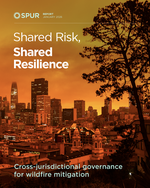
Report cover with photo of San Francisco with orange sky due to wildfire smoke in September 2020

Shared Risk, Shared Resilience

SPUR Report / January 7, 2026
On the one-year anniversary of the Los Angeles fires, a new SPUR report examines the Bay Area’s vulnerability to fire risk. Responsibility for wildfire prevention in California is spread across multiple government agencies at the federal, state, and local levels. Fire mitigation is undermined by fragmented coordination, short-term or insufficient funding, and weak alignment between local risk reduction efforts and the insurance market. SPUR recommends new governance structures for achieving community wildfire resilience.
Headshot of Mike Teitz

Remembering Mike Teitz

News / January 6, 2026
Michael B. Teitz, a former two-term SPUR board member, professor emeritus of City and Regional Planning at UC Berkeley, and senior fellow at the Public Policy Institute of California, died December 17 at age 90. He was a member of the SPUR Regional Policy Board and the SPUR Ballot Analysis Committee.
portraits of Erika McLitus and Sujata Srivastava

How San José Can Fill Its Vacant Ground-Floor Office Spaces to Speed Economic Recovery: Q&A with Erika McLitus and Sujata Srivastava

News / December 16, 2025
Like many urban centers, downtown San José is grappling with low daytime foot traffic and high vacancies in office and commercial buildings. A new policy brief from SPUR suggests that filling empty ground-floor spaces is a critical first step to long-term economic revitalization. We spoke with the brief's authors, Erika McLitus and Sujata Srivastava, about how SPUR’s recommended policy changes can support local artists and entrepreneurs and bring new energy to downtown.
photo of a heat pump water heater

Equitably Transitioning to Clean Water Heating in the Bay Area: State of Play for 2026

News / December 15, 2025
The Bay Area is shifting to zero-emission heat pump water heaters by phasing out the sale of smaller residential gas models. Despite the loss of federal tax credits, SPUR’s analysis shows that combining local and state incentives helps many residents purchase heat pump water heaters at prices comparable to those of gas models. However, continued incentives and new financing options are crucial to ensure low-income residents can afford the transition.
Dark blue report cover with title in white text

Getting In on the Ground Floor

Policy Brief / December 10, 2025
Downtown San José is a walkable, transit-rich, culturally dynamic urban center. But in the wake of the COVID-19 pandemic, it’s still grappling with low daytime foot traffic and high vacancies in office and commercial buildings. Filling empty ground-floor spaces is a critical first step in a long-term economic revitalization strategy. SPUR offers 13 recommendations to capitalize on the opportunity these spaces offer for local artists, nonprofit organizations, and small businesses.
Photo of San Francisco City Hal building with a construction crane in the foreground

Op-Ed: There’s No Fixing San Francisco Without Fixing Its City Charter. Here’s How

News / November 13, 2025
In an op-ed for the San Francisco Chronicle, SPUR argues that the San Francisco City Charter is due for an overhaul. What was meant to be a concise constitutional framework has become a detailed and disjointed instruction manual. Riddled with outdated, duplicative, and overly specific provisions, the charter ties the city’s hands at precisely the moment when flexibility and adaptability are needed most.
Solid red report cover with the title in white text

Charter for Change

Policy Brief / November 10, 2025
San Francisco's 548-page city charter, expanded through amendments over time, is hindering effective governance and solutions for housing affordability, public safety, climate resilience, and other critical issues. The November 2026 election offers a chance to update it. Our policy brief proposes 10 changes that, if approved by voters, would empower city leadership, improve outcomes, access, and accountability, and create a more effective and responsive government.
Port of Oakland - Urbanist 2026

Business Member Profile: Port of Oakland

Urbanist Article / November 3, 2025
The Port of Oakland, a SPUR business member since 2015, recently adopted a bold strategic plan for 2025–2030. From reducing emissions and modernizing infrastructure to fostering inclusive economic growth, the plan provides a blueprint to meet the challenges of the post-pandemic economy, climate change, and geopolitical uncertainty. We spoke with Executive Director Kristi McKenney about the priorities embedded in the new strategic roadmap.
Claudine Cheng - Headshot

SPUR Member Profile: Claudine Cheng

Urbanist Article / November 3, 2025
Claudine Cheng is an attorney specializing in regulatory compliance, corporate governance, and land use in San Francisco. A community advocate and activist, she believes that one of the most powerful tools for city wellbeing is a strong arts and culture scene. We asked her about the role arts and culture initiatives play in a city’s health.
Governing Adaptation - Urbanist 2026

Governing Adaptation

Urbanist Article / November 2, 2025
Meeting the challenge of sea level rise in the San Francisco Bay Area will require cities and counties to work together on adaptation efforts. Several promising local governance structures are already demonstrating how communities can work together on legally mandated subregional shoreline adaptation plans.
Downtown Revitalisation - Urbanist 2026

A New Governance Model for Downtown Revitalization

Urbanist Article / November 2, 2025
The downtown districts of San Francisco, San José, and Oakland all face high office vacancies and shuttered storefronts as hybrid workplaces and declining tourism lower the daytime population. As cities grapple with an oversupply of commercial spaces, leaders have an opportunity to revitalize downtowns in a way that creates more housing opportunities, enhances economic mobility through small-business ownership, invests in public infrastructure, and nurtures arts and culture organizations.
Relationships to Build Housing - Lead Image

Building Relationships to Build Housing

Urbanist Article / October 27, 2025
After decades of failure to build enough homes pushed prices to a crisis point, California policymakers and their constituents began to reconsider their resistance to new housing construction. Years of education and advocacy by SPUR and other housing supporters is now starting to turn the tide in favor of new housing.

Pagination

Show more

Get Our Newsletters  Join SPUR

SPUR Urban Center, 654 Mission Street, San Francisco, CA 94105-4015 | (415) 781-8726 | [email protected]


© 2026 SPUR Privacy Policy 501(C)(3) Non-Profit Tax Identification: 94-1498232