
In December, the San Francisco Board of Supervisors voted to adopt the Family Zoning Plan (FZP), a landmark legislative proposal from Mayor Lurie to reform the city’s rules on the types of housing that can be built in different neighborhoods. The FZP embraces a new approach to zoning, allowing dense multifamily housing in most neighborhoods, clarifying the city’s development standards, and providing developers with an alternative to the state density bonus, with more options for fulfilling affordable housing obligations. Specifically, it amends the city’s zoning rules to allow additional homebuilding capacity and to support the development of 36,200 additional housing units by 2031. SPUR led advocacy efforts and partnered with housing advocates, Planning Department staff, and city leaders to secure the plan’s passage.
Why Did San Francisco Need New Zoning Rules?
Like many cities in California, San Francisco is facing a housing affordability crisis driven and exacerbated by decades of low housing production. Without enough housing for the people who live and work here, the city’s limited housing stock has become increasingly expensive. For decades, new multifamily housing was allowed only in certain neighborhoods, preserving the effects of historic segregation laws. SPUR has previously written about San Francisco’s obligation to affirmatively further fair housing and its need to allow more home building in high-resource neighborhoods to address longstanding housing inequality.
It is imperative that San Francisco’s local housing policies aim to meet the housing needs of its residents and affirmatively further fair housing. In addition to addressing housing scarcity and inequality, the new plan will also meet the city’s obligations under state law. According to state housing laws, local housing policies must not overly constrain housing production and must combat discrimination and foster inclusive communities.
In 2023, the state’s Regional Housing Needs Determination (RHND) found that San Franciscans will need 82,069 new homes by 2031. This figure is based on existing unmet housing need and projected population growth. It reflects decades of low housing production, even during periods of high economic growth. San Francisco is not on track to meet this target; unfavorable economic conditions and city policies have delayed construction of some 43,000 units, and existing zoning rules have not created sufficient feasible capacity to allow enough homes to be built.
The state set a deadline of January 2026 for San Francisco to adopt compliant zoning rules, creating capacity for an additional 36,200 units, particularly in well-resourced neighborhoods that have seen little to no new multifamily housing in the last 50 years. If the city had not adopted the FZP, the state would likely have imposed penalties, including making San Francisco ineligible for state grants totaling hundreds of millions of dollars for affordable housing, street paving, transit, and other key city services. Another potential penalty was a state law that can curb local control over housing by allowing “builder’s remedy” projects. The builder’s remedy limits cities’ ability to apply most zoning rules to housing development projects, guaranteeing approval to projects that violate local height, density, affordable housing, and setback rules (only health and safety building codes still apply).
How SPUR Helped Advocate for Better Housing Policies
The state’s deadline for revised zoning rules and scrutiny of San Francisco’s housing policies created a unique opportunity to address longstanding inequities and pursue bold reforms. SPUR met the moment by partnering with pro-housing advocacy groups, Planning Department staff, and city leaders to change local housing laws not only to comply with state mandates but also to better serve San Franciscans. We wrote about how early rezoning drafts did not go far enough to affirmatively further fair housing, generated actionable amendments to expand the plan, conducted rigorous technical analysis for the city on pending amendments throughout the process, and ultimately support the passage of a much-improved Family Zoning Plan.
In addition to our policy work, as part of a broad education and engagement campaign, SPUR:
- Co-hosted workshops to help developers, architects, community advocates, and other stakeholders weigh in on the local bonus program
- Presented information on the FZP to community groups to help them understand possible impacts on their neighborhoods
- Hosted a public advocacy workshop to help residents and other stakeholders understand the FZP and to teach them how to advocate for better housing policy
- Wrote a series of articles on the FZP, including an analysis of how zoning changes might affect traffic and commuting
Compared with drafts released in 2023, 2024, and early 2025, the approved FZP has a far more expansive scope and tailored policies, in part due to SPUR’s advocacy.
What Does the Approved Family Zoning Plan Do?
- Increases height limits to allow six- to eight-story multifamily housing projects on neighborhood commercial corridors such as California Street and Balboa Street and on transit corridors along Geary Boulevard, Taraval Street, and Judah Street.
- Creates opportunities for new housing on many residential streets in high-resource neighborhoods by allowing property owners to build additional housing units while complying with existing zoning rules on building height. Minor height increases are allowed on large properties and corner lots.
- Establishes a new zoning designation, “Residential Transit-Oriented, Commercial,” to extend the areas where commercial development can occur between existing neighborhood commercial districts and residential districts. This provision aims to create new retail spaces for small businesses to move into by allowing certain commercial areas to expand.
- Incorporates other reforms aligned with best practice guidance from the state, codifying design standards, standardizing environmental requirements, and setting maximum parking requirements for the city.
- Introduces the Housing Choice–San Francisco Program, a local bonus program that offers a parallel path to the State Density Bonus Program and extends certain benefits to projects that include new rent-controlled housing or off-site affordable. In addition, Housing Choice SF creates a path to build four- to six-story apartment buildings on lots currently zoned for low density (single-family, duplex, etc.)
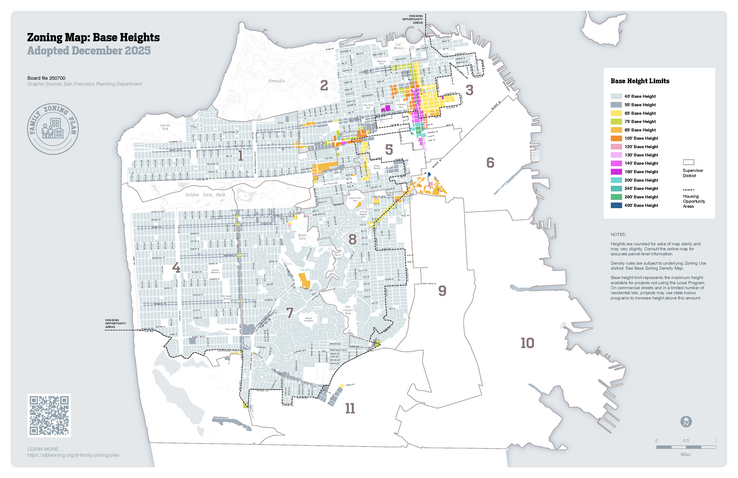
Approved Family Zoning Map
The FZP amends the city’s zoning rules to create additional homebuilding capacity and to support the development of 36,200 more housing units by 2031. Click the image to zoom, or view an interactive map.
How San Franciscans Shaped the Family Zoning Plan
The FZP was subject to review by the Planning Commission, the Land Use and Transportation Commission, and the San Francisco Board of Supervisors. Each body held at least one meeting (the Land Use and Transportation Commission held four), during which the city took extensive comment from the public. Throughout this process, the Planning Department and supervisors held informational sessions and met with community members to explain the plan and listen to concerns. In response to community feedback, supervisors proposed amendments — lowering or raising height limits on certain parcels or corridors, adjusting local bonus program requirements and incentives, clarifying the intent behind certain provisions, and affirming existing tenant protections — that were adopted in the FZP. Key amendments include:
- Exempting rent-controlled buildings from the local bonus program. Buildings with two or more rent-controlled units are now ineligible for the local bonus program, which provides an alternative to the state density bonus with options to fulfill affordable housing obligations offsite. These buildings may still use applicable state programs, as San Francisco does not have authority to preempt state laws.
- Encouraging the construction of family-sized units. The local bonus program now includes a square-footage bonus for projects that include additional two-bedroom units beyond the unit-mix requirement. Projects that include additional two-bedroom units (or larger) may build further into a rear setback than zoning would otherwise allow.
- Protecting historic landmarks and resources. Additional protections for historic landmarks exempt historic landmarks from rezoning and restrict lot mergers with historic properties unless the project maintains the historic resource and complies with the city’s preservation design standards.
- Creating additional incentives for the local bonus program. The local bonus program now includes square-footage bonus incentives for housing and mixed-use projects that add “warm shell” (nearly move-in-ready) retail spaces, replace commercial spaces (providing spaces that are roughly equivalent to existing storefronts), or retain historic storefronts compliant with preservation design standards.
What Happens Next?
Zoning reforms are only one component of a broader strategy to ensure that enough new homes are built in San Francisco. In addition to zoning reform, the city has implemented and continues to explore other ways to lower costs and encourage new housing development, including:
- Temporarily lowering city-imposed fees to support projects that have been permitted but are currently stalled and projects that convert obsolete commercial spaces into housing.
- Creating a multi-agency group, PermitSF, to reform the city’s permitting processes to support housing and small businesses. The group will, for example, evaluate the post-entitlement permitting process to identify opportunities to increase efficiency and reduce costly delays for builders.
- Creating the Downtown Revitalization and Economic Recovery Financing District to help finance commercial-to-residential conversion projects that provide significant community benefits. The district will reinvest incremental property tax revenue generated by commercial-to-residential conversion projects downtown.
- Initiating the Inclusionary Housing Technical Advisory Committee to calibrate affordable housing requirements on new housing with current economic conditions.
Alongside these city-led initiatives, SPUR will be focusing extensive research, engagement, and advocacy on lowering construction costs and speeding up permit approval times. We will continue to work with advocates and city leaders to deliver policies supporting access to safe, affordable housing in all San Francisco neighborhoods.