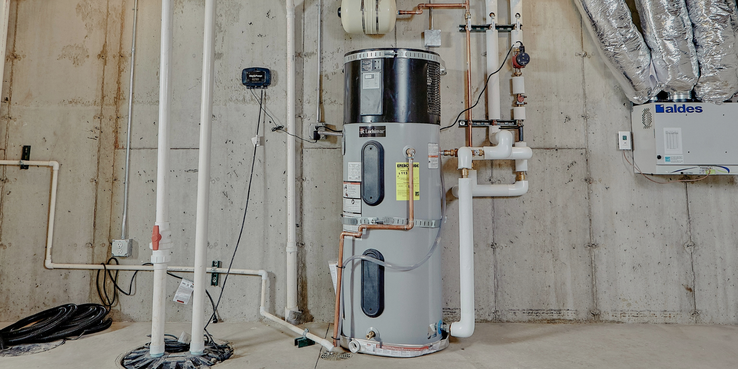
Air quality in the San Francisco Bay Area is some of the most polluted in the nation. Regulators at the Bay Area Air District delivered a win for clean air in 2023 when they passed standards phasing out the sale of small residential water heaters that emit lung-damaging nitrogen oxide (NOx) pollution in 2027. In the lead up to implementation, regulators and several organizations — including SPUR — have released reports aiming to answer a key question: Will implementation of these standards be affordable for Bay Area households? These reports include a 2022 socioeconomic analysis by the air district, a 2025 statewide impacts analysis from RMI, and a 2024 market study of implementation barriers. In 2024, SPUR analyzed the incremental cost gap between gas equipment and heat pump equipment for low-income residents after they had accessed maximum incentives. Our study found that, with access to incentives, in most parts of the Bay Area, an income-qualified resident could buy a heat-pump water heater (HPWH) for less than a gas-fired water heater.
Much has changed since spring 2024, so we decided to take a new look at the numbers. The new federal administration has removed energy-efficient home improvement tax credits and residential clean electricity tax credits (Inflation Reduction Act 25C and 25D) starting December 31, 2025. These credits would have benefited building owners seeking to install heat pumps. However, they would have been less critical for residents whose tax liability was too low to allow them to fully access the credits. Other programs, such as the federal Greenhouse Gas Reduction Fund, saw contracts terminated. However, the Home Energy Rebates program has remained largely intact because funds were obligated to states before other rollbacks took effect.
With the Bay Area Air District’s water-heating rules taking effect in a year, SPUR dug back into the data to explore what Bay Area residents will pay for an HPWH in 2026 and beyond. And there’s good news: when residents successfully “stack” currently available local and state rebates, HPWHs can be less expensive than gas-fired water heaters. But it depends on where residents live and how long incentives remain available.
Stacking Incentives
Bay Area households have multiple options to stack or bundle multiple incentives to cover the cost of purchasing and installing an HPWH.
At the state level, the TECH Clean California program releases tranches of rebates that can substantially reduce the cost of an HPWH or heat pump HVAC installation. However, it remains to be seen whether rebates will be on offer in 2026; the program is currently booked. Additionally, residents who are not served by a municipal utility but who reside within PG&E territory can access $700 to $900 in Golden State Rebate vouchers.
At the local level, municipal utilities and community choice aggregators (local governments that pool their electricity customers to purchase power on behalf of residents and businesses) offer rebates for zero-emission equipment. These rebates can usually be stacked with state rebates, further reducing upfront costs.
SPUR analyzed two incentive-stacking scenarios for single-family homeowners seeking to reduce the cost of installing an HPWH. In one scenario, TECH rebates remain available; in the other scenario, only local rebates and the Golden State Rebate voucher are available. For each scenario, we evaluated income-qualified incentives (typically for households earning less than 80% of the area median income) and market rate or middle-income incentives (typically for households earning 80% to 150% of the area median income). The scenarios do not include direct-install programs such as the upcoming Equitable Building Decarbonization Program and PG&E’s Empower My Home, which cover all installation costs for income-qualified residents for a variety of electrification retrofits.
Scenario 1: TECH Clean California Rebate + Golden State Rebate + Local Incentives
Region | Total households | Income-qualified incentives: Average upfront cost of an HPWH after all incentives are stacked | Market-rate or middle-income incentives: Average upfront cost of an HPWH after all incentives are stacked |
San Mateo County + Los Banos | 300,000 | $0 | $1,136 |
Santa Clara County (excluding San José, Palo Alto, and Santa Clara) | 300,000 | $0 | $2,071 |
Palo Alto utilities | 32,000 | $0 | $1,371 |
San José | 350,000 | $0 | $2,071 |
Santa Clara | 60,000 | $0 | $236 |
San Francisco County | 380,000 | $1,671 | $4,071 |
Napa County, Contra Costa County (excluding Antioch, Brentwood, Clayton, and Orinda), Solano County (only Benecia, Fairfield, Vallejo, and some unincorporated areas) | 600,000 | $1,671 | $4,071 |
Alameda | 34,000 | $1,036 | $3,371 |
Alameda County (excluding City of Alameda) + Tracy, Stockton, and Lathrop | 640,000 | $1,671 | $4,071 |
Sonoma County, Mendicino County | 235,000 | $1,671 | $4,071 |
All Bay Area households* | 2,931,000 | $1,070 | $3,211 |
Incremental cost of an HPWH compared with cost of a baseline gas water heater after stacking all available rebates | -$2,505 | -$364 |
Notes: Calculations use the average between the maximum value obtainable through rebates and the lower values attainable by applicants when a rebate range is listed. For example, in Sonoma Clean Power territory, where the rebate program has a relatively wide range of rebate dollars that may be issued to applicants, the after-rebate average of the maximum cost of $5,671 and a minimum rebate cost of $2,637 comes out to $4,153 for income-qualified residents. Funding for rebate programs is insufficient to cover all customers. This analysis considers only the cost for a single applicant who successfully maximizes available incentives in their region.
* The average cost for all Bay Area residents is calculated by weighting each jurisdiction’s upfront cost after incentives by the percentage of total Bay Area households served.
HPWHs can be bought and installed for less than gas equipment if a homeowner stacks TECH Clean California rebates, Golden State Rebate vouchers, and local incentives. That’s true for both income-qualified residents, for whom incentive stacking can get an HPWH down to $1,070 on average, and everyone else, for whom incentive stacking can reduce the cost to $3,211 on average. The Bay Area Air District estimated that gas water heaters typically cost $3,575 to buy and install, meaning that homeowners could save between $360 and $2,500, depending on income level, by switching from gas heaters to HPWHs.
However, the availability of TECH Clean California incentives has been volatile. Without additional attention from state lawmakers and increased allocations through the Greenhouse Gas Reduction Fund or other sources, these incentives may struggle to make a comeback in 2026. In the second scenario SPUR examined, Bay Area residents rely solely on the Golden State Rebate vouchers and local municipal utility or community choice aggregator incentives.
Scenario 2: Golden State Rebate + Local Incentives
Region | Households | Income-qualified incentives: Average upfront cost of an HPWH after all incentives are stacked | Market-rate or middle-income incentives: Average upfront cost of an HPWH after all incentives are stacked |
San Mateo County + Los Banos | 300,000 | $2,271 | $3,271 |
Santa Clara County (excluding San Jose, Palo Alto, and Santa Clara) | 300,000 | $3,271 | $4,271 |
Palo Alto utilities | 32,000 | $2,071 | $3,571 |
San José | 350,000 | $3,271 | $4,271 |
Santa Clara | 60,000 | $571 | $1,571 |
San Francisco County | 380,000 | $6,271 | $6,271 |
Napa County, Contra Costa County (excluding Antioch, Brentwood, Clayton, and Orinda), Solano County (only Benecia, Fairfield, Vallejo, and some unincorporated areas) | 600,000 | $6,271 | $6,271 |
Alameda | 34,000 | $5,571 | $5,571 |
Alameda County (excluding City of Alameda) + Tracy, Stockton, and Lathrop | 640,000 | $6,271 | $6,271 |
Sonoma County, Mendicino County | 235,000 | $4,153 | $5,571 |
All Bay Area households* | 2,931,000 | $4,856 | $5,330 |
Incremental cost of an HPWH compared with cost of a baseline gas water heater after stacking all available rebates | $1,281 | $1,755 |
Notes: Calculations use the average between the maximum value obtainable through rebates and the lower values attainable by applicants when a rebate range is listed. For example, in Sonoma Clean Power territory, where the rebate program has a relatively wide range of rebate dollars that may be issued to applicants, the after-rebate average of the maximum cost of $5,671 and a minimum rebate cost of $2637 comes out to $4153 for income-qualified residents. Funding for rebate programs is insufficient to cover all customers. This analysis considers only the cost for a single applicant who successfully maximizes available incentives in their region.
* The average cost for all Bay Area residents is calculated by weighting each jurisdiction’s upfront cost after incentives by the percentage of total Bay Area households served.
Without TECH Clean California rebates, buying and installing an HPWH becomes, on average, more expensive than installations of gas-fired equivalent equipment. However, local energy provider incentives and the Golden State Rebate vouchers can keep the cost to $1,000 to $2,000 more than a gas water heater, significantly less than the additional $3,546 average incremental cost without incentives.
Subsidies Won’t Help Everyone Equally
SPUR’s analysis reflects what a building owner could receive for replacing a single gas water heater with an HPWH if the owner successfully tapped all available rebates in the near term. But current funding levels fall far short of meeting the needs of everyone who will require support.
The Bay Area Air District estimates that the 2027 small water heater rules will lead to the annual replacement of some 120,000 noncompliant water heaters, mostly with HPWHs, as they reach the end of their useful lives. While proposed flexibility exceptions could reduce that number, the region cannot, at this time, incentivize each replacement to make HPWHs cost-equivalent to gas models for everyone. (Estimating aggregate funding for HPWHs in the Bay Area is difficult: most programs cover multiple technologies and don’t earmark funds specifically for HPWHs, and municipal utilities and community choice aggregators revise electrification budgets annually based on revenue forecasts, regulations, and board decisions.)
Fortunately, it is not necessary to subsidize all of the replacement HPWHs that will be installed each year. Nearly a third of Bay Area households make more than $200,000 a year in income. Many of the region’s homeowners and building owners will be able to afford a few thousand dollars to replace gas-fired water heaters as they age and cease functioning. But more funding will be required to serve the region's cost-constrained residents, who are either lower income or facing particularly tricky installations. Full-service installation programs, such as California’s Equitable Building Decarbonization program, will help chip away at the gap but are more expensive to operate on a per-project basis than rebate or financing programs.
Bridging the Cost Gap for Low-Income Residents
The Bay Area Air District, as well as SPUR and many of our partners, have recognized these shortfalls and are proposing flexibility measures that would allow lower-income residents to continue purchasing gas equipment until a combination of market factors and incentive availability closes their cost gap.
Commitments from policymakers and regulators can help close the gap sooner rather than later. SPUR’s recommendations focus on making heat pumps cost-competitive by transforming the market and on expanding programs that mitigate impacts on low-income households and tenants during the transition to clean water-heating technologies.
Driving Market Development and Cost Competitiveness
The Bay Area Air District rules are guaranteeing HPWH demand, which will drive down installer and supply chain costs, but expanding zero-emission rules statewide would expand the market fourfold. The California Air Resources Board should advance new heating appliance regulations that phase out all, or at least the vast majority of, small and medium-sized gas equipment sales over the next decade. Such rules would leverage California’s massive population and economy to accelerate market development for electric equipment such as HPWHs.
State agencies such as the California Energy Commission and the California Public Utilities Commission and local jurisdictions also have an opportunity to enact market-transforming policies that remove HPWH barriers, reduce costs, and increase market competitiveness. Many cities are already driving the HPWH market by implementing electrification requirements for new construction and major retrofits, or requiring that heat pumps replace central air conditioners (known as AC2HP codes). Other efforts, such as streamlined permitting and inspections, technical guidance and training for contractors, and industry incentives for widespread adoption and scale-up, can drive market development.
Finally, the California Public Utilities Commission and utilities should align electricity rates to reward electrification: time-of-use or electrification-friendly rate structures can create bill savings that help justify the switch to HPWHs.
Using Incentives and Financing for Equitable Adoption
Because heat pump water heaters currently cost more upfront than gas water heaters, incentives and financing remain essential for equitable adoption. Rebate programs — from local, state, and federal sources — should seek to secure larger, more consistent allocations so that a greater percentage of low-income residents can install HPWHs. Additionally, navigator programs and other holistic customer support models should expand and consolidate to make it easy for residents to access financial and technical support.
Financing mechanisms should be tailored for households with limited access to capital — for example, through “on-bill financing” or “inclusive utility investment” models, in which the cost is repaid through bill savings rather than an upfront payment. Silicon Valley Clean Energy is leading the pack with a zero-interest financing pilot. Obtaining enough funds to give everyone a rebate is a tall order. But financing the upfront cost of HPWHs could be scaled much more easily because programs can leverage more capital upfront with the promise of future payback.
For landlords of small properties and properties housing people with limited resources, programs must be easy to navigate and financially attractive. Otherwise, these landlords might pass costs on to tenants or abandon upgrades. Programs must be designed to prevent retrofit costs from driving rent increases, increasing eviction risks (for example, through building sales or taking units off the rental market), and reducing the affordable housing stock.
SPUR will continue to monitor the costs of transitioning to HPWHs and to advocate for equitable adoption efforts.