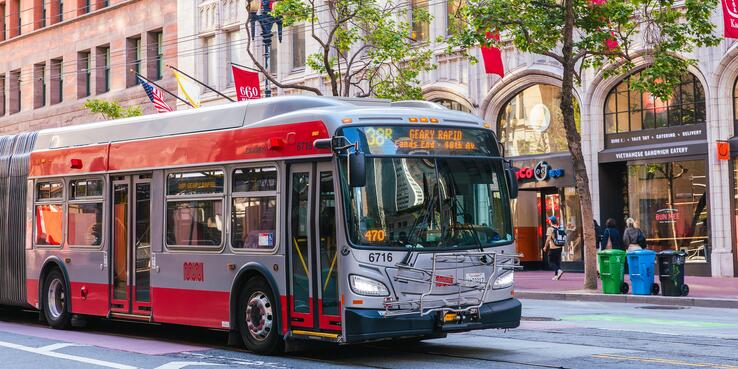
San Francisco’s beloved Muni system has been in a perfect storm of financial trouble since the pandemic: federal COVID-19 relief dollars are exhausted, downtown transit ridership plummeted due to a sluggish return to office, low tourism led to a major drop in parking revenue (which supports transit), and the city’s General Fund (which provides one-third of Muni’s operational funding) is in a severe deficit. Despite significant improvements in financial efficiency and its best customer approval rating in 20 years, Muni faces the prospect of disastrous service cuts — up to a third of the system — if the agency cannot fill a $307 million (and growing) structural annual deficit for 2027.
SPUR has been one of the leaders shaping state, regional, and local solutions to pull Bay Area transit back from a post-pandemic fiscal cliff. Alongside our business, labor, transit, and environmental partners, SPUR has secured hundreds of millions in state relief through budget advocacy with Governor Newsom and the California Legislature, including Senate Bill 125. We have sought more stable, long-term funding by supporting the passage of SB 63, which authorizes a five-county regional sales tax that will raise approximately $1 billion annually for transit operations for 14 years. SPUR is part of a broad coalition working to qualify and place the ballot measure, Connect Bay Area, on the November 2026 ballot.
Locally, SPUR has been participating in San Francisco’s Muni Funding Working Group and advising the San Francisco Municipal Transit Agency (SFMTA) and Mayor Daniel Lurie on the structure for a potential parcel tax to fund Muni. In January, the city concluded months of analysis and negotiations and released a final proposal to the public. The proposed parcel tax is estimated to generate approximately $160 million annually for Muni operations.
Both the regional sales tax and the local parcel tax measures must pass at the ballot in November 2026 for Muni to continue operating San Francisco’s high-quality, connected, and frequent bus, rail, and paratransit service. The regional sales tax is projected to generate $170 million for Muni. The local parcel tax is estimated to generate $160 million which is enough to close the remaining deficit and provide additional funds to improve Muni service.
How a Parcel Tax Would Work
Parcel taxes are paid by property owners on a per-parcel basis and added to property tax bills every year. San Francisco has previously passed parcel taxes, most commonly for K–12 or community college education. The proposed parcel tax for Muni employs a novel progressive structure with marginal rates: large buildings will pay more than smaller buildings, and nonresidential buildings will pay more than residential buildings.
Single-family homes
- Base rate of $129 for the first 3,000 square feet of space
- Add 42 cents per square foot over 3,001 square feet up to 5,000 square feet
- Add $1.99 per square foot over 5,000 square feet, with no cap
Multifamily buildings
- Base rate of $249 for the first 5,000 square feet
- Add 19.5 cents for each square foot over 5,001, up to a cap of $50,000
Commercial buildings
- Base rate of $799 for the first 5,000 square feet
- Add 76 cents per square foot over 5,001 up to 50,000 square feet
- Add 84 cents per square foot over 50,001 up to 250,000 square feet
- Add 99 cents per square foot over 250,001, up to a cap of $400,000
Examples of San Francisco Building Types and Their Estimated Tax Rate
Type of building | Building square footage | Estimated 2027 parcel tax |
Typical single-family home | 1,700 | $129* |
Large single-family home | 7,000 | $4939* |
Common 1-bedroom condominium | 820 | $129* |
Large penthouse condo | 4,000 | $549* |
Single-room occupancy building | 45,000 | $0 |
Common rent-controlled building with 18 studio and 1-bedroom apartments | 15,000 | $2,199 total Property owner would pay at least $1,099 annually out of pocket Tenants would contribute up to $5 per month, on top of their rent, toward the property owner’s tax bill |
Common mixed-use building on a neighborhood corridor, with ground-floor retail and 2 stories of apartments above | 9,000 (3,000 per floor) | $994 total |
Large apartment building (no rent control) with 450 apartments, ranging from studios to 3 bedrooms | 380,000 | $50,000 total (meets cap)** |
Large office building spanning an entire city block | 690,000 | $400,000 total (meets cap)** |
* The parcel tax will be $0 if the home is owned and lived in by a person age 65 or older.
** The city has no authority over how a parcel tax is passed on to commercial or other non-rent-controlled tenants. Pass-throughs are typically included in those terms, but they differ from lease to lease. They depend on every individual lease between the tenant and the owner and the agreed-upon contract terms.
Common Questions
The proposed parcel tax for Muni reflects complex rate structures and other provisions that ensure fairness while maximizing revenue.
Will rent-controlled tenants have to pay higher rent?
Yes, but the increase will not exceed $5.40 per month, or $65 annually. The proposed tax structure allows landlords to pass 50% of their parcel tax burden to rent-controlled tenants, capped at $65 per year (half that of single-family homeowners). This provision was added in recognition that San Francisco’s rent-controlled tenants are far more likely to be lower income than single-family property owners.
Will any property owners be exempt from the parcel tax?
Owners of single-room occupancy buildings will be exempt from paying the parcel tax, as will seniors (65 and older) on their primary residence. Seniors who own income-generating property, such as a multifamily rental or commercial building, will still be required to pay the parcel tax on that property.
Is there a cap on the parcel tax for very large buildings, such as giant apartment complexes or downtown office towers?
Yes. The non-residential cap is $400,000, which would apply to buildings over 450,000 square feet. The multifamily residential cap is $50,000, which would apply to buildings over 255,000 square feet. Single-family residences would have no cap.
What could the tax revenue be spent on?
The revenue would be spent only on public transit operations and the cost to administer the tax. Revenue would not be spent on capital projects, such as a new maintenance facility, street redesigns, or other miscellaneous non-transit initiatives at SFMTA.
Would tax rates ever change?
Recognizing that Muni’s operating costs will rise, the proposal calls for adjusting tax rates annually to keep pace with inflation.
Would the tax expire?
Yes, after 15 years.
Next Steps
A measure will be placed on the November 2026 ballot to pursue the proposed parcel tax for Muni. There are two paths for a new tax to reach the ballot: the mayor or four members of the Board of Supervisors may file the measure, or it can be done as a citizens initiative if 10,620 valid signatures are collected from registered San Francisco voters by July 6, 2026. In November, San Francisco voters will most likely have the opportunity to vote on two transit funding measures supporting Muni: the regional four-county sales tax and the local parcel tax. Maintaining the Muni service San Franciscans love and need will require passing both.