Three years ago, SPUR celebrated the formation of a new regional network management structure to coordinate and improve Bay Area transit. Since that time, the Metropolitan Transportation Commission (MTC) and transit agencies have been working hard to operationalize this new structure and to advance a key suite of early customer improvements. At a recent SPUR forum, staff from MTC and transit agencies described the progress they have made so far and what's coming next.
A New Approach to Coordinating Transit
More than two dozen transit operators serve the Bay Area’s 100-plus cities. Disparate fares, signage, and schedules can make some trips too slow, too expensive, or simply too confusing for riders traveling across the region.
In January 2023, after much discussion among agencies and years of research and advocacy by SPUR, Seamless Bay Area, and others, the Bay Area reached a pivotal milestone when MTC moved to formally establish a regional network management (RNM) structure. Regional network management is a common approach to transit coordination worldwide. Although their powers vary, transit network managers are generally charged with coordinating and improving key aspects of the customer experience across regions with multiple transit operators.
Today, the Bay Area’s RNM structure is a collaborative effort between transit operators and MTC to deliver on a series of customer priorities identified in the region’s Transit Transformation Action Plan. RNM programs are principally staffed through MTC with participation by transit operators, and direction and oversight by both the RNM Council, made up of agency general managers, and MTC’s RNM Committee, which includes both MTC commissioners and select transit agency board members.
Progress and Ongoing Work
SPUR’s forum featured Melanie Choy, MTC’s director of Regional Network Management, and MTC and agency staff, who described RNM work to date.
Making Transit Faster Throughout the Region
Britt Thesen Tanner, principal planner at MTC, described her work to expand and accelerate implementation of transit priority treatments throughout the region. Transit priority refers to a menu of design and technology treatments that help buses move more quickly and reliably through traffic, resulting in faster and more predictable trips for riders and operational cost savings for transit agencies. These interventions can be as simple as adding bus bulbs or boarding islands to reduce conflicts between buses, cars, bikes, and pedestrians, or they can include more extensive efforts, such as bus rapid transit (BRT) projects that feature dedicated bus lanes and corridor-wide adjustments to traffic signals to prioritize transit.
Transit priority treatments have already led to significant improvements. Muni, for example, experienced a 36% decrease in travel times on Van Ness Boulevard after completion of the Van Ness Bus Rapid BRT project, while the AC Transit TEMPO BRT line reduced travel time from San Leandro to Uptown Oakland from as much as 2 hours to 50 minutes. The RNM and other teams at MTC are working with individual operators to build on these successes at a regional scale. First up is BusAID, an RNM program that identifies high-impact projects to address “hotspots” where transit delays are most significant and accelerates the planning, funding, and delivery of treatments to eliminate congestion. The first round of projects funded through this program is underway and expected to be completed this year.
Looking further ahead, the RNM is working to complete a transit priority policy that will provide definitions and guidance to local jurisdictions and help prioritize funding for future transit priority projects. The RNM is also working to define a regional transit priority network that would establish transit corridors where investments would be prioritized and accelerated.
Making Transit Fares More Affordable and Easier to Pay
BART Financial Planning Director Mike Eiseman described several initiatives that move the Bay Area toward a simpler, more integrated transit fare system.
The advent of the next-generation Clipper fare payment system in late 2025 has enabled the region to finally move forward with a program of free and reduced-fare transfers for trips that require more than one transit system. This new, regionwide pilot program means that riders who transfer between systems as part of a single journey will automatically receive a discount of up to $2.85 per transfer — the high-end cost of a local bus fare. Riders who need to use multiple systems on a trip will no longer be charged extra just because they happen to cross an agency boundary or need to connect to another operator.
The RNM has incubated and grown two regional fare programs that expand transit access for key groups. Clipper START is the region’s low-income pass program that provides a consistent 50% discount on transit fares to qualifying individuals (those with a household income below 200% of the federal poverty limit). Customers now take more than 300,000 discounted trips each month. Clipper BayPass is a bulk pass program that allows Bay Area employers and institutions to purchase transit access for their constituencies. It requires an employer or institution to buy a transit pass for everyone at a site, allowing individual passes to be priced much lower than would otherwise be economically sustainable. Clipper BayPass is the first truly regional transit pass, offering unlimited trips across all Bay Area transit operators. Program users take 30% more transit trips and make 160% more frequent system transfers than those without passes.
Simplifying Signage and Wayfinding
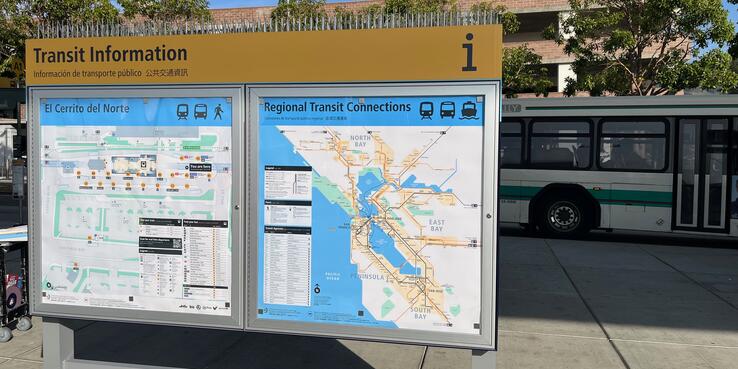
Gordon Hansen, principal planner at MTC, described the RNM’s work to simplify and improve the complex array of physical signage and wayfinding tools that guide customers through the Bay Area’s transit system. To achieve this goal, the RNM has worked with transit operators to develop common standards for train, ferry, and bus signage and mapping across multiple agencies. The goal is to make navigating transit a more consistent and less stressful experience for all users and to improve the transit experience for riders with sight impairment and other disabilities. RNM is testing prototype installations at key transfer points, including the Santa Rosa Transit Mall, the El Cerrito Del Norte station (a major transfer point between BART and regional and local bus systems), and the Powell Street BART station in downtown San Francisco (a major multimodal station frequently used by visitors and tourists). In a survey, 90% of respondents found it "easy" or "very easy" to find their way around using the new test signs and maps, an improvement of 32% from prior surveys.
Riders can expect to see new signs and installations rolling out on select bus lines and stations beginning this year as the RNM expands piloting of the new standards and works to ensure that transit operators already in the process of replacing signage can use the new standards and designs.
Making Transit Accessible
In her opening remarks, Melanie Choy emphasized that a central aspect of the RNM’s work is accessibility — making it easier for people with mobility challenges and other disabilities to use transit. Transit priority work to redesign and improve bus stops helps transit operate efficiently, but it’s also an opportunity to make transit infrastructure safer and easier to use for people with disabilities. Mapping and wayfinding work make it easier for people with sight impairments or other disabilities to navigate the system.
The RNM is also working on several initiatives to make the transit experience better for people with disabilities who use paratransit services. Under the Americans with Disabilities Act, local transit agencies must provide these shared-ride, on-demand transit services for people who cannot independently use fixed-route public transit. Paratransit typically provides door-to-door service with smaller accessible vehicles, but trips require advanced booking, and users must be certified as eligible through an application process with local transit agencies.
As of 2025, the RNM has worked with operators providing paratransit services to establish a regionally consistent set of standards, forms, and practices for eligibility verification — a major step toward improving and regularizing the paratransit experience. This year, the RNM is advancing pilot “one-seat-ride” programs in various sub-regions that would allow paratransit customers to take trips across operators’ service area boundaries while remaining on a single vehicle (rather than transferring at the border of an operator’s service area). MTC and operators are also exploring a regional paratransit booking platform to make it easier for riders and operators to reserve and schedule trips across multiple service areas.
Sustaining and Building on Momentum
SPUR’s forum showed that MTC and transit operators are continuing to make progress on a variety of integration programs that are yielding real benefits for customers. But sustaining and building on this momentum will require funding — not just for the specific programs discussed at the forum, but also for transit operations generally. The Connect Bay Area Act, which authorizes a future regional transit funding measure, includes significant funding for transit integration programs in its expenditure plan, as well as funding to sustain transit operations across the region. Transit operators and MTC are working to improve transit, but they can only succeed if they have the resources to keep the system running.