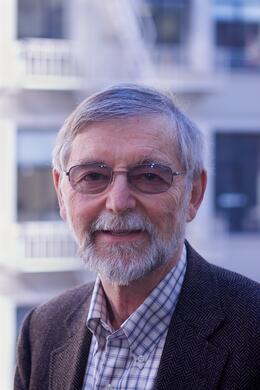
Michael B. Teitz, a former two-term SPUR board member, professor emeritus of City and Regional Planning at UC Berkeley, and senior fellow at the Public Policy Institute of California, died December 17 at age 90. He was a member of the SPUR Regional Policy Board and the SPUR Ballot Analysis Committee.
Born in London just before the Second World War, Mike was open to new opportunities from early on. He earned a B.Sc. in economics from the London School of Economics, an M.S. in geography from the University of Wisconsin, and a Ph.D in regional science from the University of Pennsylvania. His 1968 journal article “Toward a Theory of Urban Public Facility Location” was assigned reading in planning graduate programs at the time and served as one of the more accessible and cogent treatises in the just-beginning field of regional science.
At Berkeley, Mike was on the faculty of the Department of City and Regional Planning (DCRP) for 35 years. He described himself as an institutionalist and worked to build one of the world’s premier academic planning programs. He was noted for his creative and first-rate mind and his open and welcoming personality. Under his leadership, DCRP hired one of its first female faculty members and broadened its scope. He cared for students in a department noted for rough and tumble politics and believed that incorporating practitioners from different disciplines made the field of planning stronger. Positions he held included chair of the Department of City and Regional Planning, chair of the Berkeley Academic Senate, and president of the Association of Collegiate Schools of Planning. He was the recipient of many awards and commendations, including UC Berkeley’s highest honor, the Berkeley Citation.
Mike was the author of numerous papers, as well as the book Rent Control: Regulation and the Rental Housing Market. As the American correspondent for the British journal Town and Country Planning, he wrote nearly 100 pieces on topics including the future of industrial cities, New York’s 9/11 recovery, the role of planning commissioners, e-commerce, and the future of California’s Central Valley.
In addition to his leadership in academia, Mike served as a consultant and advisor to local, state, and national governments and organizations both here and abroad. He led the housing institute at the RAND Corporation in New York City, where he conducted groundbreaking housing policy analysis for Mayor Lindsay’s administration. He was an advisor to the Saudi Arabian government and the Los Angeles Rent Stabilization Board, and he helped plan and establish the Public Policy Institute of California (PPIC), where he was senior fellow and the organization’s first research director. His choice to leave the academy for PPIC reflected Mike’s longstanding interest in applying his deep academic background and wealth of planning knowledge to the pressing policy issues of the day.
Mike was known as a ready supplier of trenchant observations and dry wit. He considered himself a regionalist, which he defined as “a person who, with all his cohort, links arms — every twenty years in the Bay Area — puts the head down, runs against a brick wall, collapses, bleeding, gets up and says, ‘Well, maybe better luck next time.’” Regarding California’s failure to plan for its rapid growth, he wrote, “Few things are sadder than the sight of a friend in the grip of undernourishment, addiction, and delusion. That beloved friend is California –— undernourished in what is necessary for its collective health, addicted to the consumption of public services, delusional about the necessity to pay for them.”
Mike first got involved with SPUR as a contributor to our work on the concept of the megaregion. He was one of the big thinkers on California and provided a thoughtful counterpoint to the long tradition of thinking about the Boston-to-Washington “megalopolis” as an integrated geography. He was on the SPUR Board of Directors when we grew from a San Francisco-focused organization to a regional organization and was instrumental in helping us think about how to expand our work at a time when many possible directions and concepts were considered. The future of the Central Valley and the potential of California’s high-speed rail project was a long-term professional and academic interest for Mike. He pushed us to think about high-speed rail as an economic development project that could help reshape the economy of the Central Valley. These ideas made their way into the SPUR paper Beyond the Tracks, which he helped research and write.
After retirement, Mike remained an important part of SPUR’s Regional Policy Board, where he brought shrewd analysis on how to change policy and a broad view concerning the arc of historic change. During the Great Recession, when we were considering the future of the Bay Area’s economy, Mike reminded us, “Most innovation districts in global history have about a 50-year run at being the center of action, almost never more than 100 years. The Bay Area and Silicon Valley have been at it since before the 1960s. So we’re doing pretty well by historic standards.”
Mike himself had a similarly historic run as an influential thinker on cities, regions, and economies. His presence will be greatly missed.
A memorial for Mike will be held at 2 p.m., March 29, in the Bauer Wurster Hall auditorium (room 112) on the U.C. Berkeley campus.
Read the Bancroft Library’s oral history with Mike
Contributors:
Jim Chappell, former President and Executive Director of SPUR
Gabriel Metcalf, former President and CEO of SPUR
Robert Ogilvie, former Oakland Director of SPUR and a former colleague of Mike’s in the Department of City and Regional Planning at UC Berkeley
Egon Terplan, former Regional Planning Director of SPUR