Home
Ideas + Action for a Better City
         Join SPUR
a member-supported nonprofit organization 
Main Menu
  • About
    • Our Mission
    • Equity Platform
    • Staff
    • Contact Us
    • Board of Directors
    • Work With Us
    • Impact Stories
    • Annual Reports
    • Financial Statements
    • About the Urban Center
    • Visit the Member Lounge
    • Rent Our Facility
    • Get Our Newsletters
  • Join or Give
    • Individual Membership
    • Business Membership
    • Donate to SPUR
    • Planned Giving
  • Events
    • Events Calendar
    • Exhibitions
    • Silver SPUR Awards
    • Good Government Awards
  • Policy Areas
    • Planning
    • Housing
    • Transportation
    • Sustainability + Resilience
    • Economy
    • Governance
  • Initiatives
    • SPUR Voter Guide
    • SPUR Regional Strategy
    • Cutting Red Tape
    • Guadalupe River Park
    • Belonging in the Bay
    • Rising Together
    • Ocean Beach Master Plan
    • The Resilient City
  • Regional Strategy
  • Publications
  • Search

Primary tabs

  • General
  • Advanced Publications Search Toggle tabs as a menu
Publication Type
Topic
Geography
Date Range
Green report cover with title in white text

120 Years After 1906

Policy Brief / April 9, 2026
San Francisco’s long-term resilience is constrained by the safety of its existing buildings. While the city has made meaningful progress, thousands of seismically vulnerable buildings remain. Given the cost and complexity of retrofits, the next phase of seismic policy must align earthquake resilience with priorities to revitalize downtown and meet climate goals. On the 120th anniversary of the 1906 San Francisco earthquake and fire, this brief assesses how far the city has come in strengthening its buildings and identifies where risks remain.

SPUR Position on SB 1097: Support If Amended

Advocacy Letter / April 8, 2026
SPUR conditionally supports SB 1097, arguing that California urgently needs faster permitting to expand clean energy and meet statutory climate goals, but only if the bill is amended. SPUR urges excluding biomass thermal energy combustion facilities from streamlined environmental review because of their significant local pollution and disproportionate impacts on disadvantaged communities. Overall, SPUR backs accelerating truly clean energy projects like solar, wind, storage, and transmission, while maintaining stricter review for higher-polluting technologies.
Photo of 2060 Folsom Street, an affordable housing development in San Francisco

City-Imposed Costs on Housing Can Undermine the Public Benefits They Were Meant to Deliver

News / April 6, 2026
San Francisco requires developers of market-rate housing to provide affordable units and pay impact fees to deliver public benefits. Along with rising interest rates and construction costs, these city-imposed costs can threaten whether any new housing gets built at all. As San Francisco reviews its housing policy, it should analyze the effect that all development costs have on housing production and recalibrate its approach to public benefits.
photo of downtown San Francisco skyline

When FEMA Steps Back, Who Pays for San Francisco’s Next Disaster?

News / March 30, 2026
Over the last year, the Trump administration has sought to reform the Federal Emergency Management Agency and shift the bill for emergencies to local and state governments. Facing a major budget deficit tied to the city’s last major emergency, the COVID-19 pandemic, San Francisco must pursue new disaster management strategies, in coordination with regional and state partners, to ensure financial resilience in the face of future disasters.
Blue cover with title in white text

Taking Muni’s Vitals

Research / March 26, 2026
Muni is in dire financial straits as COVID-relief funds reach their end. To avoid catastrophic service cuts, San Francisco’s transit agency will need voters to approve two different revenue measures in November 2026. Cost reductions and efficiency are also part of the strategy to keep buses and trains running. This research paper takes Muni’s “vitals” by looking at how the system performs relative to its peers on efficiency, productivity, and effectiveness. SPUR’s analysis also suggests places to find savings and improve performance over the coming years.
Photo of art installation with San Francisco City Hall in the background

Next Steps on Streamlining SF’s Unwieldy Commission System

News / March 18, 2026
San Francisco’s commission system has become unwieldy and inefficient. A voter-approved commission streamlining task force calls for reducing the number of commissions, moving many from the city charter to the administrative code, and making governance and operational changes. If enacted, these recommendations — some of which SPUR made last year — would increase flexibility, enhance accountability, and allocate resources more effectively.
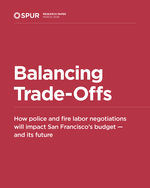
report cover with title in white text on red background

Balancing Trade-Offs

Research / March 18, 2026
As San Francisco faces a $937 million deficit, the city must consider staff salaries and benefits. Police and fire contract negotiations will touch nearly $1 billion in annual spending this year — about 39% of the city’s discretionary budget. Decisions made this year will not only directly affect the size of the city’s deficit but also set a precedent for negotiations with other employees next year. SPUR’s latest research illuminates the labor negotiations process and the trade-offs involved.

Comment Letter on Natural Gas Energy Efficiency Incentives Policy

Advocacy Letter / March 16, 2026
A coalition of environmental and community stakeholders urges the Commission to end all ratepayer-funded incentives for new gas-burning appliances in energy efficiency programs. These subsidies increase energy costs, lock customers into long-term gas use, and conflict with California’s climate and decarbonization goals while competing with cleaner electric alternatives. The letter calls for redirecting ratepayer funds toward strategies that support an equitable transition to a fully decarbonized energy system.

Bay Area Clean Air Coalition urges the Air District not to delay Rule 9-6 and to implement needed flexibilities

Advocacy Letter / March 6, 2026
The Bay Area Clean Air Coalition, of which SPUR is a leading member, urges the board to keep the Zero-NOx water heater rule (Rule 9-6) on track for its planned January 1, 2027 implementation, warning that further delays would prolong harmful air pollution and weaken the market shift toward cleaner appliances. The coalition argues that the rule has already included years of preparation and stakeholder engagement, and that staff have developed flexibility measures to address implementation challenges. While supporting targeted exemptions and financial assistance for low-income households, the coalition stresses that the rule must move forward on schedule to protect public health, reduce NOx emissions, and maintain regulatory certainty.

Recommendations on Missing Middle Housing in San José's General Plan Review

Advocacy Letter / March 4, 2026
As part of a review of its General Plan, the City of San José is looking for ways to encourage “missing middle” housing options like fourplexes and courtyard apartments to help address its housing affordability crisis. This is an opportunity to start legalizing small-scale multifamily homes citywide, particularly in exclusive, high-resource neighborhoods. Over time, the addition of thousands of such homes can meaningfully expand supply, reduce housing costs, and improve mobility within the housing market.

SPUR Co-Sponsors AB 1738, the Remote Virtual Inspection Act

Advocacy Letter / March 3, 2026
SPUR and Permit Power are co-sponsoring AB 1738 (Carrillo), legislation to expand the use of remote virtual inspections for simple, low-risk building permits across California. The bill would help reduce housing and clean energy project delays by allowing eligible inspections — such as water heaters, solar, and ADUs — to be conducted virtually, cutting costs, saving time, and freeing up inspector capacity while maintaining safety standards. By modernizing permitting processes, AB 1738 aims to accelerate housing production, electrification, and climate resilience statewide.
Homes in San José

Can Fourplexes Solve San José’s Housing Affordability Crisis?

News / March 3, 2026
As part of a review of its General Plan, the City of San José is looking for ways to encourage “missing middle” housing options like fourplexes and courtyard apartments to help address its housing affordability crisis. This is an opportunity to start legalizing small-scale multifamily homes citywide, particularly in exclusive, high-resource neighborhoods. Over time, the addition of thousands of such homes can meaningfully expand supply, reduce housing costs, and improve mobility within the housing market.
BART train pulling in next to apartment building at Fruitvale Station

Governor Newsom Authorized a $590 Million Transit Loan. Now the Real Work Begins.

News / February 24, 2026
Last week Governor Newsom authorized a loan that will prevent deep transit service cuts on BART, Muni, Caltrain, and AC Transit for the next several months. SPUR fought hard for this funding. We are deeply grateful to the Newsom Administration and the state legislature for bringing their commitment and creativity to help the Bay Area thrive. But the work isn’t finished — it’s now up to the region’s voters to finish the job by passing two ballot measures this fall.
Photo of single-family homes in the Bay Area

How Virtual Construction Inspections Can Address California’s Housing Crisis and Meet Clean Energy Goals

News / February 18, 2026
Digital tools are transforming building planning and permitting — and offering an opportunity to address California’s housing crisis. Remote virtual inspections using video and other digital technologies can lower costs and reduce inspection backlogs for many simple home projects without compromising code compliance. By accelerating resilience-focused retrofits, clean energy permitting, and accessory dwelling unit construction, such inspections could reshape California’s housing landscape.

SPUR Supports Early Action on State Budget to Support Bay Area Transit

Advocacy Letter / February 13, 2026
On behalf of more than a dozen organizations, this letter thanks Governor Newsom and the legislature for advancing a $590 million one-time loan to the Bay Area’s four largest operators, which provides the Bay Area with the support and flexibility to avoid catastrophic near-term service cuts.
Portrait of Leigh Lutenski

Improving the Fiscal Climate for New Housing: Q&A With Leigh Lutenski

News / February 11, 2026
The City of San Francisco is currently examining its affordable housing policies and their impact on the market for building new housing. SPUR asked Leigh Lutenski, the city’s director of Joint Development, about her division’s work supporting the city on its affordable housing obligations. She emphasized the need for policies that balance affordability goals with economic feasibility, in part by providing greater certainty to housing developers about affordability requirements.
Portrait of Sujata Srivastava

Accelerating Downtown San Francisco’s Revitalization: Q&A with Sujata Srivastava

News / February 10, 2026
As downtown San Francisco grapples with an oversupply of commercial space and anemic street activity, the city’s leaders have an opportunity to reimagine the area to create more housing, boost entrepreneurship, and nurture the arts. In a new brief, SPUR proposes establishing a quasi-public entity to plan and deliver capital projects, negotiate real estate deals, and provide public financing. We asked SPUR’s Sujata Srivastava how the envisioned authority could tackle downtown’s challenges.
Portrait of Shola Olatoye

Designing the Future of Downtown San Francisco: Q&A with Shola Olatoye

News / February 4, 2026
In October, Shola Olatoye became the first CEO of the San Francisco Downtown Development Corporation (DDC), a nonprofit organization formed in early 2025 to raise and deploy private investment to transform downtown San Francisco. The DDC is evaluating options to create a long-term entity with regulatory and financing capacity to play a greater role in downtown’s economic vitality. On the heels of our policy brief Reinventing Downtown, we spoke with Olatoye about the DDC’s vision, partnerships, and priorities for downtown.
Report cover with title in white text on dark blue background

Reinventing Downtown

Policy Brief / February 4, 2026
Downtown San Francisco is vitally important to the city’s economic health, but it faces significant challenges. Creating a dedicated downtown authority could streamline revitalization, making it easier to build real estate and public realm projects, assist small businesses, attract new employers, and finance workforce housing. SPUR examined the structure and responsibilities of a potential new downtown authority and recommends next steps for its formation.
Oakland residents sitting at breakout tables during a community meeting

Path to Better Governance: Oakland Mayor’s Working Group Releases Recommendations for Charter Reform

News / January 30, 2026
The League of Women Voters Oakland and SPUR co-facilitated Mayor Barbara Lee’s Charter Reform Working Group over the past six months. The collaborative process engaged more than 750 Oakland residents through public meetings and listening sessions, conducted over 60 interviews with officials and experts, and collected 433 survey responses plus written comments. Residents expressed frustration with unclear accountability and called for structural changes. The working group has released its final report and ultimately recommends adopting a strong-mayor system with a strengthened City Council.

Pagination

Show more

Get Our Newsletters  Join SPUR

SPUR Urban Center, 654 Mission Street, San Francisco, CA 94105-4015 | (415) 781-8726 | [email protected]


© 2026 SPUR Privacy Policy 501(C)(3) Non-Profit Tax Identification: 94-1498232