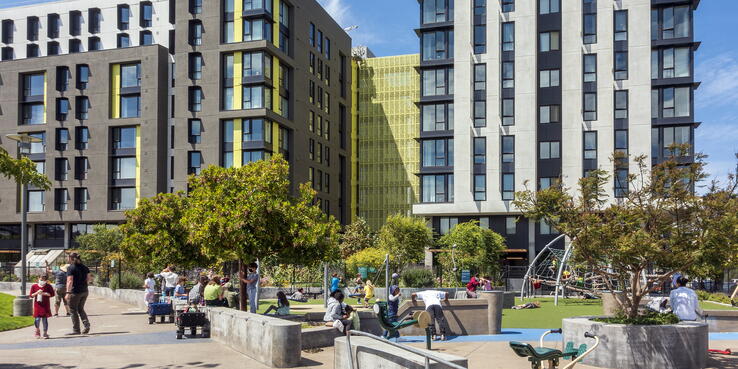
Like many other California cities, San Francisco requires developers of market-rate housing with 10 or more units to provide some subsidized homes for lower-income people, known as inclusionary housing or affordable housing. The percentage of below-market-rate units that a new building must provide is one of the factors that determine whether developers will proceed with a project. San Francisco is currently reviewing its inclusionary housing requirements, which will culminate in a Board of Supervisors vote in the summer.
15% of Zero Is Zero
San Francisco has spent years debating how much affordable housing should be required in new housing development. Currently, roughly 15% of units in new housing projects must be subsidized affordable units. However, the fundamental question is this: what rate will developers find so financially onerous that they stop building housing entirely? If a project costs more to build than it would return to investors, developers will choose to build in other cities with fewer fees rather than lose money on the job. At planning commission and Board of Supervisors meetings, one comment has been uttered countless times: “15% of zero is still zero.” The implication is that increasing the rate of inclusionary housing will not result in any affordable housing if projects are no longer financially feasible to build.
The City of San Francisco has established policies intended to create mixed-income communities and help fund other community priorities, such as transit and open space. These priorities have led to development impact fees and requirements such as the 15% affordable housing mandate. Each one can make or break a project by adding to the total cost of building housing.
When total city-imposed development fees exceed the costs a project can support, housing development halts. Ironically, policies designed to produce affordable housing can sometimes be the final cut that prevents both market-rate homes and subsidized affordable homes from being built.
The key policy question is where to strike the delicate balance: how can San Francisco deliver meaningful public benefits while making it feasible to build homes? Right now, San Francisco’s approach to layering city-imposed costs piecemeal is undermining its own affordability goals and needs to be recalibrated holistically.
Are “Greedy Developers” the Problem?
While public debate sometimes focuses on “greedy developers,” the reality is that the development business is struggling for a variety of reasons. Costs such as interest rates, land, construction, and financing shape whether projects move forward. For the most part, these costs are outside the control of local policymakers. However, policymakers can have an enormous impact on city-imposed costs. These costs include not only inclusionary housing mandates and impact fees, but also zoning, design standards, and permitting processes. Ultimately, housing development is governed by a basic constraint: if a project does not generate enough expected revenue to cover its costs, no housing will be built, and no public benefits will materialize.
Development must provide a reasonable rate of return to investors to secure financing. Most housing projects require significant up-front capital and carry substantial risk. Even the smallest changes in costs or uncertainty can sink a project. That’s why feasibility analysis is so critical. Feasibility studies attempt to model how different requirements, costs, rents, and conditions interact to determine whether projects are viable.
Recently, San José updated its inclusionary housing ordinance to reduce affordability mandates and related impact fees after determining that fewer than 10% of projects subject to the ordinance were financially feasible. Mayor Matt Mahan noted that while the policy aimed to produce affordable units, only a very few projects opted to build them alongside market-rate units (choosing instead to pay an in lieu fee), and no projects produced any units affordable at 30% of the area’s median income, one metric of affordability. He contrasted this outcome with that of the city’s gap financing program. That program provides subsidies directly to affordable housing developers and has successfully built thousands of deeply affordable housing units.
In San Francisco, more than 74,000 units are in the pipeline, but only 4% are currently under construction. The vast majority remain stuck in entitlement, review, or permitting. While these projects may be delayed by broader economic conditions, it’s impossible to ignore that city-imposed costs are contributing to whether they move forward.
Death by a Thousand Paper Cuts
Local policy decisions are not costless tools. They play a meaningful role in determining the financial feasibility of potential projects. Far too often, housing policies are evaluated in isolation rather than as part of a cumulative cost structure. San Francisco’s Inclusionary Housing Technical Advisory Committee (TAC) is tasked with examining inclusionary housing requirements, but the TAC is not required to look at the wide range of other fees housing developers are subject to: jobs-housing linkage fees; fees for child care, bicycle parking, schools, street trees, transportation, wastewater, and water capacity; and neighborhood-specific program fees such as those for public art, open space, and community stabilization. In today’s weaker housing market with high interest rates and construction costs, these requirements are increasingly rendering projects unviable. The result is a growing number of stalled or abandoned projects. The ramifications are clear: fewer homes are built, less affordable housing is produced, and less tax revenue is generated to fund the very public benefits housing policies are intended to support.
Some proponents argue that housing is a public good and shouldn’t be burdened by excessive fees or expected to solve all of a city’s challenges. Others argue that new housing should contribute to infrastructure and community needs, especially in an era of dwindling federal support. And in the absence of these fees, how will cities be able to fill the hole that the fees and affordable housing provide? While these perspectives raise reasonable concerns, the fact remains that the current system is failing to achieve its intended outcomes, and each side is responding to real pressures in the housing market.
One conclusion is clear: housing policy recalibration is essential to reflect changing economic conditions. Housing markets aren’t static: construction costs rise and fall, interest rates fluctuate, rents and home prices shift, and financing evolves. Policies must evolve accordingly. As the nation grapples with an affordability and housing shortage crisis, cities must balance economic realities with efforts to build new homes and achieve affordability.
In the coming months, San Francisco will wrestle with how much affordability and public benefits to require from new housing. But that debate only matters if housing gets built in the first place. The city can set the requirements as high as it wants, but if those requirements render projects infeasible, they will not be built.