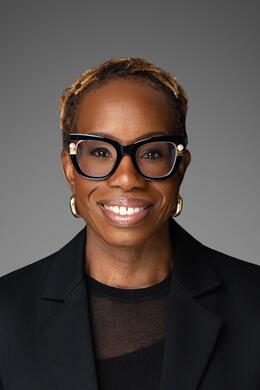
In October, Shola Olatoye became the first CEO of the San Francisco Downtown Development Corporation (DDC), a nonprofit organization formed in early 2025 to raise and deploy private investment to transform downtown San Francisco. Olatoye, who most recently served as Chief Operating Officer at Eden Housing, previously led Oakland’s Housing & Community Development Department and was chair and CEO of the New York City Housing Authority.
The DDC’s programs so far have primarily focused on support for small businesses, arts and culture, clean streets, and public safety. But the organization — which has so far raised $60 million in private, corporate, and philanthropic contributions — has bigger goals. With its new CEO in place, the DDC is evaluating options to create a long-term entity with regulatory and financing capacity to play a greater role in downtown’s economic vitality.
SPUR’s policy brief Reinventing Downtown, proposes creating a quasi-public authority that would be empowered to implement downtown projects such as affordable housing, infrastructure, parks, the public realm, and affordable spaces for small businesses, community organizations, and the arts. We spoke with Olatoye about the DDC’s vision, partnerships, and priorities as the organization grows and evolves.
What inspired you to take this role at the DDC?
This was a full circle moment for me. I’ve spent my career at the intersection of public service and private sector partnerships, working with mayors, CEOs, nonprofits, and civic leaders to align policies and resources toward visible improvements in neighborhoods and cities. What motivates me is the ability to impact real people’s lives. I am a student at heart, so understanding the market and policy problems that prevent investment and opportunity is deeply intriguing. I told David Stiepleman, DDC’s board chair, that I wanted my next role to coordinate across sectors, align stakeholders around a shared vision, and drive catalytic change at scale. That’s exactly what the DDC was created to do.
Tell us about the DDC's priorities for downtown and how you envision partnering with city government, civic institutions, businesses, and community organizations to implement them.
The concept and practice of partnership is baked into our DNA. The DDC is designed to deliver tangible improvements in five program areas: safety, cleanliness, arts and culture, real estate, and open space. In our first year, that has translated into actions like expanded daily power washing and cleaning in the Moscone Convention Center area, support for the Market Street Safety Program – contributing to a more than 50% drop in safety-related 911 calls at key downtown BART stations – and providing catalytic funding to extend Downtown First Thursdays through all of 2026. The latter has already brought hundreds of thousands of people downtown and driven significant economic impact for local businesses. We’re also advancing work to reduce storefront vacancies and support merchants along high-traffic corridors through the launch of the Downtown Business Fund this summer.
We focus on backing evidence-based programs that are already showing results, then providing catalytic capital to help them scale and sustain momentum. That includes piloting ideas, learning quickly, and expanding what works in close partnership with city agencies, community organizations, businesses, and cultural institutions. We’re proud to do this work alongside Mayor Daniel Lurie and his administration, and in partnership with a broad cross-section of civic, philanthropic, and business leaders, including major downtown employers like Google, Amazon, OpenAI, Salesforce, and others who are invested in San Francisco’s long-term success.
We do not do this work alone. So many existing community and civic partners have been working on important initiatives downtown. I see our role as a center of gravity downtown: aligning and investing resources in things that work, driving increased foot traffic, reducing office and retail vacancies and, ultimately, creating a mixed-use community for everyone. Our model is built on proven approaches from cities like New York and Cincinnati. Like these cities, San Francisco can use public-private partnerships to not just recover but redefine downtown for the next generation.
As an independent nonprofit, we’re able to move faster, aligning public, private, and philanthropic partners to deliver visible, street-level improvements people can see every day while laying the foundation for long-term investment in downtown’s future.
Recently, there have been a number of positive headlines about downtown and the city's economic growth. Why is it important to continue to invest in downtown San Francisco?
Downtown has always been San Francisco’s economic engine. It occupies approximately 4% of the land area of San Francisco but prior to COVID was the source of nearly 60% of the city’s tax revenues. Those revenues funded police, fire, roads, and community centers. Pre-COVID downtown San Francisco was home to more than 40% of the city’s jobs and nearly 40% of its small businesses. The dramatic change in return-to-office patterns, a decrease in convention center bookings, stubborn office and retail vacancies, and real and perceived unsafe street conditions were all a recipe for San Francisco’s decline. That’s why the new mayoral administration put out a call for business, civic, and philanthropic partnerships to get involved in the necessary and challenging work to design a downtown of the future for everyone.
A strong downtown directly funds city services and supports neighborhoods across San Francisco and the broader Bay Area. Downtown is also how the world experiences and judges San Francisco. It’s our cultural and financial center, the place that global visitors, investors, and conferences encounter first. Continued investment ensures that downtown reflects the best of who we are: innovative, inclusive, and vibrant.
We can feel and see the momentum: crime is down, foot traffic is growing, and people are choosing to spend time downtown again. Sustained investment helps lock in that progress, so everyone can feel safe, included, and excited to be in the heart of the city.
SPUR's report Reinventing Downtown makes recommendations for new tools to revitalize the city's center. What do you think is needed to create a more prosperous downtown? Are there any considerations beyond those we identified in our paper?
The DDC’s impact will be measured by its ability to drive investment that ladders up to key metrics, such as increased foot traffic, additional downtown residents, reduced office and retail vacancy, and, in the long term, an increase in San Francisco’s gross domestic product.
Our long-term goal is to become a sustainable entity with concrete, specific regulatory and financing capacity to support downtown’s economic vitality. This could take the form of a development entity that leverages municipal financing to unlock billions in capital investment and to deliver a more resilient city for all. While early funding will come from major donors and philanthropic partners, the DDC is designing a model for durable organizational and fiscal sustainability. We are in the process of evolving the organizational infrastructure, securing additional private capital, and evaluating options for the long-term entity. We expect to share more of our plans about the long-term vehicle in late summer 2026. We’re excited to work with SPUR and others as we all have a vested interest in making downtown resilient, inclusive, and vibrant for everyone.