grid of blue and red squares

The November 2026 SPUR Voter Guide

This year’s ballot is a beast. We did the research for you.

photo of traffic congestion on the Bay Bridge

Bumper to Bumper

How potential transit service cuts could affect Bay Area traffic, affordability, and carbon emissions

multifamily housing in downtown Oakland

SPUR's Guide to California Housing Laws

A comprehensive analysis for planners, housing advocates, project sponsors, and community stakeholders

People walking in San Jose's San Pedro Square

The SPUR Annual Report

Learn about our impact

new multifamily housing under construction

Permitting Progress

How charter reform can help San Francisco speed delivery of housing, transit, new businesses, and more


Illustration of a crane stacking cargo containers that say "sound fiscal policy," "structural change" and "economic growth"

Balancing Oakland's Budget

Closing the city’s structural deficit to move toward fiscal solvency and economic growth

Solutions to California’s Housing Crisis Start With the State: Q&A With Sarah Karlinsky

News /
In a new report, SPUR Research Director Sarah Karlinsky describes the alphabet soup of state agencies that influence housing development — with little to no coordination of efforts to address the state’s housing crisis. We spoke with Sarah about the report’s central insight: although zoning and planning are local actions, the only way to build the millions of housing units California desperately needs is through state-level reform.

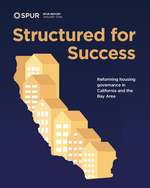
Structured for Success

SPUR Report /
A key cause of California’s high housing costs is its decentralized and fragmented housing governance system. Multiple state and regional agencies, offices, departments, and systems are responsible for planning and funding housing. Add hundreds of cities, each with its own authority to zone for housing, and the complexity becomes dizzying. A new SPUR report makes 11 recommendations to set California and the Bay Area on the path to produce the housing we need.

15 Minutes to Everything: Q&A with Erika Pinto

News /
The “15-minute neighborhood” concept promotes people-centered development as a way cities can improve convenience, affordability, and equity while decreasing air pollution and carbon emissions. In a new policy brief, SPUR Housing and Planning Policy Manager Erika Pinto explores how the 15-minute model could help improve and accelerate San José’s approach to planning for more compact and connected urban development. We spoke with Erika about 15-minute principles and planning for more complete communities.

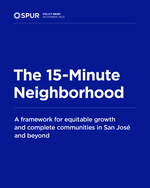
The 15-Minute Neighborhood

Policy Brief /
The concept of the “15-minute neighborhood,” where residents can access essential, everyday services just a short walk or bike ride from home, has gained currency in recent years. San José’s plan to grow by building dense, mixed-use “urban villages” could guide the kind of development that would create 15-minute neighborhoods. SPUR suggests that San José could use the 15-minute framework to implement its urban village plan. We recommend six strategies to enable the creation of these more complete, connected, and equitable communities.