SPUR has covered the transition from gas heating equipment to heat pumps — led by the Air District’s groundbreaking zero-emission heating rules— at length. Tenant protections, workforce development, equitable electrification, affordability and incentives, panel upgrades and electrical capacity, and permitting and inspections are just a few areas where we’ve dug in and worked for policy and regulatory changes that will make the transition affordable, smooth, and equitable.
However, one big question keeps coming up: how much money is available in the Bay Area for homeowners who need financial help to install heat pumps?
SPUR is working on a report that tackles this question and the avalanche of other questions that follow: How is the available money invested, and how effective is it at reducing barriers to heat pump adoption? How can we obtain more money for homeowners to upgrade to heat pumps? Are there geographic and demographic gaps in where we invest in heat pump incentives? How can we make incentive money go further, without sacrificing the deep retrofits — involving additional interventions like weatherization, electrical work, and asbestos remediation — that will be needed for equitable decarbonization?
While our analysis is still in the works, some initial insights are emerging.
1. Heating electrification remains a robust annual investment, with Bay Area energy providers leading the way.
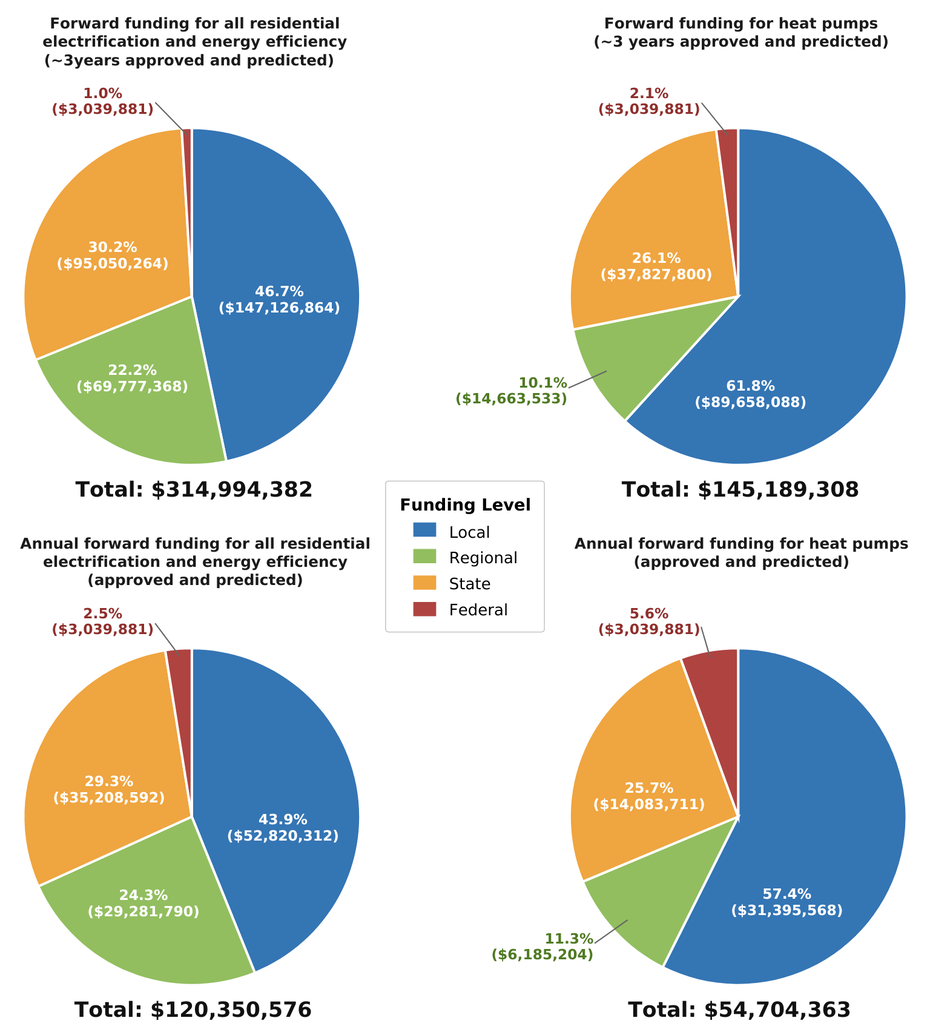
Some $145 million per year is invested in home energy efficiency programs in the Bay Area, including roughly $55 million per year solely for heat pump incentives. Local incentives represent the largest portion of sustained, yearly investment in heat pumps.
SPUR projection: $315 million will be invested in residential energy efficiency and heat pump incentives between 2026 and 2029
Source: SPUR analysis based on data from program implementer interviews, financial statements and budgets from implementer organizations, California Municipal Utility Association energy efficiency data, California Energy Data and Reporting System, public funding announcements, the American Community Survey, and additional demographic data sources.
Note: "Forward funding" refers to budgeted dollars approved or near approval that will be spent in the future.
At a moment when state and city deficits remain intractable issues, and the federal government is actively ditching clean energy, the fact that funding for the transition has remained this robust is both surprising and encouraging. The Bay Area’s energy institutions are the main reason: Community Choice Aggregators (CCAs), BayREN (the regional energy network), municipal utilities, and PG&E, which remains supportive of the electric transition. Gaps remain, particularly in Alameda County, where a CCA-level incentive is still lacking. But the overall responsiveness of the region’s institutions to the Air District rules, and to longer-standing local decarbonization goals, is impressive.
2. Funding has faced some headwinds but remains resilient.
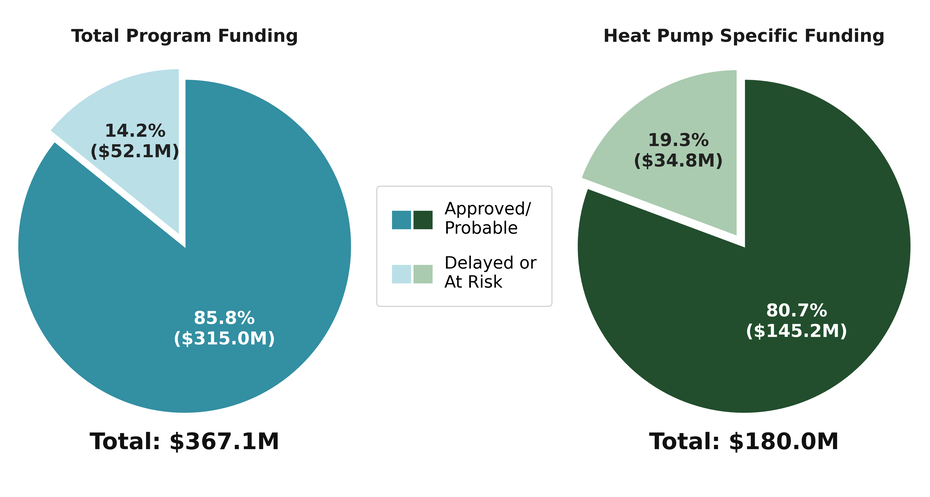
Federal and state rollbacks of green energy programs are commonly cited as the major new barrier that has emerged since the Air District passed its zero-emission rules in 2023. However, our analysis suggests these rollbacks have had minimal impact on direct incentives applied at the time of purchase. When funding is narrowed to just investments in heat pump incentive programs, only 14% of funding directed to the Bay Area was eliminated or delayed.
Federal and state rollbacks have disrupted less than one-sixth of Bay Area funding for energy efficiency and electrification programs (excluding tax rebates)
Source: SPUR analysis based on data from program implementer interviews, financial statements and budgets from implementer organizations, California Municipal Utility Association energy efficiency data, California Energy Data and Reporting System, public funding announcements, the American Community Survey, and additional demographic data sources. Note: Not reflected is the loss of the 25C federal tax credit of up to $2,000 on purchases of a heat pump (eliminated December 31, 2025, by H.R.1).
However, this analysis addresses only approved funds that have been eliminated or delayed. Some programs that advocates hope to renew have run out of funding. Most notably, the TECH Clean California program, a pillar of incentive funding in California, will remain reliant on state legislators, regulators, and California’s next governor to fund this cost-effective, data-driven vehicle for heat pump incentives.
3. TECH program incentives helped make heat pumps cheaper than gas equipment — and they can again.
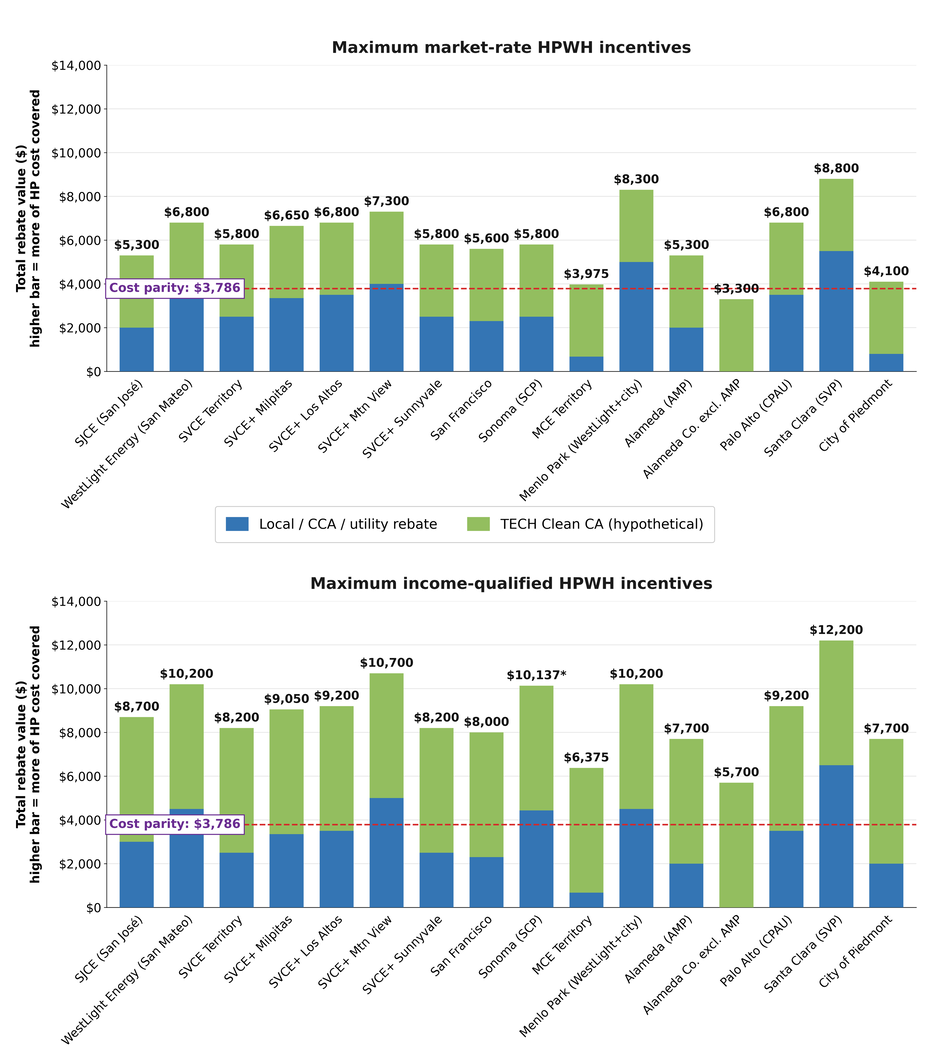
If the state TECH program is renewed, Bay Area residents will have the opportunity to obtain heat pump water heaters (HPWHs) for less than gas water heaters.
If TECH Clean California is refunded at 2025 rebate levels by the next legislature and Governor, HPWHs could be cheaper than gas water heaters when homeowners stack market rate or income-qualified incentives.
Source: SPUR analysis based on data from program implementer interviews, financial statements and budgets from implementer organizations, California Municipal Utility Association energy efficiency data, California Energy Data and Reporting System, public funding announcements, the American Community Survey, and additional demographic data sources.
Governor Newsom’s Extreme Heat Action Plan recently called for an additional $75 million investment in TECH incentive funding to restore heat pump installations. With the state budget balanced and revenues ticking up, there’s an opportunity in the 2027–2028 fiscal year to refund state clean heating investments like the TECH program and ensure that HPWHs will cost, on average, less to install with available incentives than gas water heaters in the majority of Bay Area jurisdictions.
However, by focusing solely on single appliance rebates at fixed dollar amounts, the above graphs miss most current heat pump funding, especially funds available to lower-income residents to cover the full cost of multiple retrofits measures in electrification and energy efficiency retrofits (direct install programs).
4. Direct install programs and income-qualified programs are on the rise.
A somewhat surprising finding emerging from our analysis is the degree to which direct install programs that offer zero-cost or low-cost retrofits, usually for low-income residents, are dominating the incentive landscape.
Direct install programs account for nearly half of expected funding for building efficiency and electrification programs over the next three years.
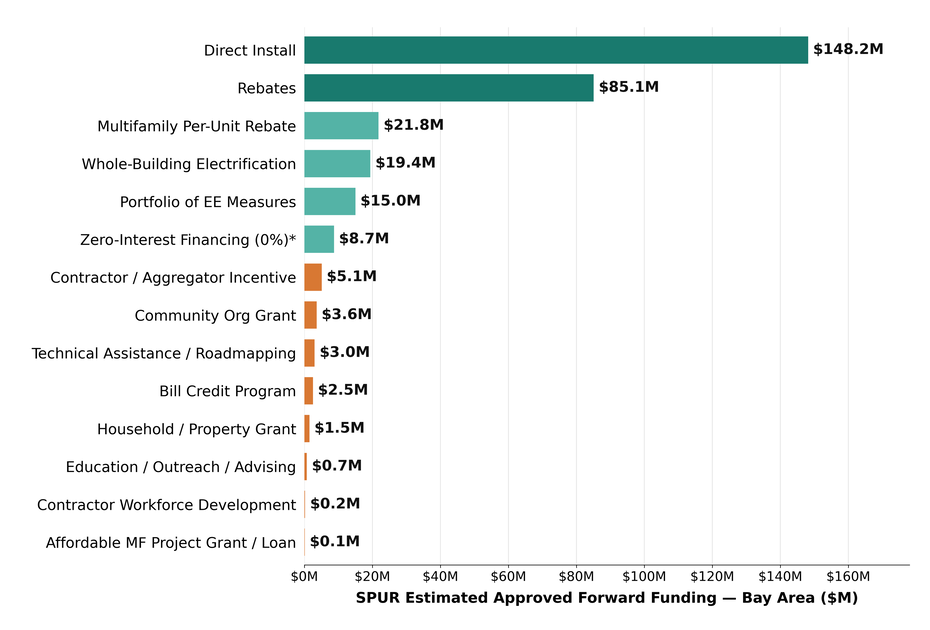
Source: SPUR analysis based on data from program implementer interviews, financial statements and budgets from implementer organizations, California Municipal Utility Association energy efficiency data, California Energy Data and Reporting System, public funding announcements, the American Community Survey, and additional demographic data sources. 0% interest financing is based on a revolving loan fund that is counted here as a direct investment.
Direct install programs are often designed to address not just the appliance replacement but also additional retrofit work to ensure that electrification benefits the homeowner: weatherization work, ductwork, electrical wiring or panel upgrades, and remediation such as asbestos abatement. Without this work, installing a heat pump may be difficult, and even if it is installed, poor home efficiency could still lead to higher bills. Direct install programs such as the state’s Equitable Building Decarbonization program, launched this year and likely to bring tens of millions of dollars in retrofits to the Bay Area, invest directly in these “deeper retrofits” while ensuring costs are covered by the program instead of billed to homeowners who can’t afford them — often low-income residents who disproportionately own older, “retrofit-needy” homes.
The catch is that a smaller percentage of direct install program dollars goes directly to heat pumps because, by their nature, these programs invest in other auxiliary supportive retrofits that make homes “electrification ready.” However, these retrofits are essentially what makes the switch to a heat pump possible in many older homes. Equitable building decarbonization requires these more expensive, deep retrofits if homes are to electrify.
The Next Step: Consolidation and Expansion
The heat pump landscape is highly complex, with more than 100 types of available incentives and nearly 60 programs offering heat pump incentives in the Bay Area. Regional coordination and consolidation would help ensure incentives are better targeted and distributed more equitably across the region.
The Sprint-to-9-6 working group — organized by the San Francisco Environment Department and referencing the Air District rule phasing out the sale of gas water heaters — is working with BayREN and the CCAs in the Bay Area to develop regional incentives. If implemented, the group’s proposed heat pump water heater bulk-buy program could lower installation costs through manufacturer discounts and by eliminating the cost contractors incur to acquire new customers by guaranteeing business through the program. The working group is also pursuing a regional point-of-sale incentive that would apply at the time of a heat pump purchase and that would ensure quick access to support. By contrast, most current rebates require submitting applications and permit approvals and are not well suited to emergency replacements.
Our forthcoming report focuses on funding levels for existing programs and approved or recurring budgets. However, efforts of local and state advocates and policymakers, such as the Sprint-to-9-6 working group, and grantors such as the Air District through its Community Benefits Fund, promise a new wave of investment. SPUR is taking lessons from the current funding landscape to advocate for smart investments that fill access gaps and ensure programs align with the Air District’s zero-emission rules.
For more details about our analysis, please contact Sam Fishman at [email protected].