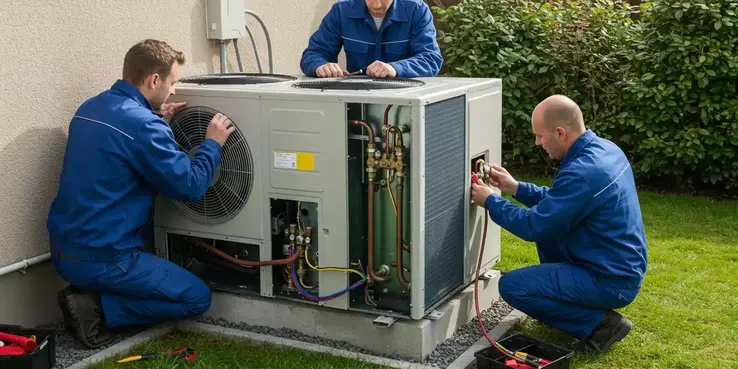
Electric heat pumps may save homeowners money on their energy bills, but at this time they’re still more expensive to install than gas furnaces and water heaters. It doesn’t have to be that way. Efforts to develop the heat pump installation workforce, avoid unnecessary electrical costs, and streamline permitting can work together to reduce heat pump installation costs.
The Bay Area’s Heat Pump Market
High-efficiency heat pumps are zero-pollution and can save households on their energy bills. So why aren’t they everywhere? Their installation cost remains significantly higher than that of the gas equipment they’re usually replacing.
Why do heat pumps cost more upfront? Compared with gas equipment, their installation requires more complex electrical work and more advanced controls, and, unlike gas equipment, heat pumps require routing refrigerant lines to an outdoor compressor. Even so, most of the elevated price stems from market barriers, not the technology itself.
Three interlocking factors play an outsized role in these market barriers: workforce development, smart electrification planning practices (for example, right-sizing equipment to avoid panel upgrades), and streamlined permitting.
Critically, greater demand for heat pumps will help mitigate each of these cost barriers and improve the market conditions by incentivizing workforce development and smarter electrification planning by contractors and building departments. This virtuous cycle is already underway in the Bay Area: the Air District’s zero-emission heating rules (rules 9-4 and 9-6) guarantee accelerating heat pump sales.
This transition will occur expeditiously and equitably if market barriers are addressed before the Air District’s zero-emission water heater and furnace standards take effect. The road to affordable household electrification and to achieving California’s ambitious carbon neutrality goals starts with understanding where costs come from and how policy can bring them down.
Breaking Down the Costs
The largest share (about 70%) of a heat pump’s cost is its installation. WestLight Energy (formerly Peninsula Clean Energy) provides a rough estimate of the typical costs for a heat pump water heater installation. According to its figures, installing the equipment represents almost half the cost ($3,500). Other significant portions of the cost are additional electrical circuitry ($1,200) and the fees and labor hours required for permitting ($750). While heat pumps can save customers money on their energy bills, these non-material costs are the reasons heat pumps remain more expensive than gas equipment.
Average Cost of Heat Pumps vs. Equivalent Baseline Gas Equipment
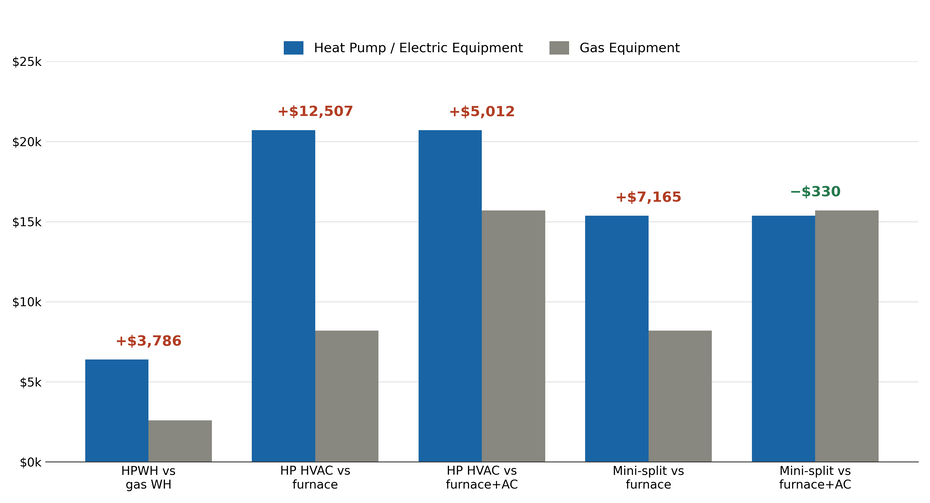
Sources: Heat pump costs — mean of Opinion Dynamics market characterization study (2025) and TECH working SF dataset. Gas water heater costs — updated baseline. Gas furnace/furnace+AC — updated baseline. Mini-split source: Closing the Eletrification Affordability Gap, Appendix C, SPUR, February 2024.
While heat pumps are more expensive now, cost declines could make up the difference. While hardware costs for heat pumps are only going to come down slowly, there’s a long runway for innovation to bring down “soft costs” like labor, permitting, and electrical design. The chart below imagines what the cost of a heat pump water heater would be if achievable cost declines occur in these categories.
Cost Profile of a Heat Pump Water Heater (HPWH)
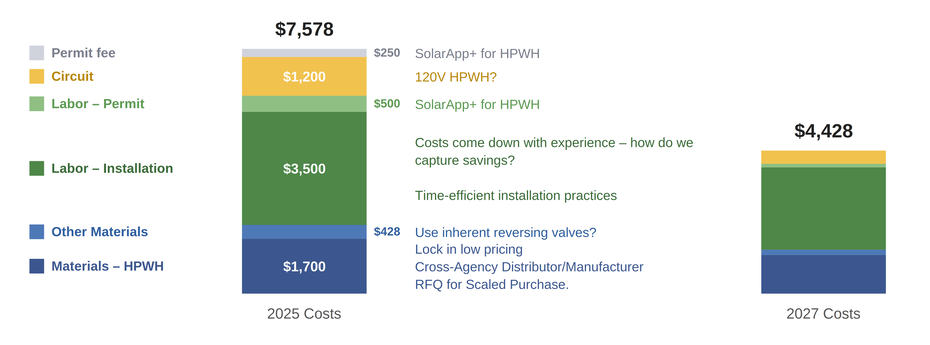
Source: Courtesy of Blake Herrschaft, Peninsula Clean Energy, unpublished presentation, 2026.
Note: Descriptions on the right of the first column represent actions, policies, or tools that can reduce costs, putting them more in line with the 2027 cost bar.
Using figures from All-Electric California, heat pump water heater (HPWH) installer Eric Morrill recently examined subcategories of labor, procurement, communication, fees, and materials required to complete an installation. He found that permitting, compliance, and rebate administration are 22% of the total cost of purchasing and installing a HPWH.
All-Electric California’s Study of HPWH Project Costs in San Francisco
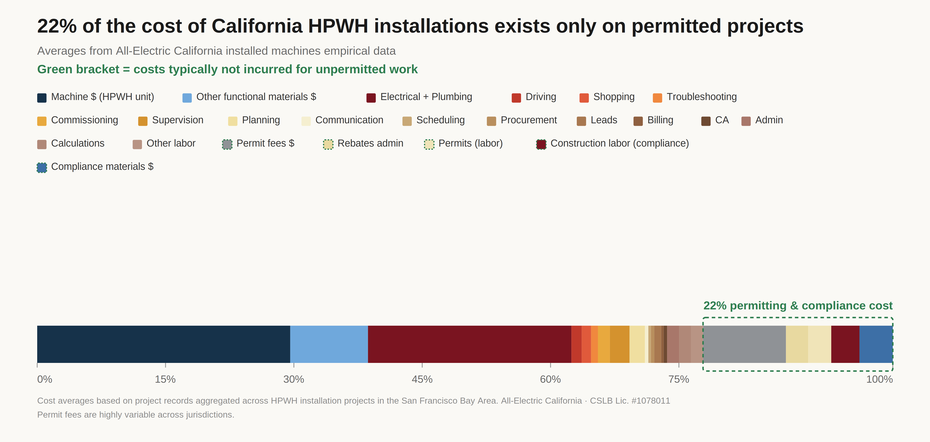
Source: LinkedIn post by Eric Morill
Three Policy Tools to Reduce Costs
Heat pump installation costs could plummet if jurisdictions implemented policies to develop the heat pump installation workforce, avoid unnecessary electrical upgrades, and streamline permitting.
Develop the Workforce
Contractors in California are still developing familiarity with heat pump technology. Without sufficient demand, too few contractors compete to install heat pumps, and contractors are not incentivized to specialize and scale efficient business models. This situation keeps prices artificially high.
TECH Clean California’s installation-level data show that projects in counties served by 100 or more enrolled contractors cost roughly $1,301 less on average than projects in counties served by only about 10 contractors. Contractor count is one of the strongest drivers of return on investment for both HPWH and heat pump HVAC customers: with a larger contractor base, competition rises and prices lower.
The Bay Area Air District’s rules create predictable and concentrated demand for heat pump technology and function as a cost-reduction mechanism, but only when a contractor base is ready to meet the volume. CalMTA, a California Public Utilities program to drive energy efficiency/decarbonization, frames the workforce challenge well: the task is not building a workforce from scratch, but giving firms a sufficiently strong business case to offer the technology consistently, which ultimately gives them a reason to specialize.
Increased demand is driving down costs, as illustrated in Kern County, where a few large firms handle high volumes of installations driven by TECH Clean California incentives. These firms have managed to consolidate their operations and achieve real economies of scale. Concentrated demand has produced a local market wherein firms can specialize and lower soft costs per job. The result: TECH found that the median installation cost was $4,319, far below the $6,973 median cost for the rest of the state, or a 38% lower cost.
Rule 9-6 could create this same dynamic across the Bay Area if jurisdictions pair guaranteed equipment demand with expanded workforce training opportunities for contractors. San Francisco’s “Sprint to 9-6” working group, which focuses on market preparedness for the water-heating rules, is collaborating with BayREN to organize HPWH trainings across the Bay Area to prepare contractors and staff for the transition. Another benefit of contractor training programs is that they offer opportunities to integrate best practices in electrification planning, including power-efficient design (PED), and to provide permitting and compliance assistance that further reduce market frictions.
Increase Technology Literacy and Improve Electrification Planning
SPUR has written extensively about the growing set of technologies, electrification planning strategies, and load calculation methodologies that can help avoid costly electrical panel and service upgrades and reduce the cost and complexity of electrification retrofits. The question is how quickly the electrification workforce adopts them.
A Lawrence Berkeley National Laboratory analysis of TECH Clean California program data found that 96% of 1,764 homes with a 100-amp panel could add a heat pump water heater system, a heat pump HVAC system, or both without upsizing the panel. Upgrading a panel costs an average of $2,000 to $4,500 and requires additional time to obtain permits. A panel upgrade could also necessitate an increase in service line capacity, which may, in turn, require transformer or pole upgrades, or both, at a cost of thousands of dollars.
To help homeowners eliminate these costs, the workforce needs to learn how to make planning decisions that avoid expensive electrical upgrades. SPUR is currently working with the California Energy Commission’s Electric Program Investment Charge grant team to develop a research-based load calculation tool — the Home Power Planner — that will enable contractors to employ PED strategies. However, workforce development and training programs will be the most critical vectors for these best practices and tools.
Streamline Permitting
Permitting is one of the largest drivers of compliance costs: SPUR’s Greenlighting Clean Heat found that inconsistent and onerous permitting systems across Bay Area jurisdictions are a major barrier to heat pump adoption, driving permit compliance rates for electric heating equipment below 20% in some parts of the Bay Area.
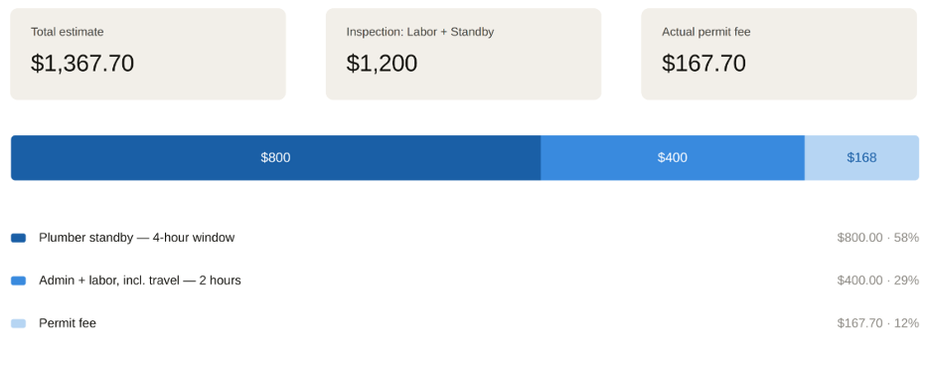
Testimonials from contractors, electrification specialists, and public officials are deepening understanding of the direct and indirect costs of compliance (for example, permit costs, project delays) and ways to eliminate them. One contractor SPUR consulted estimated that pass-through permitting costs for heat pump HVAC installations in select Alameda County cities are roughly 7% of total project cost, about $2,173 per project, with 4% coming from permit fees and plan drafting and 3% from time and effort. A Bay Area contractor offered a detailed estimate of $1,367.70 for a permit and inspection of a simple heat pump plus an HVAC job in Pacifica.
Permitting and Inspection Costs for a Heat Pump HVAC Project in Pacifica
Source: SPUR.
Many of the HVAC contractors SPUR interviewed reported waiting two to six hours for inspections that take 5 to 15 minutes. A City of Palo Alto audit found that the most critical issue in its permit process was the long lead time for inspections, typically two weeks between request and visit. Many jurisdictions do not communicate the inspection window until the day of the inspection, forcing full-day work stoppages. Depending on the contractor’s standby rate, a homeowner may incur $600 to $1,000 in additional labor costs per inspection. As one contractor from the Central Valley put it, “When a technician is stuck waiting for an inspector instead of completing revenue-generating work, the lost revenue can easily reach $1,000 or more.”
SPUR is sponsoring two bills to address these long lead times and work stoppages. Senate Bill 222 (Wiener, the Heat Pump Access Act) would establish a statewide inspection framework by prohibiting jurisdictions and homeowner associations from imposing additional zoning requirements on heat pump installations, mandating instant permit issuance for simple projects, capping permits at one per installation, and standardizing fees. Assembly Bill 1738 (Carrillo) would support remote inspections, expediting permitting and lowering fees to significantly reduce compliance costs for home electrification, as well as for wildfire home-hardening re-roof projects such as upgrading wood shake roofs to “Class A” roofs. Many jurisdictions have already adopted instant (same-day) permitting systems and single permits per appliance. San Mateo County is piloting permitting improvements across several participating jurisdictions. Lowering administrative barriers for heat pumps will save contractors and homeowners time and money, in turn lowering the overall market price for heat pumps.
Market Transformation for Climate Resilience
In the Bay Area, SB 222 and AB 1738, workforce training, and adoption of best retrofit planning practices are poised to make home electrification easier and more affordable. Notably, some of the policies needed to reduce cost limitations for heat pump installation can also serve as models for other needed resilient building upgrades, such as making homes more prepared for wildfires, floods, and earthquakes. SPUR is taking learnings from our work on heat pumps and seeking policy pathways to make resilience upgrades more affordable.
Learn how cities can ensure an affordable transition to electric for renters.