As Bay Area cities pursue building electrification, one of the main challenges is ensuring that efforts to deliver the broad social benefits of energy efficiency and cleaner air do not inadvertently undermine housing affordability or renter stability by causing rent increases or evictions.
Buildings account for about 25% of California’s greenhouse gas emissions, and the state has committed to carbon neutrality by 2045. The Bay Area Air District’s new rules speed that transition by phasing out the sale of gas water heaters starting in 2027 (Rule 9-6) and gas furnaces starting in 2029 (Rule 9-4). But the rules are not just aimed at cutting emissions. Replacing gas equipment with heat pumps and electric appliances improves indoor and outdoor air quality and protects people from extreme heat. According to census data, renters are especially exposed to the latter: 29% of renter-occupied homes lack central or room AC, compared with 20% of owner-occupied homes.
In California, 44% of households rent, and in the dense centers of San Francisco and Oakland, renters are the majority of residents. They will be most affected by the energy reach codes that are driving the electrification transition by allowing cities to go beyond the state’s building code to advance all-electric new construction and accelerate electrification in existing buildings. Energy reach codes for existing buildings matter most for renters because they apply to already-occupied units. They include:
- AC-to-heat-pump codes, requiring a heat pump replacement for a central air conditioner that burns out
- Electric-readiness codes, requiring pre-wiring and panel capacity during alterations
- FlexPath codes that offer a menu of measures
- Code improvements triggered during major renovations or at a set project threshold (such as the number of square feet involved in the project)
- Single-family remodel and cost-effective-upgrade codes
- Rules steering aging gas infrastructure toward electric replacements
As retrofits scale across multifamily housing, tenant protection policies are needed to address the specific risks related to cost pass-throughs, evictions, and deed-restricted affordable housing. Otherwise, electrification can raise rents and trigger displacement.
Three Critical Affordability and Tenant-Protection Policies
A variety of measures could ease the gas-to-electricity transition for renters. SPUR finds that three tenant protections represent real opportunities to do so. The first of these, capping cost pass-throughs to renters, applies to the handful of Bay Area cities with local rent stabilization ordinances, whereby owners can petition to recover retrofit costs through abatement. The second, just-cause eviction protection, determines whether tenants can be displaced during a retrofit. This protection is set by the statewide Tenant Protection Act, Assembly Bill 1482 (2019) and by stronger local ordinances where they exist. The third, deed-restricted affordable housing, faces a distinct challenge: utility-allowance rules that can penalize owners for electrification, calling for policies that keep decarbonization from cutting into their revenue.
Three Critical Mechanisms for Multifamily Building Electrification: Status and Opportunity in the Bay Area
Mechanism | Status | Where it exists/ closest example | How it relates to reach codes | Opportunity for local jurisdictions |
Caps on cost pass-throughs to renters | Gap (no electrification-specific rule in Bay Area) | Capital-improvement pass-through caps in Oakland, San Francisco, and Berkeley and the Apartment Rent Ordinance in San José limit how retrofit costs reach tenants. CA Civil Code 1941.1 already makes heat and hot water a property owner habitability duty. | Reach codes impose conversion costs. In rent-controlled cities, an owner can petition to pass these costs through as a capital-improvement rent surcharge. | Implement a decarbonization-specific pass-through cap that is set below a city’s existing capital-improvement pass-through ceiling. Alternatively, clarify that fuel-switching heating equipment conversions fall under a property owner’s duty to maintain habitability. |
Just-cause eviction laws | Gap (no electrification-specific control in Bay Area) | No Bay Area jurisdiction has electrification retrofit-specific eviction controls. General just-cause plus “substantial remodel” rules (AB 1482 plus local rules) apply. Redwood City extends just-cause and a right to return for general renovations. In the case of municipally or state-funded retrofits, AB 157/TECH bars displacement. | A substantial remodel (>30 days) can lead to eviction under AB 1482. Eviction is not triggered by the reach code but by ordinances such as San Francisco’s all-electric major renovations ordinance, which attaches electrification requirements to substantial remodels. | Close AB 1482’s “substantial remodel” eviction loophole, which permits permanent eviction for a retrofit requiring displacement of tenants for more than 30 days. Instead, prohibit evictions due to renovation, explicitly naming electrification renovations, and guarantee a right to return at same rent for tenants who are displaced. Amend anti-harassment ordinances to classify eviction and cost pass-through threats tied to mandated clean energy or public health upgrades as unreasonable, abusive, and coercive conduct. |
Updated utility allowances for deed-restricted housing that account for heat pump efficiencies | Partial (state/finance, not local code) | The San Francisco Housing Authority includes a heat pump water heater allowance tied to actual efficiency gains. | Reach codes that push electrification of deed-restricted buildings can reduce the building owners’ revenue unless the owners’ utility allowance is adjusted. | Pair existing-building reach codes with a utility-allowance adjustment or on-bill credit that accounts for heat pump efficiencies. |
Sources: California Housing Partnership (2026); U.S. Department of Housing and Urban Development (2023)(Utility Allowance Schedule, Form HUD-52667); SPUR (2025–2026); California Civil Code section 1941.1; San Francisco Rent Board and Rent Stabilization & Arbitration Ordinance; Oakland, Berkeley, and San José anti-displacement and capital-improvement pass-through rules; Redwood City Tenant Protection Ordinance (2026); TECH Clean California; California AB 157 (2024); California AB 1482 (2019).
Notes: Status reflects Bay Area adoption as of June 2026. PARTIAL indicates it exists but is not tied to electrification or operates at the state or finance level rather than through local code; GAP indicates no targeted policy in the region. Where no local rent control applies, the AB 1482 cap governs (5% plus Consumer Price Index, or 10%, whichever is lower; Costa-Hawkins exempts single-family homes, condos, and units first occupied after 1995). AB 1248’s limits on ratio-based (RUBS) electricity billing take effect on April 1, 2026.
Capping Cost Pass-Throughs to Renters
With both the Air District rules and reach codes setting the stage for a large expansion of electrification retrofits, tenant impacts need to be carefully addressed. In cities with rent control, an owner can petition to recover building upgrade costs by passing them on to tenants through a rent increase. In cities without rent control, AB 1482 caps annual rent increases and requires just cause for eviction.
The Bay Area has the opportunity to minimize electrification retrofits’ added rent burden. Cities can implement a decarbonization-specific pass-through cap set below their existing capital-improvement pass-through ceiling. San Francisco’s Rent Ordinance (Sec. 37.7) already treats energy conservation and renewable energy improvements as their own pass-through category but doesn’t put a lower cap on these improvements than on other capital improvements. It could close this gap by reducing the cap on electrification-specific upgrades.
Cost pass-throughs could further be avoided through California Civil Code 1941.1, which requires property owners to maintain habitability, including supplying heat and hot water to rental units. Rent control rules generally let property owners pass through the cost of capital improvements, but not the cost of maintaining necessary infrastructure. Therefore, a city-mandated swap from gas equipment to a heat pump could be understood as a measure to maintain habitability, thereby restricting cost pass-through to the tenant. San Francisco and Oakland do treat equipment replacements as capital improvements under current renter laws.
SPUR recognizes that electrification imposes a real cost burden on some property owners, especially given the limited availability of rebates and the upfront premium associated with heat pump systems. To ease that burden, SPUR is sponsoring two bills that lower upfront costs through permit streamlining and remote virtual inspections. Senate Bill 222 (Wiener, the Heat Pump Access Act) would establish a consistent statewide framework: prohibiting jurisdictions and homeowner associations from imposing additional zoning requirements on heat pump installations, mandating instant permit issuance for simple projects, capping permits at one per installation, and standardizing fees. Assembly Bill 1738 (Carrillo) would streamline permitting through remote inspection offers, expedited approvals, and lower fees to significantly reduce compliance costs for home electrification. Reducing upfront costs incentivizes electrification and, in turn, protects tenants from rent increases tied to pass-through costs. However, in some retrofit cases, smaller or lower-resourced property owners may need additional subsidies to ensure they can electrify without recovering costs through rents.
Just-Cause Eviction Laws
Just-cause eviction laws require property owners to have a valid, legal reason to remove tenants who have occupied a residence for more than one year. The risk electrification raises here is a renoviction: an eviction that occurs when a property owner renovates the home, taking advantage of existing just-cause law to deliberately trigger “no fault, just cause” eviction. This pathway is sometimes used by property owners in order to raise rents.
Under most local rent-stabilization ordinances, substantial renovation work requires the property owner to temporarily relocate tenants and grant them a right to return at the same rent. However, AB 1482 allows property owners to evict tenants for remodels that take more than 30 days, introducing a substantial remodel loophole, an issue identified by Strategic Actions for a Just Economy. Electrification retrofits may take longer than a month, and even if not, property owners can choose not to disclose a renovation’s timeline or scope. Additionally, relocation assistance, if offered, may be insufficient to cover the costs of moving and finding another place to stay.
Existing law offers some protections, but only in narrow cases. SB 567 (2023) requires property owners to give notice of their intent to remodel, including a timeline and copies of required permits, and to define “substantial remodel” as permitted structural, electrical, plumbing, or mechanical work, not cosmetic upgrades. Additionally, property owners must offer the unit back at the same rent if the work is never done. Even with these requirements, a substantial remodel is still a lawful reason to evict a tenant.
If the retrofits are funded by TECH Clean California and backed by AB 157, California’s Budget Act of 2024, they carry anti-displacement and no-cost-shift conditions, so property owners who use that funding for a renovation cannot evict tenants or pass its cost on to them. These conditions, however, apply only to TECH-funded projects, leaving other projects subject to local law.
To address gaps in AB 1482, local ordinances are needed to clearly state that a substantial remodel, at least for electrification, is not a just cause for eviction. Redwood City’s 2026 Tenant Protection Ordinance extends just-cause coverage and, for a substantial remodel that requires a tenant to vacate for 30 or more days, requires the property owner to offer a right to return once the work is complete at the prior rent plus any state-allowed increases. The ordinance raises relocation assistance to three months of fair market rent for low-income tenants and four months for seniors, disabled tenants, and families with children. The ordinance still allows eviction, but the property owner must offer the tenant relocation assistance and a right to return after the renovation is completed. A stronger fix would remove substantial remodels as grounds for eviction outright, as Los Angeles City Council did in 2025. Two other ideas come from Menlo Park’s anti-displacement plan. The first involves education to landlords, tenants, and relevant enforcement bodies on why most electrification projects, especially those involving installations of heat pump water heaters and heat pump HVAC systems, do not come close to meeting the 30 day "substantial remodel" clause. The second proposes to amend its anti-harassment ordinances to classify eviction and cost-pass-through threats tied to mandated clean energy or public health upgrades as unreasonable, abusive, and coercive conduct. The gap is not that protections are absent but that their language does not directly address electrification and the types of remodels it requires.
Challenges for Deed-Restricted Affordable Housing
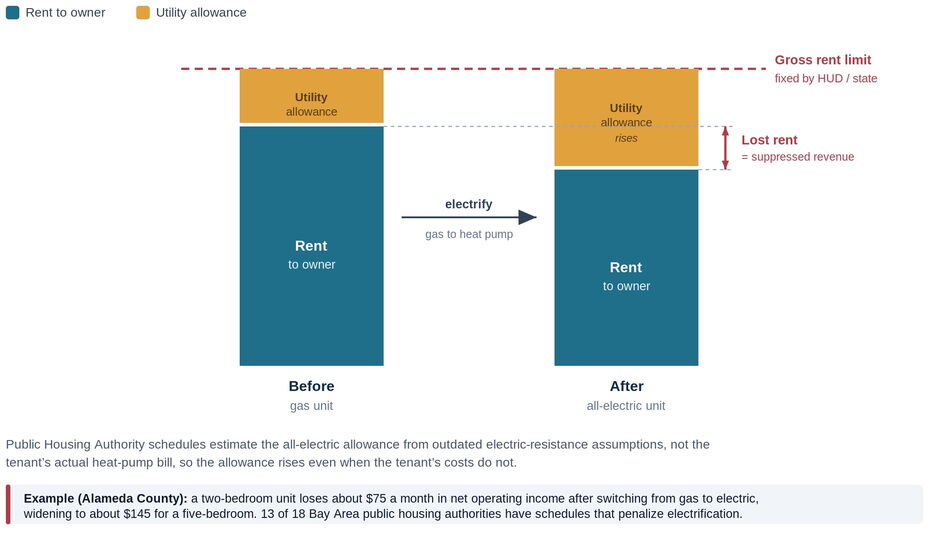
The specific challenges faced by deed-restricted affordable housing need their own policies to incentivize electrification. In subsidized affordable housing, a tenant’s total housing cost is capped, and that cap is split between the rent paid to the owner and a utility allowance, an estimate of the tenant’s monthly utility bills that is subtracted from the rent the owner can charge. That allowance comes from a utility allowance schedule, which is a table of estimated monthly utility costs that a public housing authority publishes for each unit type and fuel. Many of these schedules assume that electric appliances cost more to run than gas appliances because they rely on outdated estimates that fail to account for the efficiency of heat pumps. As a result, electrifying a building can trigger a higher allowance, which lowers an owner’s revenue and disincentivizes electrification. The California Housing Partnership found this disincentive exists in 13 of 18 Bay Area housing authority schedules. The fix is well within reach: updating allowance schedules to reflect heat pumps’ efficiency would remove the penalty and allow affordable housing to be electrified without losing revenue. Santa Clara County has already addressed this challenge and updated its 2026 utility allowance schedule to reflect heat pump efficiency, a model other counties can follow.
How Electrification Can Suppress Owner Revenue in Deed-Restricted Housing
The gross rent limit is fixed, so a larger utility allowance leaves less room for rent to the owner.
Source: California Housing Partnership, “Utility Allowance Draft Findings in the BAAQMD Region,” presentation to the Bay Area Climate Adaptation Meeting by Blanca de la Cruz, May 4, 2026.
Where the Bay Area Stands
These gaps in pass-through, eviction, and utility-allowance rules vary across the region, depending on the tenant protections a jurisdiction has in place and on whether its building codes have encouraged electrification. SPUR has helped develop decarbonization-specific energy reach codes for buildings in the Bay Area, ahead of the recent Assembly Bill 130 building-code freeze, which restricts new local residential building standards from October 2025 through June 2031. Since August 2025, many Bay Area cities have passed energy reach codes aimed at energy efficiency and electrification. However, reach codes have been adopted faster than the tenant protections meant to match them. Some Bay Area jurisdictions have adopted reach codes for existing buildings, overlaid with current tenant protections.
Bay Area Jurisdictions’ Building Reach Codes and Tenant Protections
Jurisdiction | Existing-building reach code(s) adopted | Local rent control | Just-cause/relocation protections |
Oakland | FlexPath and electric readiness (2025) | Rent Adjustment Program (1980) | Just Cause for Eviction (Measure EE) + relocation; capital-improvement pass-through capped |
Marin County | Single-family remodel energy reach code (2022) | — | Just-Cause for Eviction Ordinance + mandatory rent-increase mediation |
San Anselmo | Renovation reach code (threshold 200 sq ft) | — | AB 1482 just-cause; mediation access |
San Rafael | Renovation reach code (threshold 500 sq ft) | — | Mandatory mediation (>5% increases) + just cause |
San Francisco (city and county) | All-electric major renovations ordinance (2025) | Rent Stabilization & Arbitration Ordinance (1979) | Just cause includes no-fault substantial rehabilitation; controls extended to substantially rehabbed buildings since 2020 |
Sunnyvale | AC2HP and electric readiness (2025) | — | CA AB 1482 just cause + 1-mo relocation (no-fault) only |
Menlo Park | AC2HP, FlexPath, electric readiness (2025) | — | CA AB 1482 just cause + 1-mo relocation (no-fault) only |
Portola Valley | AC2HP and electric readiness (2026) | — | CA AB 1482 just cause + 1-mo relocation (no-fault) only |
San Mateo (city) | Electric readiness for remodels (2022); AC2HP, non-res AC2HP, FlexPath (threshold 1,000 sq ft / 12-pt), electric-readiness (2026) | — | Local just-cause ordinance (2019) + enhanced relocation (11-mo threshold) + right to return after substantial rehab |
Los Gatos | AC2HP and electric readiness (2025) | — | CA AB 1482 just-cause + 1-mo relocation (no-fault) only |
Mountain View | AC2HP and electric readiness (2025) | Community Stabilization & Fair Rent Act (Measure V, 2016): rent control (Consumer Price Index cap) | Just-cause + relocation (Measure V) |
Palo Alto | FlexPath, electric readiness, and AC2HP (2025) | — | CA AB 1482 just-cause + 1-mo relocation (no-fault) only |
East Palo Alto | AC2HP, non-res AC2HP, FlexPath (~1,000 sq ft/12-pt), and electric readiness (2026) | Rent Stabilization & Just Cause for Eviction Ordinance (2010) | Just-cause + no-fault relocation ($7,500–$10,000, plus $2,500 more for low-income or vulnerable tenants) |
Los Altos | AC2HP and electric readiness (2025) | — | CA AB 1482 just-cause + 1-mo relocation (no-fault) only |
Los Altos Hills | AC2HP and zero-NOx (2025) | — | CA AB 1482 just-cause + 1-mo relocation (no-fault) only |
Saratoga | AC2HP and electric readiness (2025) | — | CA AB 1482 just-cause + 1-mo relocation (no-fault) only |
Sources: SPUR (2025); Sierra Club (2025); SF Environment (2025); Marin County (2026); Portola Valley (2026); City of San Mateo (2026); Peninsula Clean Energy (2025); SF.gov (2019); City of East Palo Alto (Rent Stabilization Program); City of East Palo Alto (Guide to Just Cause for Eviction); Tenants Together (rent-control ordinances by city);California Energy Codes and Standards (2026)
Notes: In the absence of local rent control, the AB 1482 cap applies (Costa-Hawkins exempts single-family residences/condos/post-1995 construction). Marin County, San Anselmo, and San Rafael reach codes remain current but emphasize non-energy CALGreen Tier 1 measures following AB 130. Portola Valley’s new-construction mandate is paused.
Mapping electrification retrofits against existing tenant protections reveals where those protections fall short. Even jurisdictions with strong tenant protections rarely have language that directly addresses electrification, leaving renters exposed when decarbonization retrofits begin.
Pathways Forward
SPUR has advanced the Bay Area’s equitable electrification transition by weighing in on the development of energy reach codes, informing exemptions to the Air District’s water heater rules, and proposing permit streamlining and virtual inspections to reduce heat pump installation costs. As the Air District’s rules take effect, the next priority is protecting renters. Local jurisdictions and housing authorities should implement a combination of tenant protections to ensure electrification reduces emissions without undermining housing affordability or creating undue burdens for building owners.
Effective implementation of any local tenant protections will also require strong enforcement. Because many tenant protections depend on tenants filing complaints, jurisdictions should provide clear information about tenant rights and accessible complaint processes. For example, when pass-through costs are reviewed, San Francisco provides notices to tenants, informing them of their rights, such as the right to request a means-test exemption. A means-test exemption allows low-income tenants to avoid paying specific rent surcharges, provided they can demonstrate that their household income falls below certain thresholds.
Finally, proactive planning can reduce displacement and costs. Policies such as electric-readiness ordinances and major renovation requirements encourage building owners to electrify over time rather than through costly emergency replacements, making compliance more affordable while minimizing disruptions for tenants.