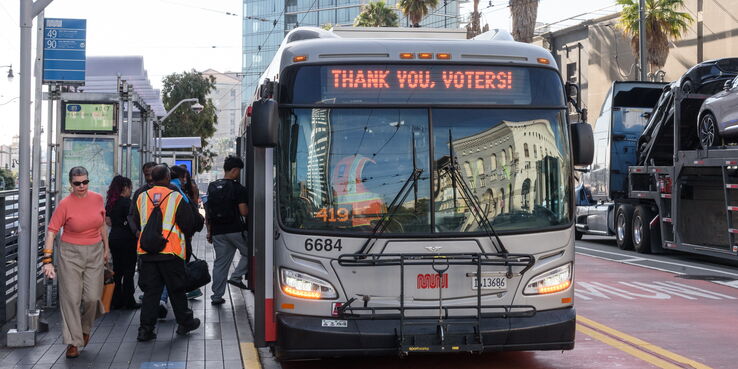
The future of Bay Area transit was on the ballot on November 4, and voters showed up to save it. The Regional Transit Measure (Proposition RTM) passed with 63% of the vote across five counties, and Stronger Muni for All (Proposition H) passed with 74.3% of the vote in San Francisco. The message is clear: transit isn’t just what moves us; it’s what unites us.
Prop. RTM is estimated to raise $980 million to $1 billion annually to bolster public transportation in five counties and serve as a crucial lifeline for BART, Muni, Caltrain, and AC Transit for the next 14 years. Prop. H is estimated to raise $170 million per year for 15 years to address the remaining portion of Muni’s deficit not covered by the regional tax. With the passage of Prop RTM and Prop H, Muni, BART, and Caltrain will be able to maintain a network of fast, frequent, and reliable service and avoid devastating service cuts.
Over the past few months, transit agencies refined their plans to cut service, preparing to make cuts and lay off workers starting in January 2027. Passage of Prop. RTM and Prop. H allowed them to shelve those plans.
After nearly six years of relying on a patchwork of one-time relief funding from the state and federal governments, the Bay Area’s largest transit systems are finally out of the intensive care unit and in stable condition.
Three Priorities to Tackle Next
These measures are critically important, but they are not the end of the line. Three priorities remain: an ongoing commitment to financial efficiency, continued efforts to attract riders and increase transit trips, and more operating and capital funding from the state.
Financial Efficiency
Financial efficiency will remain a top priority for transit agencies, the Metropolitan Transportation Commission (MTC), and SPUR. Many voters supported Prop. RTM and Prop. H because they strongly support public transit, despite real misgivings about the overall financial management of public transit agencies. Others supported the measures precisely because they incorporate strong accountability requirements, making their vote a vote for change.
The impetus for Prop. RTM and Prop. H was a large drop in revenues triggered by external circumstances that agencies couldn’t control, namely, the lasting effects of the COVID-19 pandemic on commute patterns. However, transit agencies still need to closely manage the factors they can reasonably control: their cost structure and business model. That’s why Prop. RTM requires an independent financial efficiency review of BART, Muni, Caltrain, and AC Transit.
An appointed independent oversight committee will guide this review. In October, the Senate Bill 63 Financial Efficiency Review Independent Oversight Committee approved the review scope, contingent on the measure’s passage. The review is expected to begin in early spring 2027 and follows the preliminary phase of work that was completed by MTC in 2026.
The review will identify a menu of cost-saving measures to reduce one-time and ongoing costs as well as recommendations to maximize the value of operators’ real estate and develop new sources of revenue. Operators are required to develop implementation plans for cost-saving measures that they choose to implement. The oversight committee will help determine operator-specific targets for financial and operational improvements based on each operator’s revenues and cost structure, performance, peer benchmarking, policy goals, and other factors. These targets will define what success looks like and help agencies prioritize which strategies to implement. The targets will be further translated into interim milestones and time frames. The committee and the regional transit district will work to establish a process for monitoring compliance and enforcing consequences for non-compliance.
Continued Improvements
As the pandemic reminded us, ridership levels depend on the economy, where people work, and other factors far outside transit agencies’ control. Nonetheless, transit agencies are committed to rebuilding ridership by giving riders a high-quality experience, so that when people do choose to take transit, they will want to keep choosing it.
Over the last several years, the agencies have made significant progress. For example, BART has increased cleaning frequency and has made a concerted effort to enforce the customer code of conduct through the in-person presence of staff and ambassadors and discreet reporting through a text message line. By refining its schedules, BART is improving transfer times and reducing overall trip times to the East Bay. BART, Muni, and Caltrain have doubled down on fare compliance and efforts to provide reliable and convenient surge capacity at big events. Muni and AC Transit have used rider feedback to adjust stops and schedules, improving reliability and speed. These and other improvements are showing up in both year-over-year ridership numbers and record-setting customer satisfaction across the board.
MTC’s Regional Network Management Structure, composed of transit agency general managers and MTC commissioners, will continue to oversee the implementation of customer-focused improvements. For example, agencies have been coordinating their schedule changes twice per year — in a process they call “the big sync” — to improve inter-operator transfers. MTC has transformed Clipper START, a discount pass for low-income riders, from a modest pilot into an ongoing program with 74,000 enrollees. MTC will use 5 percent of annual Prop. RTM revenues to support ongoing customer-focused improvements, including fare programs, accessibility, mapping and wayfinding, and transit prioritization. For example, over the coming year, MTC will continue to refine fare products and programs such as the Clipper START and Bay Pass, award funding for transit priority projects, and launch efforts to improve paratransit services and booking platforms.
State Funding and Policy Reform
The third priority is to secure additional dedicated, ongoing state funding for transit operations, maintenance, and capital projects. As SPUR wrote previously, state funding makes up only a relatively small portion of the operating funding that California’s largest and most productive transit systems rely on, especially compared with peers and the state’s own climate commitments. In short, the state underfunds public transit service, especially for its largest urban systems. As a result, voters have had to carry more than their fair share through local taxes. It’s time to fix that.
Prop. RTM and Prop. H avert the “fiscal cliff” — the severe, pandemic-influenced drop in fare and parking revenues needed for day-to-day operations — but they don’t address the “fiscal slope” — the slow and steady decline of state sources of transportation funds. These sources include a sales tax on gasoline, a sales tax on diesel fuel, and an excise tax on diesel fuel. All these revenues are declining because of lower fuel consumption, driven by electric vehicles and better mileage efficiency. In 2023, the Legislative Analyst’s Office projected that the state could lose an estimated $31 billion in gas tax revenue through 2035. Declining state transportation funds from fuel taxes will reduce the funding many transit agencies receive annually through formula distribution, as well as from the competitive capital grant program known as the Transit and Intercity Rail Capital Program (TIRCP).
Nor do Prop. RTM and Prop. H address the recent loss of funding from the Cap-and-Invest program, previously a source of significant transit capital funding. Cap-and-Invest (formerly Cap-and-Trade) was designed to generate revenue from polluters that sold carbon credits at auction. From 2014 until last year, auction proceeds were deposited into the Greenhouse Gas Reduction Fund, where specified shares were transferred to TIRCP and the Low Carbon Transit Operations Program (LCTOP). In 2025, the legislature and governor reauthorized Cap-and-Trade and renamed it Cap-and-Invest. Cap-and-Invest de-prioritized TIRCP and LCTOP, casting uncertainty over those funds in the future. Later in the year, the California Air Resources Board changed the program rules, casting further uncertainty about fund availability. Although Cap-and-Invest was never intended as a long-term source of funding for public transit, its recurring nature and the additional funds it provided helped transit agencies access federal dollars, among other things. Finding a way to backfill funding for these transit programs in next year’s state budget is critical.
The decline of multiple sources of state transportation dollars is a problem for most transit agencies statewide. For some midsize and large transit agencies, cost savings and efficiencies may help offset the near-term reductions in state funding. Small bus operators are likely to be hit hardest by the loss of state funds because state funds make up a larger share of their overall budgets. But the decline in fuel taxes also hurts local governments and the state, which rely on those taxes to maintain local and state roadways.
In the near future, state leaders will need to grapple with how to fund the state’s growing transportation needs in a way that provides the adequate, ongoing, and predictable operating and capital funds that transit has lacked for too long. Absent such a commitment, it will be tremendously difficult to build — let alone justify — some of the ambitious transit projects across the state.
Keeping Voters’ Support
This election, Bay Area voters showed California’s new governor and elected leaders that public transit is not just essential; it’s popular. But keeping their support requires transit agencies to continue making good-faith efforts to improve fiscal management, attract riders, and serve more trips. But survival is not the end goal: the region needs the state to step up with ongoing, predictable funding for transit — and more of it — if public transit is to truly thrive.