This year, during Governor Gavin Newsom’s final legislative session, SPUR made progress on two important housing issues: not enough new homes are being built, and too many existing homes still run on gas and aren’t ready for a hotter, more fire-prone climate. The governor signed seven SPUR-sponsored bills. Five of them make it quicker and cheaper to build housing, and two make it easier to electrify the homes we already have. He also signed several other priority bills SPUR supported, including a property tax exemption for moderate-income rentals and new financing options for energy and wildfire upgrades.
Here’s what passed, what fell short, and what comes next.
Building more homes, faster and for less
As a founding member and convener of the California Home Building Alliance (HBA), an informal statewide coalition of pro-housing advocates and organizations, SPUR drafts, sponsors, and supports legislation, regulatory reforms, and budget requests that reduce housing construction time and costs and address the urgent need for affordable homes.
The governor signed the first SPUR-sponsored housing bill of the year — SB 1036 — in June, just before the summer recess. Then, on September 29, he signed nearly three dozen bills into law “to build more homes and make progress in reducing unsheltered homelessness,” including four more sponsored by SPUR.
SB 1036 (Grayson) prevents cities and special districts from charging a redevelopment or an adaptive reuse project the full development impact fee when the site had a previous use. Instead, the prior use would receive a fee credit, so the project would pay only for the additional impact created by the new development. Example: If an old store becomes housing, the project wouldn’t pay as though it were developing an entirely new site. It would receive credit for the store’s existing impact and pay fees only for the added impact from the housing.
SB 457 (Becker) requires the California Department of Housing and Community Development (HCD) to develop and approve economic models that assess whether cities and counties have enough sites and zoned capacity to meet their Regional Housing Needs Allocation (RHNA) targets and to accept that analysis at the conclusion of the housing element certification process. This bill will reduce HCD review time, give jurisdictions greater certainty about the housing-element certification process, and ensure that identified sites have realistic, zoned capacity to meet RHNA targets.
AB 2433 (Alvarez) strengthens state density bonus law. It clarifies that granting a density bonus is a ministerial act under the California Environmental Quality Act. It allows lower-income units and 100% affordable developments, in addition to moderate-income units, to qualify for the stackable 100% super density bonus, which can let eligible projects reach up to twice the otherwise permitted density by combining multiple density bonuses. Finally, it provides two additional incentives for for-sale housing. SPUR cosponsored the bill with Circulate Planning & Policy, the San Diego Regional Chamber of Commerce, Greenbelt Alliance, and Inner City Law Center.
SB 1014 (Grayson) requires local jurisdictions to disclose early which on-site and off-site improvements a development will need: a preliminary estimate within 30 business days of a preliminary application, and an itemized list within 30 business days of a post-entitlement phase permit application being deemed complete. Jurisdictions cannot require improvements left off that list. SPUR cosponsored the bill with California YIMBY.
AB 2390 (Schiavo) is cleanup legislation that improves implementation of SB 35 (Wiener, 2017) and SB 423 (Wiener, 2023), the landmark laws that streamline housing approvals. Modifications to an approved housing development project must be evaluated under the objective zoning, subdivision, and design standards in effect when the original application was submitted, using the local government’s original assumptions and methodology. The law also clarifies that approval extensions during litigation apply to multiple modification requests, not just the developer’s first.
In addition to the bills we sponsored, SPUR and the HBA supported a few more successful pieces of legislation. The Assembly Select Committee on Housing Construction Innovation, led by Assemblymember Buffy Wicks, passed four laws to promote cost-effective factory-built housing, with strong advocacy from HBA members. They will take effect on January 1, 2027.
SPUR State Policy Director Michael Lane served as a primary witness in committee hearings for AB 1294 (Haney). Sponsored by San Francisco Mayor Daniel Lurie, the bill will help deliver true mixed-income communities by providing a 15-year property tax welfare exemption for nonprofit-owned rental housing built or converted in the next three years that serves moderate-income households in Alameda, Sacramento, and San Francisco counties. After eight years of attempts, including bills by former Assemblymember David Chiu and senators Scott Wiener and Jesse Arreguín, Assemblymember Matt Haney got this pilot version signed into law.
Three housing bills that got away
Unfortunately, three key bills in our housing legislative package did not advance, highlighting the ongoing challenges to improving California’s business climate for housing feasibility and production.
AB 1903 (Wicks) was intended to make it easier for condominium homeowners to get construction problems fixed. Under California’s “right to repair” law, homeowners generally must notify the builder about defects and give the builder an opportunity to inspect and repair them before filing a lawsuit. AB 1903 would have made that process more transparent and helped homeowners resolve problems through repairs rather than immediately pursuing litigation. The bill passed the Senate Judiciary Committee, but disagreements over amendments delayed it. After lawmakers substantially narrowed the bill near the legislative deadline, the Senate held the bill and did not advance it. SPUR cosponsored it with the California Building Industry Association, Bay Area Council, California YIMBY, Council of Infill Builders, Habitat for Humanity California, and the Housing Action Coalition.
AB 1406 (Ward) would have “de-risked” condominium financing by raising liquidated damages from 3% to 6% of the purchase price when a buyer cancels a contract, discouraging speculation and aligning with industry standards in other states. After the bill passed the Assembly, the Senate Judiciary Committee, this time aligned with the California Association of Realtors, refused to give the bill a hearing. SPUR cosponsored it with California YIMBY.
SB 328 (Grayson) would have set timelines for the Department of Toxic Substances Control (DTSC) to respond to permit requests and capped fees for reviewing cleanup of brownfield infill sites the housing sponsor did not contaminate. Since a $100,000 cap on DTSC fees was removed in 2023, those fees can reach $1 million or more, pushing developers away from infill sites and making projects infeasible. SPUR cosponsored SB 328 with the Bay Area Council and the Housing Action Coalition.
Streamlining critical climate upgrades for existing homes
New construction is only part of the picture. Most Californians live in existing homes, and making them healthier, more efficient, and climate-ready is urgent. This year, SPUR sponsored two bills that cut red tape for electrification and supported three more that tackle the cost and accessibility of retrofits.
Cutting red tape to electrify existing homes
Both SPUR-sponsored bills grew out of Greenlighting Clean Heat, our June 2025 report on streamlining and standardizing clean heating installations, and were signed in late September.
SB 222 (Wiener) modernizes and standardizes permitting for heat pump water heaters and heat pump HVAC systems in existing homes. Cities and counties must offer asynchronous inspections for basic installations and an online automated permitting system for simple swap-outs. The law limits each installation to one permit, caps permit fees, and prevents homeowners associations from blocking heat pump installations. SPUR first sponsored a version of this bill in 2025; when it fell short, we built a stronger coalition and cosponsored SB 222 with the Building Decarbonization Coalition and the Bay Area Air District.
AB 1738 (Carrillo) requires cities and counties to offer remote virtual inspections for all or part of the inspections needed for solar panels, battery storage, heat pump water heaters, HVAC changes, and re-roofing on one- and two-family homes. SPUR analysis found that at least 19 California jurisdictions already offer remote inspections, saving time and money for homeowners, contractors, and building departments while maintaining safety standards. SPUR cosponsored the bill with Permit Power.
Together, the two laws remove permitting and inspection barriers that add cost and delay to electrifying a home. SPUR will help implement both by convening local building departments, city staff, contractors, software platform companies, and organizations like BayREN.
Making retrofits affordable and accessible
Streamlined permitting lowers costs, but many households still need help with upfront costs and access. In addition to sponsoring the bills above, SPUR lent support to three others aimed at an equitable climate transition. All three are now law.
AB 2313 (Berman), the Home Energy Choice Act, sponsored by Earthjustice and the Natural Resources Defense Council, gives homeowners a voluntary incentive to electrify and disconnect from natural gas. When a home’s gas service line needs replacement, gas corporations must offer an alternatives program with an incentive of up to $17,500 for residential electrification, priced below the cost of replacing the pipe, which utilities typically pass on to ratepayers. SPUR testified in support.
SB 894 (Allen), sponsored by Megafire Action, creates the California Wildfire Resilience Loan Program to finance home hardening, defensible space, and other wildfire risk reduction projects. Loans will be structured as a revolving fund, similar to the state’s GoGreen financing platform, using repayments to replenish the pool for future borrowers rather than relying on one-time grants. Because SB 894 did not appropriate funding, its launch depends on future state budgets. Building on our January 2026 Shared Risk, Shared Resilience report, SPUR is continuing research and advocacy on home hardening and defensible space in the Bay Area.
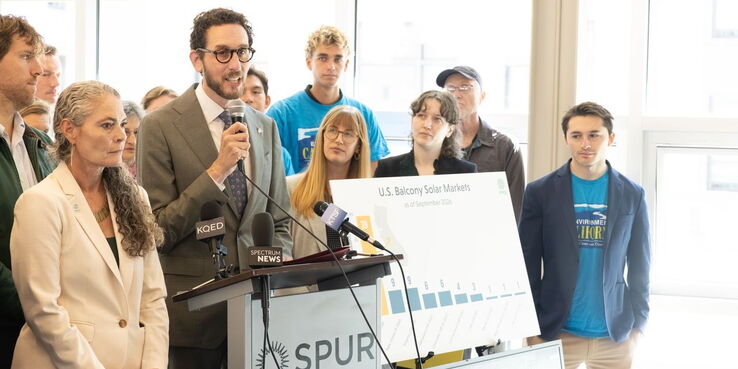
SB 868 (Wiener), sponsored by the Environmental Working Group, legalizes and streamlines plug-in or “balcony” solar. Certified systems under 1,200 watts skip the standard interconnection process and application fees. Affordable, nonpermanent, and usable in any outdoor space, the kits open solar to renters, lower-income households, and apartment dwellers. In a press release, Senator Wiener said the panels “will give everyone, including renters, the relief they desperately need on our outrageous energy bills.” Compliant kits are expected on the market early next year.
Staying the course on the stalled bills
Governor Newsom’s final session closes with meaningful wins: laws that make it easier to plan, approve, and pay for new homes, and laws that make it simpler and cheaper to keep existing homes healthy and climate-ready. But the bills that stalled on construction defects, condo financing, and brownfield cleanup show that serious obstacles remain. As a new administration takes office, SPUR will keep working with partners to implement these laws and bring back the reforms California still needs.