photo of people walking past a produce market

Economy

We believe: Prosperity is essential to a thriving region and should be planned for, supported, and shared so that all people can participate in and benefit from economic growth.

Our Goals

• Allocate resources to meet the needs of the most disadvantaged groups.

• Strengthen and expand the social safety net.

• Rebuild the middle class.

• Build effective and equitable fiscal policies.

Bay Area Market

SPUR Report

Undue Burden

Sales taxes are a common revenue-raising tool, but they also play a role in reinforcing structural inequality. SPUR explores three options for creating a more equitable tax code.
Bay Area Market

SPUR Report

Undue Burden

Sales taxes are a common revenue-raising tool, but they also play a role in reinforcing structural inequality. SPUR explores three options for creating a more equitable tax code.
Homeless Camp

SPUR Report

Mending the Net

Long before COVID-19, California had the highest poverty rate in the nation. The state is also one of the worst at getting benefits to those who need them. Streamlining the application process would help Californians receive the public support they have a right to.
Homeless Camp

SPUR Report

Mending the Net

Long before COVID-19, California had the highest poverty rate in the nation. The state is also one of the worst at getting benefits to those who need them. Streamlining the application process would help Californians receive the public support they have a right to.
Ladders Out of Poverty

SPUR Report

Ladders Out of Poverty

Thousands of Bay Area households struggle to pay their bills each month, a situation worsened by the COVID-19 pandemic. The region should look to the promise of unrestricted cash transfer programs, which give people money with no specific requirements on how it is spent.
Ladders Out of Poverty

SPUR Report

Ladders Out of Poverty

Thousands of Bay Area households struggle to pay their bills each month, a situation worsened by the COVID-19 pandemic. The region should look to the promise of unrestricted cash transfer programs, which give people money with no specific requirements on how it is spent.

Updates and Events


What It Will Take to Close Oakland’s Structural Deficit, Part 3: Balancing Budget Priorities

News /
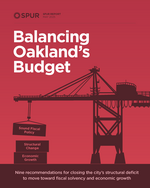
On May 1, Oakland’s interim mayor will roll out the city’s proposed 2025–2027 budget, which will look to address a $280 million projected deficit over the next two years. As Oakland navigates this moment of leadership transition, policymakers, administrators, employee unions, and community must work together to find creative ways to reduce spending and grow revenues. Although the structural budget deficit cannot be closed in this budget cycle, the city can pass a balanced budget that commits to sound financial practices, lays the foundation for reforms to Oakland’s governance structure, and builds the city’s capacity to grow economic prosperity for all Oaklanders.

Purchasing Power

SPUR Report /
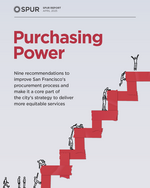
Procurement can be a powerful tool to realize San Francisco’s goals to reduce inequalities and protect the health, well-being, and financial security of its constituents. But the complicated maze of legislation and policies that govern the city’s procurement system is making it harder to reach these goals. Our newest report identifies procurement process improvements to better wield this tool for social gains.

What It Will Take to Close Oakland’s Structural Deficit, Part 2: Budget-Setting, Spending, and Revenues

News /
Oakland city leaders must close a $129 million shortfall in this year’s budget and eliminate an additional $280 million deficit projected over the next two years. Now, policymakers, administrators, employee unions, and Oaklanders must work together to reduce spending and grow revenues. To support the process, SPUR provides a primer on the city’s budget-setting process, where its revenue comes from, and how that money is spent.

What It Will Take to Close Oakland’s Structural Deficit, Part 1: How We Got Here

News /
Oakland is at a pivotal moment as city leaders work to address a significant budget shortfall of $129 million this year, with an additional $280 million projected over the next two years. Solutions to the city’s structural deficit may come from examining how past budget priorities and decisions led to current challenges.

Belonging and the Civic “We”

Urbanist Article /
Roberto Bedoya led the creation of Oakland’s cultural plan, Belonging in Oakland, framing it as a prompt that enlivens civic life, place, and belonging. In this essay, he argues that facilitating social cohesion among residents needs to be framed as a municipal goal. And cities need to invest in this goal as our social networks are changing, collapsing, and being reimagined.

Reducing the Toll of Tolls on Low-Income Drivers

News /
Research shows that low-income families benefit most from the time savings provided by toll roads — but they use these roads less than any other income group. That’s because they are disproportionately burdened by tolls. Toll discount programs like the one just established by the Metropolitan Transportation Commission will reduce the impact of tolls on low-income drivers without undermining tolls’ climate and congestion benefits.