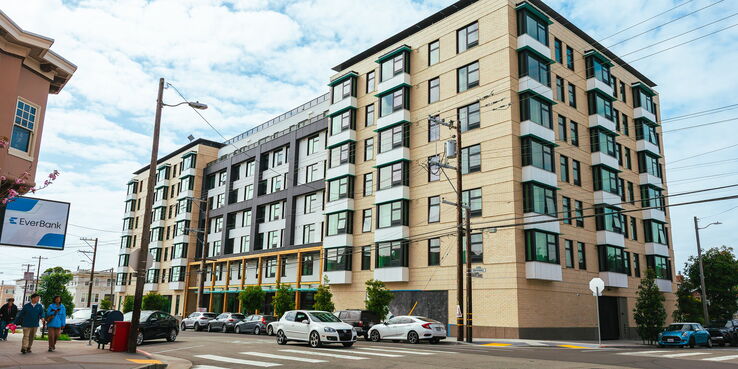
San Francisco voters spoke decisively on November 4 about housing affordability and the direction the city should take to spur housing production. Proposition C won, expanding and extending the Housing Trust Fund to help finance affordable housing across the city. Proposition J, a measure to eliminate a transfer tax exemption for certain foreclosed properties, also passed easily. Proposition I, a measure to earmark a portion of the existing transfer tax proceeds solely for affordable housing and tenant protections and strip the Board of Supervisors’ ability to amend the transfer tax, went down to defeat, with 52% of the voters rejecting it. On housing, San Francisco voters’ stance mirrored Mayor Lurie’s administration and signaled a willingness to address both affordable housing and development feasibility concerns.
Prop. C, the consensus affordable housing measure carried and crafted by Supervisor Myrna Melgar and Mayor Daniel Lurie, was the night’s biggest winner, earning 82% of the vote — support that spanned across San Francisco’s political spectrum. Prop. C was part of a broader strategy to address both the lack of affordable housing funding and the challenging environment for market-rate housing development. As SPUR recently noted, building housing is not currently financially feasible in San Francisco. As a result, a technical advisory committee of affordable housing and market-rate housing experts unanimously recommended that San Francisco realign its housing strategy to reflect economic realities and pursue a more sustainable source of affordable housing funding. To do so, the committee recommended reducing various city-imposed costs, including lowering San Francisco’s affordable housing inclusionary housing percentage and fees on market-rate development to help address skyrocketing construction costs in today’s challenging economy. Inclusionary housing percentage refers to the share of homes in a new market-rate residential development that must be set aside as affordable to lower-income households. Fees on market-rate development are payments the city requires developers to make, including fees that help fund affordable housing. Both requirements increase development costs, potentially making some housing projects financially infeasible.
The technical advisory committee also recommended pursuing a more reliable and sustainable source of additional affordable housing funding that isn’t a development fee. Because market-rate housing development was infeasible at the previous rates, virtually no affordable housing or inclusionary units were funded, so both affordable housing and market-rate housing suffered. In the past two years, San Francisco received an average of $112,615 in affordable housing inclusionary housing revenue. Given that total development costs for one affordable housing unit in San Francisco hover around $1 million, the previous inclusionary policy was not an effective way to finance affordable housing. While reducing inclusionary rates and impact fees would lower market-rate housing costs, the committee recognized that affordable housing could suffer as the economy rebounds. As a result, it recommended alternative affordable housing funding models, which resulted in Prop. C. This two-pronged strategy of reducing city-imposed costs and creating a reliable source of affordable housing funding was the big winner in 2026.
Prop. J, which eliminates a transfer tax loophole on certain foreclosed properties, won overwhelmingly with 81% of the vote. This measure’s revenue was initially a cornerstone of the Mayor’s BUILD Act, a broad plan to reduce the transfer tax for high-value properties, which was doubled in 2020. Although Prop. J moved forward, the proposal to reduce the transfer tax to stimulate housing development stalled because of concerns about its impact on the General Fund. As it stands now, Prop. J will allow the city to generate additional revenue without increasing the tax burden on families and small businesses, bolstering the city’s General Fund until the real estate market improves and foreclosure claims diminish.
SPUR recommended a “No” vote on Prop. I, and voters rejected it on Election Day. Although the measure sought to increase funding for affordable housing and tenant protections, it raised significant concerns about the city’s fiscal and policy flexibility. Prop. I would have permanently redirected more than $110 million in existing transfer tax revenue from the General Fund, reducing the funding available for other city priorities. More importantly, it would have stripped the Board of Supervisors of its authority to amend, repeal, or suspend property transfer taxes, limiting the city’s ability to respond to changing housing needs and economic conditions. Prop. I also would have tied affordable housing funding to highly volatile transfer tax revenue, making it difficult to plan for long-term construction and acquisition. SPUR supports a more stable and sustainable source of affordable housing funding while preserving the city’s ability to adjust its policies as conditions change.
What do the housing votes mean? For the most part, SPUR, like most San Franciscans, prefers a more stable source of affordable housing and favors Prop. C over Prop. I. Prop. J could generate up to $150 million annually for San Francisco’s General Fund, helping the city weather turbulent economic times or fund major policy initiatives. With Prop. J’s passage, we expect Mayor Lurie or a supervisor to renew efforts to reduce the real estate transfer tax, as proposed in the BUILD Act earlier this year.
After voters approved Prop. I in 2020, doubling the transfer tax on properties worth more than $10 million, transfer tax revenue fell to $177.7 million in FY 2023–24, its lowest level in more than a decade. Housing production also dropped by 71%, from nearly 5,000 newly constructed units in 2020 to 1,457 units completed in 2024. Although many factors contributed to these declines, the figures underscore the challenges facing San Francisco’s housing market and the need to consider how city policies affect development.
The next steps remain uncertain, but voters have sent a clear message: San Francisco needs more housing of all types, along with sustainable funding to make affordable housing possible.