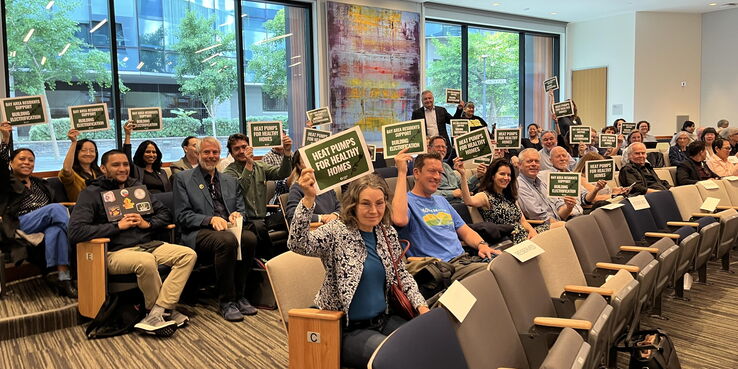
At two May meetings, the Bay Area Air District board discussed staff recommendations for exemptions to the zero-emission water-heating rules, which were adopted unanimously in March 2023 and are set to take effect in January 2027. After extensive public comment and a robust debate, a majority of board members favored directing staff to proceed with the current exemption package and an October 2027 implementation date. They will formally vote on the amendment language in October.
The water-heating rules are part of the Air District’s ambitious, first-in-the-nation effort to phase out the sale of gas appliances, a cornerstone policy aimed at reducing smog-forming nitrogen oxide (NOx) pollution, improving public health, and cutting greenhouse gas emissions in the Bay Area. The rules are expected to influence clean-air agencies across the country and expand the market for clean, high-efficiency electric heat pumps, yielding consumer savings. Residential gas prices in California surged by 70% between 2019 and 2025 and remain volatile. Every purchase of new gas appliances locks residents into decades of subsidizing gas pipeline infrastructure costs, which make up most of residential gas bills.
Although the rules include a robust exemption framework, reflecting an expansive and inclusive deliberation process, affordability concerns, amplified by realtor groups and the fossil fuel industry, have emerged. Because some Air District board members and public commenters question the viability of implementing the rules on schedule, it’s worth distinguishing legitimate concerns from misinformation and explaining how the exemption framework addresses the major barriers to implementation.
Eight Exemption Categories Could Cover More Than a Third of Annual Water Heater Installations
The proposed regulation includes several exemption categories for NOx-emitting water heaters: Applicant-based exemptions cover low-income or housing-cost-burdened homeowners (estimated at 15.8% to 17.4% of annual installations), licensed contractors using a temporary emergency loaner (gas equipment to be removed once a zero-NOx alternative can be installed), and businesses with high or specialized hot water demands. Project-level exemptions address physical and electrical constraints, insufficient ventilation space, low ceiling heights, and inadequate electrical infrastructure and require a licensed contractor to submit the application. Finally, two product categories receive extended sales windows until January 1, 2031, without requiring any application: small tanks (≤35 gallons, with 30 gallons under consideration) and hydronic heating systems, for which compliant alternatives remain costly or technically limited. Taken together, Air District staff estimate these exemptions cover up to 38% of annual water heater installations.
Water Heater Rules Exemption Framework
Exemption Category | Who Applies | Key Criteria | Notes |
Low-income property owners | Applicant (owner) | Enrolled in CARE/FERA/food stamps, or housing cost-burdened (mortgage + taxes ≥28% of income) | ~15.8% to 17.4% of annual residential installations |
Emergency replacement loaners | Licensed contractor | Pre-purchased NOx units used as temporary loaners; not permanently installed | Expected low use given rise of 120-volt plug-in units |
High hot water demand businesses | Applicant (business, self-certify) | Restaurants, laundry, healthcare/assisted living with specialized temperature needs | Self-certification |
Ventilation space constraints | Licensed contractor | <700 cubic foot space, not adjacent to larger space, no feasible duct/grille retrofit | |
Physical space constraints | Licensed contractor | Garage ceiling <7.2 feet, or non-garage ceiling <6 feet | |
Electrical constraints | Licensed contractor | Knob-and-tube wiring; panel <100 amp (SF) or <60 amp (MF); >50-foot new 240-volt run; insufficient breaker space | Any one condition qualifies |
Small tanks (≤35 gallons) | No application needed | Extended compliance date: Jan. 1, 2031 | 30-gallon threshold also under consideration |
Hydronic systems | No application needed | Extended compliance date: Jan. 1, 2031 | Compliant alternatives scarce and costly |
SPUR and our partners in the Bay Area Clean Air (BACA) coalition have been engaged in the exemption design process for more than a year, and the staff proposal directionally reflects the technical recommendations we submitted. To some rule advocates, these exemptions may appear to significantly limit the rule’s reach. But exemptions like these were always likely. The Air District established an implementation working group process specifically to identify market barriers, adapt to changing circumstances, and craft targeted responses.
Despite Broad Exemptions, The Rules Will Spur Market Transformation, Lowering Costs and Providing Widespread Health Benefits
Even if only half of Bay Area residents who need to replace water heaters in 2027–2028 end up installing a zero-emission heat pump, a course toward full decarbonization of heating would be set. Because the water-heating regulations create demand for heat pump water heaters, they are destined to spur a market transformation. Heat pump water heaters currently represent just 3% of the Bay Area’s water-heating appliance market share. Even a modest uptake in the rule’s first year would represent a 10-fold increase in the appliances’ previous market share and would drive economies of scale, workforce education and knowledge, policy adaptations, and technology innovation, all of which can help bring costs down.
What about the concern that low-income residents who leverage exemptions and remain on gas may face disproportionate health outcomes? As Air District staff have outlined in their regulatory overview, roughly 60% of pollutant exposure linked to gas water heaters results from secondary formation driven by NOx emissions. In other word, because the pollutant (called PM2.5) forms regionally, rather than near the source, even homes that receive exemptions under flexibility amendments would still benefit from broader air quality improvements across the Bay Area.
Exemptions Are Designed to Address Affordability Concerns
Opposition to the water-heating rules typically focuses on affordability challenges for exactly the categories of residents who would be exempted under the proposed framework.
The concern most frequently raised is that many families cannot afford the upfront cost of a heat pump water heater. The Air District estimates that these electric appliances cost roughly twice as much as a typical gas water heater. That gap is real and is the reason staff developed deep income-based exemptions: any resident who is housing cost-burdened or below 250% of the federal poverty level can continue purchasing gas equipment under the current proposal.
But what about middle-income residents? Project-based exemptions address the scenarios most likely to drive high costs for this group. Tricky spatial configurations and electrical infrastructure constraints are the primary culprits behind expensive installations — if projects that qualify for those exemptions are filtered out, the average cost of the remaining projects is likely to be much lower than headline estimates suggest.
For those who do make the switch, stacked rebates, direct-install programs, financing options, and concierge services are available. In a forthcoming analysis SPUR is conducting, we’ve found at least 108 active heat pump incentives or heat pump adder incentives (incentives for other home improvements that support heat pump installations) across the Bay Area. An analysis we conducted last December found that, even with the expiration of the TECH Clean California program rebates, residents can stack local rebates with Golden State Rebate vouchers and keep the net cost of a heat pump to between $1,000 and $2,000 more than a gas water heater, significantly less than the additional $3,546 average incremental cost without incentives. Perhaps even more significant are the operational savings residents stand to benefit from: heat pumps can pay for themselves over time. With gas delivery costs escalating at an unsustainable rate, the benefits of getting off the gas system will only rise.
The most persistent and outdated concern is the need to upgrade home electrical panels and service lines, a process that can double or even triple a project’s cost in the most challenging cases. But this scenario is far less common than the opposition suggests. A Lawrence Berkeley National Laboratory analysis of the TECH Clean California program data found that 96% of homes with 100-amp panels can add a heat pump water heater without upgrading the panel. Perhaps most definitively, among nearly 30,000 TECH incentive-financed heat pump installations, only 3% required a panel upgrade. The rapid growth of 120-volt plug-in heat pump water heaters, which require no new 240-volt circuit, has further reduced this barrier. And where electrical constraints are genuine, the proposed framework includes specific exemptions.
Nevertheless, panel upgrade costs remain front and center in arguments that the water-heating rules are coming too fast. The gap between what the installation data show and what the public debate assumes is significant, and narrowing it is an important part of building confidence in implementation.
Getting Exemptions Will Be Fairly Easy, and the Process Could Provide Data for Removing Installation Barriers
SPUR and our coalition partners have recommended a low-touch approach to exemption implementation: simple attestation forms (where residents sign a form attesting to meeting the qualifications for an exemption), automatic online issuance of waivers, and minimal verification burdens, particularly for income-qualified residents. The Air District’s proposal moves in this direction, and agency staff have committed to an online system designed for nearly instant waiver issuance. There’s still room for improvement: requiring documentation of housing cost burden, for example, adds friction that could deter eligible households. The goal should be an exemption process that genuinely functions well for those who need it.
The Air District should use the exemption process as an opportunity to collect data. Each waiver documents a real installation barrier; over time, that record can inform the progressive tightening of exemption criteria as the market develops. One of the most valuable services a well-designed exemption framework can provide is the flexibility to adjust to a changing market while keeping the transition to clean heating on track.
A Public Education Program Must Roll Out Soon to Allay Misperceptions
While the Air District has conducted an extensive public engagement process with key stakeholders, it has yet to broadly advertise the rules to the public. A planned public education campaign awaits greater certainty about the exemptions. However, the widespread misinformation and general risk of public misperceptions about the rules require much faster action. The Air District should launch its public education campaign now, not in October, when exemptions will be voted on by the board.
SPUR Recommends Some Adjustments to the Proposed Exemptions and a More Coordinated Regional Rebate Program
The Air District should make some adjustments to the exemptions:
- An alternative compliance pathway should be developed for deed-restricted affordable housing, because this class of housing relies on tight public funding cycles and typically conducts bulk retrofits for multifamily properties.
- Some of the exemptions related to electrical infrastructure provide too much leeway in cases where rewiring or panel space acts as a barrier. Because 120-volt heat pumps and simple panel optimization strategies are low-cost options, only more extreme panel space and wiring constraints should qualify for exemptions.
Additionally, the Air District should also work with community choice aggregators, BayREN, PG&E, and state regulators to develop a more coordinated regional rebate program. The district’s May board meetings reflected genuine confusion about what incentives are available and where gaps exist. This confusion remains one of the largest drags on both political support and confidence in implementation. While money is flowing into the Bay Area to support residents, the programmatic landscape remains fragmented, and rebates are unevenly distributed across the Bay Area. Regional agencies must take the lead in developing consistent approaches to rebates and financing across all nine counties.
Imperfections in the incentive landscape and exemption package cannot justify backsliding after six years of deliberate rulemaking and development of a carefully tailored exemption framework. The choice is not whether to implement clean water-heating rules. It is what additional solutions are needed to make the rules’ rollout as successful and equitable as possible.
For SPUR’s full body of work on building decarbonization, visit the Sustainability and Resilience section of our website.