On May 26, organizers for the Connect Bay Area campaign submitted more than 300,000 signatures to county election officials in Alameda, Contra Costa, San Francisco, San Mateo, and Santa Clara counties. The tally far exceeds the 186,000 valid signatures required for the measure to qualify as a citizen initiative, and organizers are confident it will be on the ballot in November 2026. That means that in a few months, residents in the Bay Area’s southernmost five counties will decide whether to approve a 14-year sales tax that would provide critical funding support to BART, Muni, Caltrain, and AC Transit, which are at risk of severe service cuts, reduced hours and frequencies, route and station eliminations, and weekend service suspensions. The measure would also provide similar, albeit significantly smaller, flows of relief funding to support some of the Bay Area’s smaller transit operators, such as County Connection, the Livermore Amador Valley Transit Authority, and the San Francisco Bay Ferry. Importantly, these agencies do have operating needs but are not facing an immediate “fiscal cliff” that jeopardizes their ability to maintain service.
In addition to staving off transit cuts through operational support, the Connect Bay Area Act would invest in expanding and improving transit in the region. Approximately $50 million per year (just under 5% of the estimated total) would go directly to the Metropolitan Transportation Commission (MTC) for administration and investment in regional transit coordination and integration efforts overseen by the regional network management structure. Another $330 million per year (33% of the total) would flow back to individual counties, where it can be used for a range of transit purposes, including sustaining and expanding local transit service, investing in transit capital projects, or repaving roads where transit operates. These “return to source” funds are particularly important in Santa Clara and San Mateo counties.
The Connect Bay Area Expenditure Plan and Return-to-Source Funds
The overall expenditure plan for the Connect Bay Area measure was mandated by Senate Bill 63 (Weiner, Arreguín) and addresses the complex challenge of balancing differing levels of transit usage and sales tax generation across a large, multi-county region. It was developed to be fair to all five participating counties by aligning the expenditure of funds with the relative usage of transit in each county and each county’s total sales tax generation. Said another way, if the measure passes, funds collected within a county would first go to the costs of administering the measure and regional integration programs, and then to cover the county’s share of regional transit deficits, which were determined proportionally to residents’ use of those services. Once these obligations are satisfied, any remaining revenue would be returned to the county of origin as return-to-source funds to invest in local public transit improvements and expansion.
In practice, this approach resulted in an expenditure plan that is fair to all but looks quite different from county to county, because the geography and tax bases of the five counties included in the measure do not entirely align with where large transit systems operate or with how county residents use and consume transit. San Francisco, for example, is at the center of the region’s transit network and is served by Muni, BART, AC Transit, and Caltrain, the four agencies facing the largest deficits. Consequently, San Francisco residents tend to be major consumers of transit service, and the SB 63 expenditure plan also assigns them a proportionally large share of operator deficits to cover, which is why the sales tax rate for San Francisco is set to a full cent in the measure rather than the ½-cent levy in other counties. San Francisco would receive no return-to-source funds because all revenue generated in the county would be used to offset transit deficits. Alameda and Contra Costa counties, similarly, are served by several transit agencies with significant financial needs and would see the majority of funds generated within their jurisdictions go toward supporting and sustaining transit operations, with relatively smaller amounts of funding returning to them each year for use on local transit priorities.
The situation in Santa Clara and San Mateo counties is different. Santa Clara County is the most populous county in the Bay Area and has a correspondingly large sales tax base (generating upward of $300 million annually from a ½-cent rate). But while Santa Clara County is served by both Caltrain and BART, the latter system operates only in a small portion of the county and is covered by a prior agreement with the Santa Clara Valley Transportation Authority (VTA) that already addresses operational deficits through a separate funding mechanism. Further, the voters of Santa Clara County have already approved multiple sales taxes; those revenues are used for capital projects as well as for the majority of VTA’s operating expenditures. The net result is that Santa Clara County would receive significant return-to-source funds after funding its share of regional programs and covering its portion of Caltrain’s projected deficit. Similarly, while much of the funding generated in San Mateo County would cover its residents’ use of Caltrain, BART, and Muni (which provides significant service into the north of the county) the county would also receive a significant amount of return-to-source funds.
Connect Bay Area Expenditures by Category
If the regional transit ballot measure passes, revenues collected by the taxing district would be distributed to transit operators and county authorities across the five counties according to the SB 63 expenditure plan. In practice, the results will look different from county to county. In San Francisco, all revenue would be used to offset significant transit deficits. Other counties would receive varying levels of “return to source” funds to invest in local public transit improvements and expansion.
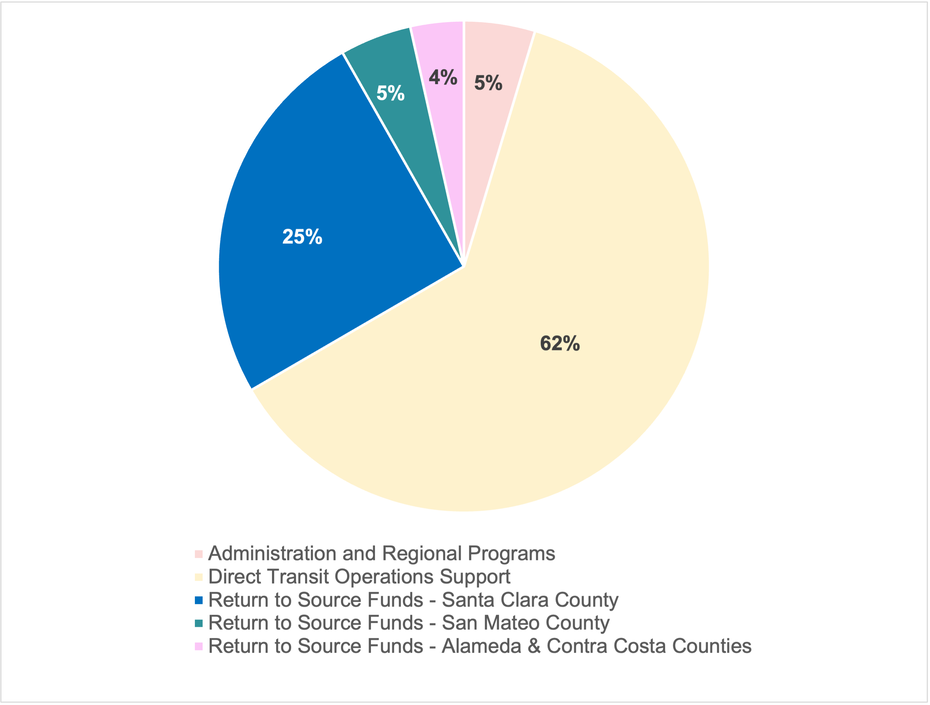
Source: Senate Bill 63 (Weiner, Arreguín)
Investment Frameworks in Santa Clara and San Mateo Counties
Since SB 63 became law in January, officials at VTA in Santa Clara County and the San Mateo County Transit District (SamTrans) in San Mateo County have been working to develop their own local expenditure plans that show how they would use the return-to-source funds that would flow to them if the Connect Bay Area measure passes. Staff from both entities solicited extensive feedback from cities and stakeholders in their respective counties, and both boards recently adopted local expenditure plan frameworks outlining how new funding would be invested.
If voters approve the Connect Bay Area measure in November, Santa Clara and San Mateo counties could see substantial improvements in and expansions of their local transit systems.
Approximately $264 million annually, or about 85% of all funds generated in Santa Clara County, would return to VTA for investment through its local investment framework. (The remaining 15% of funds generated within the county would cover Santa Clara’s share of administration and regional programs as well as VTA’s agreed share of Caltrain’s projected deficit.) Throughout the development of the local investment framework, several VTA Board members emphasized the importance of investing funds in ways that help the VTA system increase ridership, improve productivity, and enhance financial sustainability. This focus led to development of an investment framework that groups potential expenditures into three broad categories:
- Foundation: Make pothole repairs and bus stop improvements and provide basic operations support to sustain and improve existing transit services and facilities.
- Reimagine: Enhance the service VTA provides by implementing transit signal priority to speed buses and trains, expanding service to deliver VTA’s Visionary Network, and introducing new fare products and discounts to expand access for students and others.
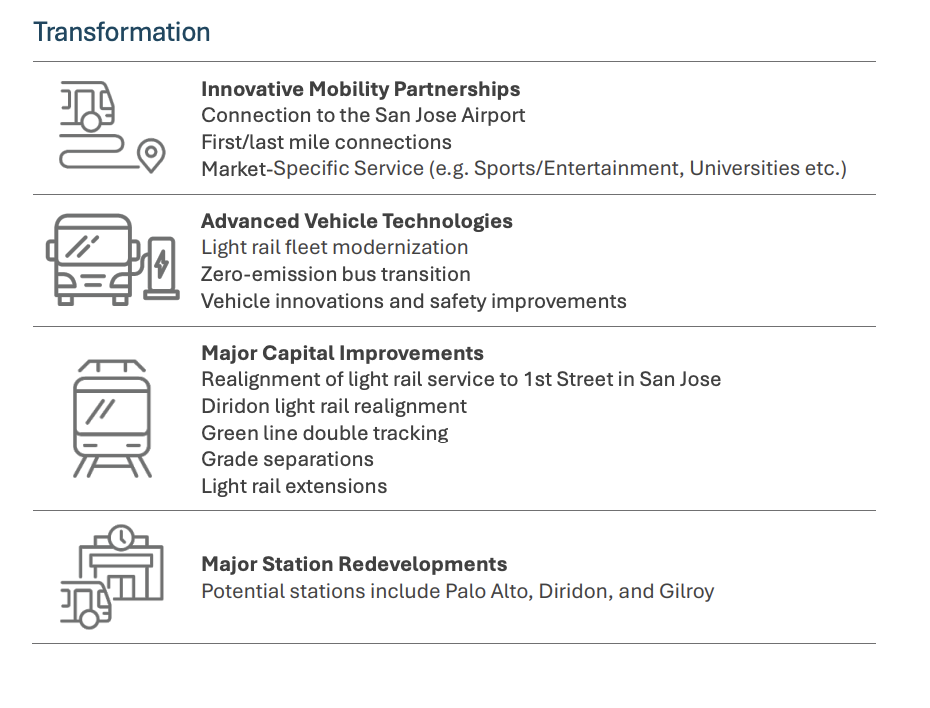
- Transform: Invest in new technologies, service models, and capital expansions, including a new zero-emission fleet and new light-rail vehicles, as well as innovative technologies and partnerships for first- and last-mile connections, and in major capital projects such as grade separations and station redevelopments.
VTA’s Local Investment Framework
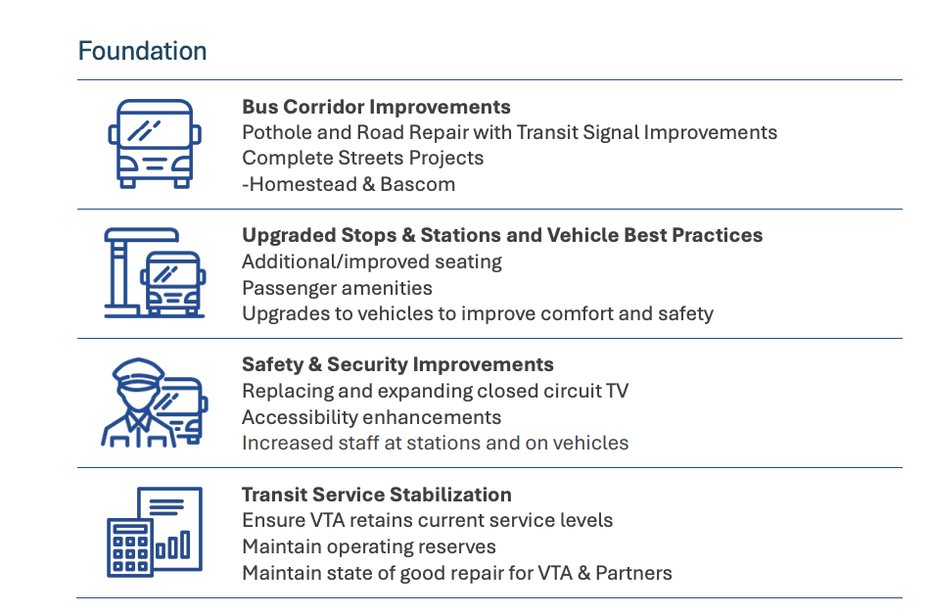
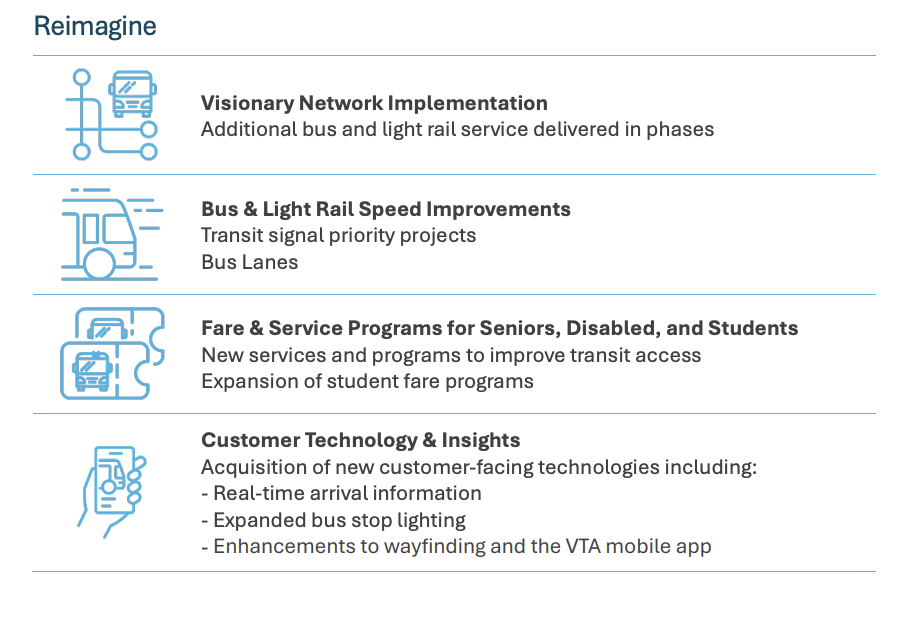
Source: Santa Clara Valley Transportation Authority
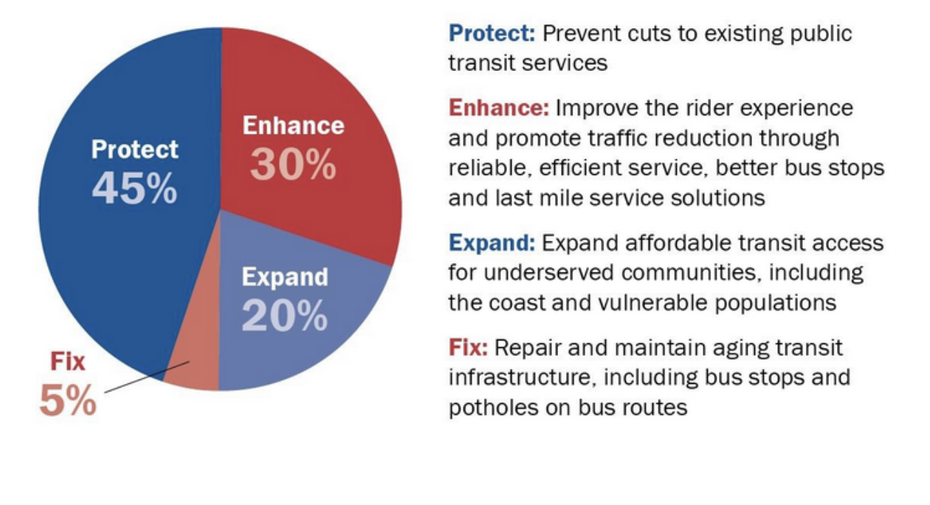
In San Mateo County, SamTrans would receive approximately $50 million annually or about 37% of all Connect Bay Area funds generated in the county; the other 63% of funds would cover San Mateo’s share of administration and regional programs as well as agreed-to levels of operating support for Caltrain, BART, and Muni (which is used extensively by San Mateo residents). SamTrans’ approach to developing a local investment plan is similar to VTA’s, but the agency-defined expenditure categories differ and also include percentages by category over the life of the Connect Bay Area measure.
- Protect (45%): Prevent cuts to existing public transit services.
- Enhance (30%): Improve the rider experience by increasing reliability, improving bus stops, and expanding last-mile services.
- Expand (20%): Expand affordable access for underserved communities, including the coast and vulnerable populations, through new services and programs.
- Fix (5%): Repair and maintain aging transit infrastructure, including potholes on bus routes.
SamTrans’ Local Investment Plan
Source: San Mateo County Transit District (SamTrans)
Financial Accountability and Efficiency
Although the local investment plans are now codified in the frameworks adopted by the VTA and SamTrans boards, each board still has flexibility to determine how to allocate funds to projects and service within each of the specified categories. Consequently, both VTA and SamTrans have mapped out processes for allocating funds to specific projects and for managing and updating investment choices.
In Santa Clara County, the VTA Board, as mentioned earlier, has emphasized that any new funds from a regional measure should be invested to improve the overall health of the transit system. In consideration of this goal, staff developed a preliminary analysis that scored all of the framework’s potential investments based on their potential to achieve these objectives. VTA has indicated that performance measures will be refined and tracked to serve as the basis for a four-year rolling process for prioritizing and allocating funds to specific projects. In adopting the framework at its June meeting, the board directed staff to return with a more detailed analysis of performance measures and to begin work on an independent financial efficiency and sustainability plan (similar to the one SB 63 mandated for BART, Muni, Caltrain, and AC Transit) that identifies strategies to improve productivity, reduce operating costs, and sustain existing and expanded service levels over the life of the measure while reducing reliance on future tax increases or renewals.
In San Mateo, SamTrans has indicated that it will develop a shortlist of near-term, deliverable, and publicly visible projects to prioritize for funding should the Connect Bay Area measure pass and that it will reassess the relative balance of categories in its local investment plan every three years. Like VTA, SamTrans has committed to identifying new efficiencies and working toward long-term financial sustainability, declaring that it will undergo “a public and transparent process to prioritize cost containment, revenue generation, accountability and efficiency in operations with the goal of fiscal stability” by the end of the measure’s 14-year term.
SPUR Advocacy
SPUR is co-leading the Connect Bay Area campaign and actively encouraged San Mateo and Santa Clara counties to participate in the Connect Bay Area ballot measure during the development of the authorizing legislation. As a result, these counties are poised to generate funds to sustain regional services such as BART and Caltrain and to collect new funding to improve their own local transit systems. By adopting frameworks for how these return-to-source funds would be used in each county. In doing so, the agencies have shown their riders and residents the kinds of improvements they can expect if the Connect Bay Area measure passes.