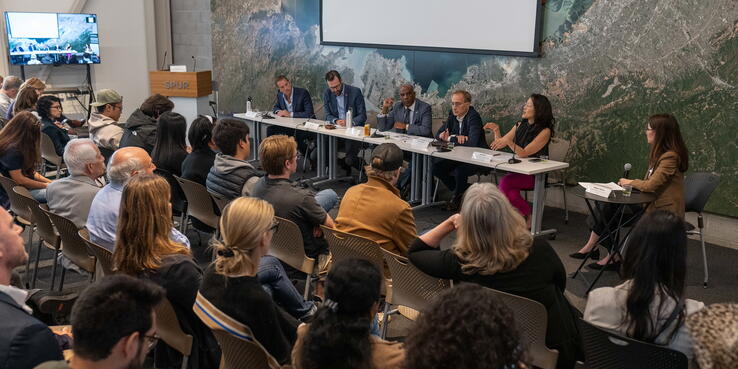
Few statewide elections stand to matter more this year than the race for California’s insurance commissioner, the primary official tasked with stabilizing a home insurance market that has been upended by climate change and wildfires. This race isn’t just a bureaucratic down-ballot election; it affects the cost of living, disaster resilience, and where Californians will build, buy, and rent homes. As a recent Terner Center report explored, homeowners who are low-income, Black, Hispanic, or living in mobile homes are most likely to be uninsured, and low-income Californians are being pushed further into suburban and rural areas that have higher wildfire risk. The insurance crisis is not just an issue for single-family homeowners — it also threatens the solvency of affordable housing providers with already-thin margins as well as rising insurance rates and limited coverage. SPUR co-hosted a candidate forum with insurance brokerage startup Rhino on April 9. (Watch the forum here.) The San Francisco Chronicle’s Megan Munce moderated the discussion.
How is fire risk shaping the insurance landscape?
In January, SPUR released Shared Risk, Shared Resilience, which provides recommendations to improve community-scale wildfire resilience and insurability in California. As SPUR’s report details, growing losses from fires in California have increased pressure on insurance companies to be selective in their underwriting: 7 of the 12 largest home insurance companies in California have limited their coverage since 2022, forcing many homeowners onto the state insurer of last resort, the FAIR plan. Because that plan only covers fire, homeowners must layer it with a privately issued difference-in-conditions policy to "fill the gaps," adding coverage for perils like theft, water damage, and liability to mimic a standard homeowner’s policy. The FAIR plan was designed as a temporary backstop in 1968 to provide coverage for high-risk properties unable to obtain private insurance, but in recent years, growing climate risk has driven enrollment up by more than 400%, from roughly 124,000 policies in 2019 to more than 645,000 by late 2025.
In the Bay Area, Contra Costa and Sonoma counties experienced the most dramatic increases in FAIR plan enrollment, with policy counts growing by 612% and 563%, respectively, suggesting significant withdrawals from the private insurance market and underinsurance in these high-risk areas. This development has led to excessive risk concentration and instability. After the Los Angeles fires in January 2025, the FAIR plan required a $1 billion bailout from private insurers to pay out claims, and the California Department of Insurance (CDI) is currently reviewing a proposed 35.8% rate hike for residential policies.
Implementing many of SPUR’s recommendations in Shared Risk, Shared Resilience will require strong leadership from the CDI, the state’s consumer protection agency, which is tasked with regulating home, auto, life, health, and workers’ insurance policies and reviewing rate changes. The next insurance commissioner will lead the CDI and will be tasked with incentivizing private insurance companies to re-enter the California market while ensuring transparency and accountability, reducing wildfire risk, and protecting affordability for Californians.
What does the insurance commissioner do?
The California insurance commissioner oversees one of the world’s largest insurance markets and has broad authority through Proposition 103 to enforce existing regulations, establish new rules, and partner with the State Legislature to sponsor laws to create new solutions and expand CDI authority where necessary. The commissioner is charged with safeguarding affordability by upholding the protections under Proposition 103 and reviewing insurers’ inputs and estimates, including those from newly allowed catastrophe models, during rate approval requests to ensure that rates are adequate and fair. The commissioner can also establish guardrails for geographic pullbacks and non-renewals, thereby protecting communities from destabilizing market withdrawals, as seen in the last decade.
As SPUR explores in its report, the insurance commissioner is increasingly responsible for ensuring that risk mitigation efforts, such as home hardening and defensible space or “Zone Zero” landscaping, at the individual and community levels translate into meaningful access to coverage and fair pricing. These mitigation efforts are a crucial piece of the puzzle: as homeowners invest money in retrofitting homes and changing their landscapes and backyards, Californians want to know that their efforts to reduce fire risk will be rewarded by insurers, as they have been in Colorado through House Bill 1182.
Who are the candidates for insurance commissioner?
About a dozen candidates are officially running, though not all of them have active campaigns. Five candidates accepted an invitation to join SPUR for a conversation on April 9. Each candidate attempted to differentiate themselves in an unusually crowded field, sharing priorities and plans and occasionally pointing fingers. Here’s what we learned about them:
Ben Allen (Democrat): Allen is a third-term Democratic state senator who represents the Palisades fire zone and has authored bills to provide tax relief to fire victims, raise payments and simplify the process for personal property losses, and require penalties if companies don’t meet deadlines for claims payments. He led the effort for Proposition 4, the $10 billion climate bond that provides money for climate resilience, including wildfire prevention. He also previously authored a bill to form a Resilient Rebuilding Authority in Los Angeles, which would have centralized government efforts and leveraged economies of scale in rebuilding. This year, he is authoring a bill to establish a low-interest loan program to provide financial assistance for home hardening and defensible space implementation.
Allen advocates restricting new construction in high-risk zones, focusing on community-wide fire risk reduction for existing homes, and pushing insurance companies to better support customers by interrogating their business practices. Allen supports taxpayer incentives and other financing mechanisms for home hardening, but says, “We can’t have the public bear all the cost here; there has to be a role here for some of these folks to play in reducing our risk, including the fossil fuel industry.” He hopes to invest in CDI staffing and digital infrastructure to efficiently handle rate requests, consumer complaints, and disaster claims, including by creating a consumer advocate who will report directly to the insurance commissioner. Allen has also called for a ban on commissioners and top staff working in the insurance industry after leaving office. Allen is endorsed by senators Adam Schiff and Alex Padilla, more than two dozen state lawmakers (including Jesse Arreguin, Scott Wiener, and Speaker Robert Rivas), California Environmental Voters, the Sierra Club, the California Federation of Teachers, California YIMBY, the Sierra Club, professional firefighters and auto worker unions, and Dave Jones, a former insurance commissioner.
Steven Bradford (Democrat): Bradford is a former state assemblymember and senator from Southern California and a former executive at the utility company Southern California Edison. As a state representative, he authored laws protecting taxpayers from the outstanding bond debt of certain public power plants and holding utilities accountable for spending, requiring electric and gas corporations to report when funds for maintenance or safety are redirected to other purposes. He created the Family Electric Rate Assistance Program, which provides bill assistance for middle-income households.
“I think insurance companies need to be at the table when we’re talking about developing and planning for communities,” Bradford said. “That will ensure that they provide coverage if they’re at the table saying, ‘Here’s what we need to do.’ So we have to have clear standards on building infrastructure, which we don’t have in California.” He supports a voluntary buyout program to encourage people to move away from high-risk areas, citing potential funding from the CDI’s California Organized Investment Network, which is backed by the insurance industry and invests in underserved communities. Bradford has advocated for the department to approve rate adjustments more quickly and for insurance companies to be more transparent in their rate-making. He also supports the creation of a public–private partnership that shares risk with insurance companies to retain insurers in the market and keep rates stable. Bradford is endorsed by U.S. representatives Adam Gray and Luz Rivas, State Treasurer Fiona Ma, Secretary of State Shirley Weber, state representatives (including reps-turned-mayors Barbara Lee and Karen Bass), and assemblymembers Weber and Carrillo, as well as Teamsters California, the State Building and Construction Trades Council of California, the California State Association of Electrical Workers, and other labor groups.
Jane Kim (Democrat): Kim, an attorney, is a former San Francisco supervisor, California director for the Working Families Party, and California political director for Bernie 2020. Kim has the most aggressive and ambitious platform, advocating for a state-run insurance program with guaranteed coverage. “People don’t actually lower their prices just because there’s more competition,” she said. “They all roughly hover in the same area, and actually, without regulation, without protection for consumers, corporations don’t look out for you. They actually raise rates as high as they can and cancel your coverage, which is why we have to build an alternative, a single-payer home disaster insurance program...where the state actually uses premiums to invest in fire and flood prevention.”
Kim is also running to create a Medicare-for-kids plan to guarantee healthcare for every child in California, as well as a public option for auto insurance. The CDI does not oversee managed health care plans, but Kim believes all insurance regulatory authority should be centralized within the CDI. Kim has said she wants to freeze rates after policyholders file a claim, penalize delays to speed up payments, and create a public dashboard of insurer performance. She also wants to extend the advance notice period for home insurance nonrenewal or major policy changes from 75 days to 6 months. Kim is endorsed by Bernie Sanders, United Farm Workers Co-founder Dolores Huerta, U.S. Representative Ro Khanna, several state elected officials, the Working Families Party, the California Teachers Association, the Service Employees International Union California, the National Union of Healthcare Workers, the California Young Democrats, and other labor unions.
Merritt Farren (Republican):Farren is a former Amazon and Disney executive who lost his home in the Palisades fire in 2025 and became a public intervenor, pushing for more information on State Farm’s request to raise its rates as a result of the fires. He spoke at length about his legal experience working for Disney and Amazon, drawing parallels with how the state should simplify the process of regulating and buying insurance and create new tech jobs that could spur market innovation. He proposes charging insurers a fee to create a state-backed public reinsurance program, CAL Reinsure, which would replace the FAIR plan and be modeled on Florida’s hurricane catastrophe fund. In his opening statement, Farren criticized Allen for failing to address the insurance crisis while he was in the legislature, saying, “Here’s where I differ from you, Ben. I think you have been in a position to fix the problems that have accumulated for many, many years, and you have not managed to do so. That’s not on you, you’re from an entire party that has failed to do so.” He also criticized the current commissioner, Ricardo Lara, stating that many of the solutions don’t need the legislature at all — they could be achieved through effective leadership and quicker decision-making.
Patrick Wolff (Democrat):Wolff is a financial analyst, having worked in the 2000s building a home and auto insurance brokerage for a bank and obtaining his insurance license. His main focus would be restoring the office’s credibility and making it work better for consumers, for example, by adhering to the 60-day timeframe for approving rate change requests and releasing a claims performance report card for each insurer so consumers can better understand companies’ behavior. Wolff wants to address underinsurance by quantifying the gap between insurers’ replacement-cost estimates and the likely actual replacement cost that’s based on CDI data and by requiring companies to offer consumers the option to purchase sufficient coverage to close this gap.
At the SPUR forum, he pulled out a copy of the California Earthquake Authority’s recently released Catastrophe Resilience Study, which was required under Senate Bill 254 (2025) to explore the economic and insurance consequences of the climate crisis and make recommendations for the state to improve resilience and insurability. “I have noticed over the years that there is a disease in Sacramento, that Sacramento tends to think the way to get an outcome is to mandate it,” Wolff stated. “That’s not true…what you have to do is actually create the conditions and align incentives. The Department of Insurance shouldn’t be mandating things for homeowners; they should be mandating insurers that, as a condition for coming into California, ‘you have to tell us what you’re going to recognize, you have to provide significant, meaningful discounts for those, and we’ll pass that information along to the homeowners.’”
Wolff wants to use AI to improve transparency on insurance policies by creating a dedicated task force to study how technology can help consumers. He is endorsed by the San Francisco Chronicle Editorial Board, the Los Angeles Daily News, the Daily Bulletin, and other media outlets and by several neighborhood Democratic clubs.
The two candidates who receive the most votes in June’s primary will move on to the November ballot.
Watch a recording of the forum