Welcome to the June 2026 election season! Every election, the ballots Bay Area voters cast represent decisions that shape their daily lives and the future of their communities. This year, there's a lot at stake in both the June 2 primary election and the general election on November 3. The measures on the ballot will touch critical issues from emergency infrastructure funding and support for small businesses to city governance and the future of Bay Area transit.
But voting is not always straightforward, especially when it comes to ballot measures. Measures are drafted in dense legal language, competing arguments can sound equally persuasive, and it's difficult to know whose analysis to trust. On top of that, San Francisco voters in particular face a longer ballot than most Californians, often weighing in on more than a dozen initiatives in a single election, many of them highly technical, a challenge we discuss in our report Charter for Change.
This is why before every election, SPUR takes several months to dig deep into local and state ballot measures that impact the Bay Area and San Francisco, San José, and Oakland, specifically. The result is the SPUR Voter Guide, our plain-language analysis covering the backstory and equity impacts behind each measure, the arguments for and against it, and a clear recommendation on how to vote.
Our goal is to give you the research and analysis you need to make a confident decision. We focus on measures tied to our core policy areas: housing and planning, transportation, sustainability and resilience, economic justice, and governance.
How We Do Our Analysis
SPUR policy staffers start the process by reviewing city, county, and state records, relevant articles and arguments, and the official language posted on the county and state election websites. We interview the people advocating for and against the measures to better understand the pros and cons.
Because SPUR has been making policy recommendations for over a hundred years — and producing a voter guide for over 50 — we don't just look at this election in isolation. Instead we draw on our archive of past research to understand how today's proposals connect to past decisions, including what worked, what didn't, and what we've learned along the way.
Recommendations aren't made by staff alone. For state measures, a committee of SPUR board members reviews the research, hears directly from proponents and opponents, debates the merits, and votes. For city measures, SPUR's advisory boards in San Francisco, San José, and Oakland go through the same process, and their recommendations are then confirmed by the full SPUR Board of Directors. It's a thorough, multi-layered process designed to keep our analysis honest and grounded.
How to Use This Guide
Think of the SPUR Voter Guide as one voice in a broader conversation. We encourage you to weigh our analysis alongside recommendations from other organizations you respect, including your neighborhood association, your union, democratic clubs, or other civic or advocacy groups you follow. Democracy works best when voters engage with multiple perspectives and arrive at their own conclusions.
If you want to go deeper, join us for one of our upcoming Ballots and Brews events, where we will present our analysis on the June measures. You can ask questions, hear from SPUR policy staff, and talk through the measures with fellow voters over a drink.
Ballots and Brews Events
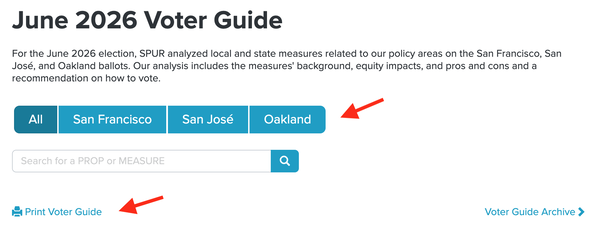
Can't make it to Ballots and Brews? You can host your own voter education event. Invite friends over to share notes and voter guides from different sources. You can download and print the SPUR Voter Guide for your guests by selecting your city and then “Print Voter Guide” at the top of the page:
We’re grateful to the policy experts and measure proponents and opponents who met with us, and to the SPUR Board of Directors and City Advisory Boards for their contributions to this election’s guide. We have already begun our research for the November election and look forward to bringing you the next SPUR Voter Guide in early October.