What Prop. F Would Do
Proposition F would expand the mayor’s authority by changing how executive branch departments are managed and how appointed commissioners are removed.
Department head appointment and removal. Currently, the city charter provides several paths to appoint and remove department heads, leaving the mayor with authority over only a handful. Boards or commissions play a role in appointing or removing many department heads, and some require Board of Supervisors approval. The measure would give the mayor sole authority to directly appoint and remove most executive branch department heads. It would not change processes for appointing or removing department heads outside the executive branch.
Department oversight and supervision. The charter requires the mayor to directly supervise all executive branch departments and prohibits using deputy mayors or comparable roles. The measure would remove these prohibitions, permitting the mayor to establish reporting relationships and delegate supervision to others, including deputy mayors.
Executive branch reorganization. Currently, the mayor may reorganize only departments that were created by ordinance, subject to rejection by the Board of Supervisors. To change departments, powers, and duties established in the city charter, voters generally must approve the change at the ballot box. The measure would authorize the mayor to reorganize most charter-created executive branch departments, including by transferring (but not modifying or eliminating) functions among departments, consolidating departments, and transferring functions across departments, subject to rejection by the Board of Supervisors within 60 days. Exemptions from this authority would include those departments headed by elected officials, the independent Elections and Ethics Commissions, most city enterprise departments, and the controller and city administrator.
Appointed commissioner removal. Currently, the mayor, Board of Supervisors, and other elected officials appoint members of boards and commissions established in the charter. Most serve fixed terms and may be removed only for cause through a charter-defined process. The measure would establish most commissioners as at-will appointments by their appointing authorities (typically the mayor or Board of Supervisors). Independent oversight bodies, including the Ethics Commission, Civil Service Commission, and Board of Appeals, would be exempt.
The Backstory
Although the charter establishes the mayor as San Francisco’s chief executive officer, it limits the mayor’s executive authority in critical ways. The mayor currently directly appoints and removes only 6% of department heads, often sharing these powers with commissions, the Board of Supervisors, or others.1 The charter requires the mayor to directly supervise more than 50 executive branch department heads and prohibits deputy mayors or comparable roles in the Mayor’s Office.2
By contrast, comparable city governments generally give chief executives broader authority to appoint senior management, structure operations, and hold department leaders accountable.3 Increasing the mayor’s authority to hire and fire department heads and establish management structures used in other large cities could improve city operations and strengthen accountability to voters.
Unusually, San Francisco’s charter prescribes the city’s organizational structure and procedures. About 90% of city departments are established in the charter, compared with 49% in Los Angeles, 41% in Denver, and 24% in Seattle.4 Consequently, voters must approve relatively minor organizational changes. SPUR and the Controller’s Office have recommended moving many departments and procedures into the administrative code, where they could be amended legislatively.
Peer City Comparison: Proportion of Departments in the City Charter
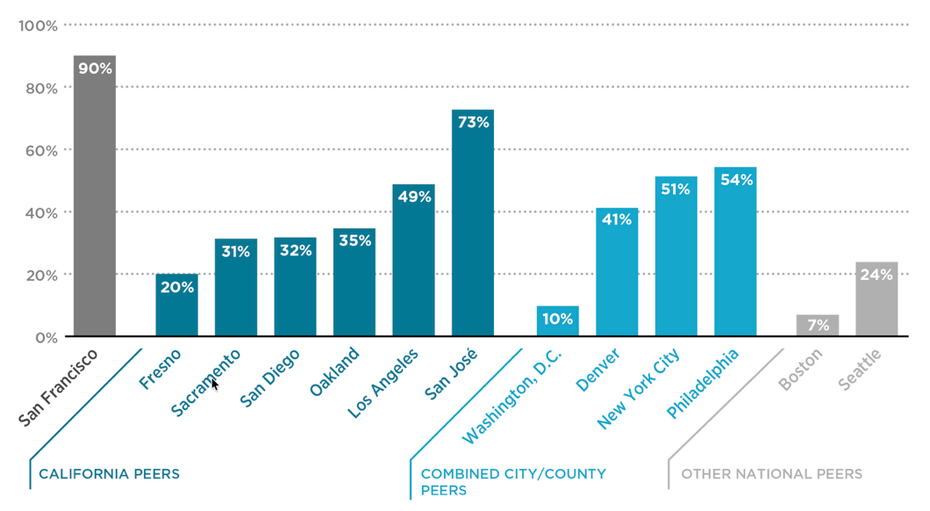
Source: San Francisco Controller’s Office, Charter Reform Working Group: Summary and Analysis, April 2026, p. 36.
Prop. F takes a different approach. It would allow the mayor to reorganize charter departments or responsibilities after notifying the Board of Supervisors, with changes taking effect unless the board rejects them within 60 days. A similar process already applies to functions established outside the charter.
The proposal comes amid national debate over executive authority, underscoring the importance of checks and balances. San Francisco currently distributes oversight among the Board of Supervisors, commissions, the controller, city administrator, other elected officials, and voters.
Prop. F would preserve many of these relationships while modifying others. Core independent offices, including the Ethics and Elections commissions, Controller, City Administrator, Human Resources Director, City Attorney, and District Attorney, would remain exempt. Commissions would have less authority to appoint and remove department heads, while some organizational decisions that now require voter approval would shift to the mayor, subject to board rejection.
Mayor Lurie proposed the measure, and it qualified for the ballot through a voter signature initiative. It requires a simple majority (50% plus one vote) to pass.
Equity Impacts
Prop. F could have mixed equity impacts. A mayor with greater authority to reorganize departments and manage executive leadership may be better positioned to coordinate services that disproportionately affect historically underserved communities, particularly when multiple departments must work together on issues such as homelessness, behavioral health, housing, public safety, and economic development. At the same time, reducing commission involvement in department head appointments and removals may lessen opportunities for public participation, particularly for vulnerable communities that lack informal political access.
Pros
- Removing constraints on the Mayor’s Office in managing a large and complex government would improve cross-departmental coordination.
- Giving an elected citywide leader more authority would give voters a clearer sense of who is responsible for executive branch performance.
- San Francisco’s executive structure would be more closely aligned with governance models used in other major cities while preserving key independent oversight agencies and functions.
- Reorganizing city government as needs change would become less reliant on voter-adopted charter amendments.
Cons
- Concentrating more authority in the Mayor’s Office would increase the risk of misuse or abuse by an ineffective or unprincipled mayor.
- Mayors could exercise broader organizational authority in ways that some communities or policymakers oppose, with fewer checks.
- Allowing reorganizations without amending the charter would create inconsistencies between the charter and the city’s actual organizational structure.
