What Prop. 4 Would Do
Proposition 4 would give state and local jurisdictions the option of creating a public financing program for candidates running for office. If state and local governments opt in, they would have to develop spending limits and criteria for candidates to qualify for public funds. Candidates would be barred from using public finance dollars for legal defense fees, fines, or to repay personal loans to a campaign. The source of funding, such as a city’s General Fund or a property tax, is left to local governments, but the funds cannot come from money earmarked for education, transportation, or public safety.
The Backstory
California has one main law governing campaign finance. In 1974, Proposition 9 created the Political Reform Act. This act regulates campaign finance disclosure, contributions, expenditures, lobbying practices, and government conflicts of interest and ethics. It has been amended more than 200 times. In 1988, Proposition 73 banned public campaign funding on the grounds that too much money was being spent on political campaigns and that public funds should be directed to other priorities.
Since then, several ballot measures have attempted to reshape the state’s public financing landscape with varying success. Proposition 34, passed in 2000, imposed contribution, transfer, and voluntary spending limits for candidates listed in the ballot pamphlet that remain largely in effect today. In 2016, the Legislature passed a measure that would have lifted the state’s ban on public financing, but the courts ruled that it needed to go to the voters. The legislature addressed this issue in 2025, resulting in Prop. 4 on the 2026 ballot.
Wealthy donors and corporate-funded political ads often dominate elections in California, sidelining everyday voters and eroding public trust in government. Lobbying groups spent more than $500 million to influence the state government in 2024, the most ever.1 Prop. 4 does not set a limit on this activity but aims to help level the playing field by providing public funding to candidates who do not have access to support from wealthy individuals or corporations.
Campaigns have become increasingly expensive to run at all levels. At the state level, according to the organization Common Cause, it costs roughly $1 million to run and win a California Assembly seat and $1.7 million to run and win a State Senate seat.2 As a result, megadonors and outside interests routinely foot the bill and, in the process, discourage those without wealthy networks from running.
Current state law permits public campaign financing only in charter cities, not at the state level or in non-charter cities. Of California's 121 charter cities, 6 have public financing programs: Berkeley, Long Beach, Los Angeles, Oakland, Richmond, and San Francisco. Nationally, 20 other cities and counties and 14 states have public campaign financing. Public financing programs vary from grants and vouchers to matching programs. Los Angeles and San Francisco have a 6:1 matching fund — every $1 donated by a resident is matched by $6 from the city — with a cap depending on the office a candidate is running for. Seattle and Oakland offer Democracy Dollars, whereby every resident over 18 receives four $25 vouchers to donate to their preferred local candidate(s).
States with Public Campaign Financing Systems
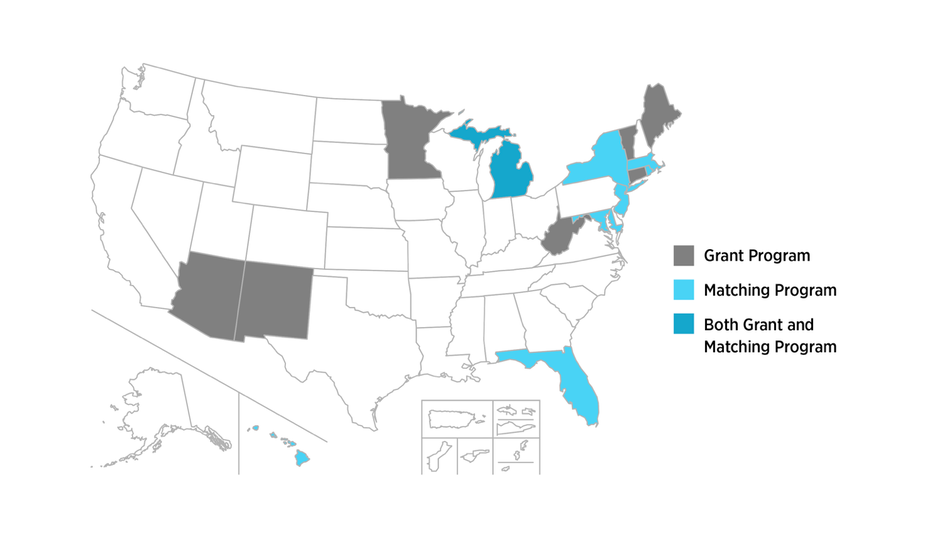
Source: National Conference of State Legislatures
State Public Campaign Financing Programs
State | Enacted | Program Type | Offices |
|---|
Arizona | 1998 | Full grants | Statewide offices, legislature |
Connecticut | 2005 | Full grants | Statewide offices, legislature |
Florida | 1986 | Small donor multiple match | Statewide offices |
Hawaii | 1979 | Small donor single match | Statewide offices, legislature, county offices |
Maine | 1996 | Full grants | Governor, legislature |
Maryland | 1974 | Small donor progressive match | Governor |
Massachusetts | 1975 | Small donor single match | Statewide offices |
Michigan | 1976 | Small donor multiple match and partial grants | Governor |
Minnesota | 1974 | Partial grants and refunds | Statewide offices, legislature |
New Jersey | 1974 | Multiple match | Governor |
New Mexico | 2003 | Full grants | Statewide judicial offices, district judges |
New York | 2020 | Small donor progressive match | Statewide offices, legislature |
Rhode Island | 1988 | Progressive match | Statewide offices |
Vermont | 1997 | Full grants | Governor, lieutenant governor |
Source: Brennan Center for Justice
Evidence suggests public campaign financing can lead to more small-dollar donors, greater donor diversity, and a broader range of people running for office. A 2022 University of Washington study found that in the two election cycles since Seattle implemented its program, the number of donors per race increased by 350%. Donations of less than $200 increased by 270%, and the number of candidates rose by 86%. A separate analysis also found that some residents were almost 12 times more likely to vote if they participated in the program, and low-income Seattleites and people of color were more likely to use their vouchers than they were to give a cash donation.4
The Government Accountability Office's review of five programs (Arizona, Los Angeles, Minnesota, Montgomery County, Maryland, and Seattle) found that publicly financed candidates performed better than candidates who did not opt in. A participating candidate won or advanced in at least 50% of all contests in four of the five locations — reaching 85% to 95% in some Minnesota and Los Angeles elections. In matching-fund and voucher programs, candidates consistently received far more, but smaller, contributions; for example, in Los Angeles's 2022 mayoral race, publicly financed candidates averaged around 6,600 contributions of about $530 each, while non-participants averaged approximately 560 contributions of almost $25,000 each.
Prop. 4 was placed on the ballot legislatively through Senate Bill 42 (2025) and requires a simple majority (50% plus one vote) to pass.
Equity Impacts
Wealthy, often demographically narrow donor networks currently dominate California campaign funding, disproportionately affecting people by race, income, and geography. Oakland’s 2023 campaign finance measure (Measure W) was proposed to address this disparity. Research found that campaign contributions gave disproportionate power to donors outside Oakland and in the city's wealthier, whiter neighborhoods.5 That disproportionate power muted the political voice of lower-income residents and communities of color in their own local elections.
Public financing can counter such impacts. In Seattle, low-income residents and people of color were more likely to use Democracy Dollars than to make a cash donation, meaning the model activates participation among populations least engaged by traditional, wealth-dependent giving. Voucher users were also substantially more likely to vote. By lowering the fundraising bar, public financing also opens pathways for candidates without wealthy networks (often candidates of color, women, and working-class candidates) to run competitively, diversifying who’s on the ballot, not just who funds them. Prop 4 could encourage more candidates to run for office and help the candidate pools better reflect local racial, gender, and socioeconomic diversity.6
Because Prop. 4 is optional for cities, these equity gains depend on which jurisdictions adopt and properly fund programs (as the research on Oakland’s still-unfunded Measure W shows). But removing the state-level barrier allows every California city and county to build systems that broaden who can run and whose voices matter locally.
Pros
- Prop. 4 could encourage more candidates to run for office who reflect California’s racial, gender, and socioeconomic diversity by lowering the barrier to entry for candidates without wealthy networks, name recognition, or fundraising experience.
- The measure would foster more small donors and reduce reliance on big money.
- Public campaign financing can increase voter engagement and turnout when using vouchers.
- The measure would allow local flexibility and would be optional, rather than a mandate, reducing the risk of a one-size-fits-all system.
Cons
- Evidence on whether public campaign financing can reduce big-money influence in elections is mixed. Prop. 4 would not limit campaign financing through independent expenditures and political action committees, which have had outsized influence on elections since the Supreme Court’s 2010 Citizens United decision.
- Prop. 4 would present a cost to taxpayers. Public financing requires ongoing public money through General Fund appropriations, dedicated taxes, or fees.
- The measure would entail administrative burden and complexity. Campaign financing programs require qualification review, spending-limit enforcement, audits, fraud detection, and other processes.
