
What the Measure Would Do
Proposition A would authorize the City and County of San Francisco to issue a $535 million general obligation bond to finance projects that increase San Francisco’s ability to respond to and recover from a major earthquake or other disaster. The bond would fund seismic upgrades and other improvements to buildings and infrastructure.1 It would allocate
- $200 million to replace the 110-year-old Potrero Bus Yard with a modern facility
- $130 million to expand and seismically upgrade the city’s Emergency Firefighting Water System, including service to the Sunset and Richmond neighborhoods
- $100 million to repair and replace seismically unsafe neighborhood fire stations
- $72 million for seismic, safety, and operational improvements to police stations and support facilities
- $33 million for upgrades to other public safety facilities, including roofs, plumbing, and electrical systems
General obligation bonds are a way for cities to borrow money to finance capital improvements that cannot be easily funded through the General Fund. San Francisco’s policy is to issue new bonds only as older ones are retired or as assessed property values increase; therefore, Prop. A would not increase existing property tax rates above the city charter-set limit of 3% of the assessed value of taxable property.2 San Francisco’s Citizens’ General Obligation Bond Oversight Committee is responsible for auditing bond implementation, ensuring transparency in spending.
The Backstory
According to the U.S. Geological Survey, there is a 72% chance that a major earthquake (6.7 magnitude or greater) will strike the Bay Area within the next 30 years.3 San Francisco’s emergency response system depends on a citywide network of critical infrastructure, including first-responder facilities (fire and police) and water infrastructure (cisterns, water pipes, and so on).
Voters overwhelmingly approved Earthquake Safety and Emergency Response (ESER) bonds in 2010, 2014, and 2020. These bonds funded critical seismic upgrades to aging public safety infrastructure, ensuring essential facilities can remain operational after major disasters. Because the city owns hundreds of aging municipal buildings in need of upgrades, ESER bonds are proposed on a four- to eight-year cycle.
Completed Projects Funded by Previous ESER Bonds
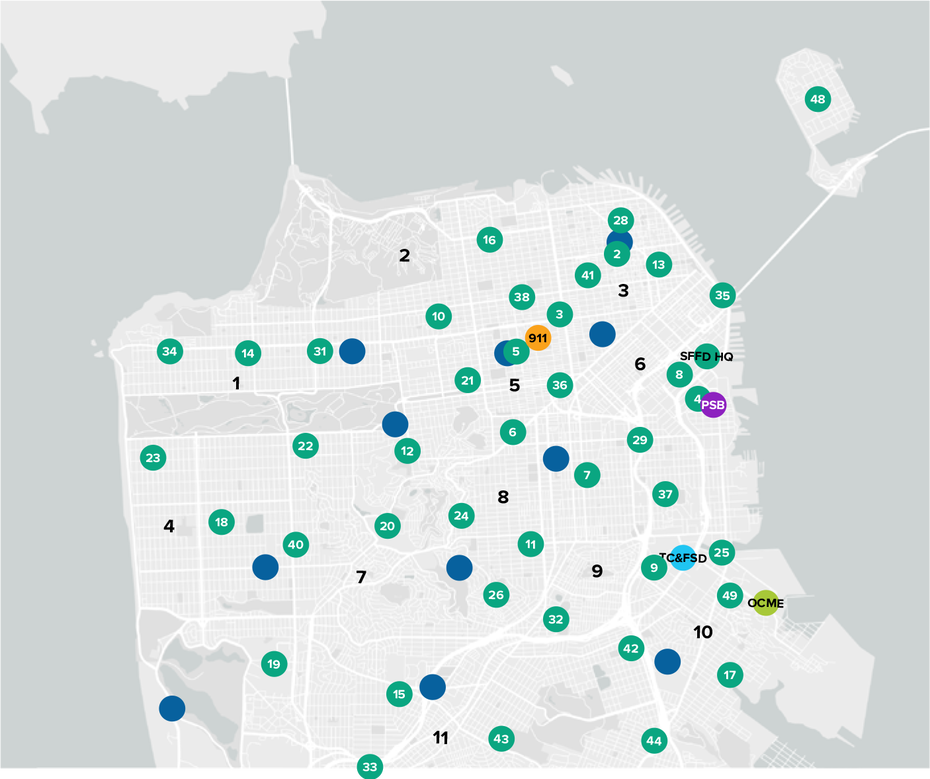
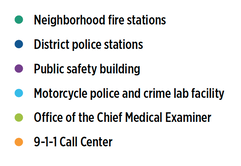
Source: City and County of San Francisco.
The proposed bond is part of San Francisco’s 10-year Capital Plan, which anticipates $2 billion in bond funding for capital improvements.4 Introduced by Board of Supervisors President Mandelman, the bond measure was placed on the ballot by the Board of Supervisors. It was originally scheduled for the ballot in 2028, but it was advanced to replace a previously proposed transportation bond. With a Muni parcel tax likely headed to the ballot in November, the city moved up the ESER bond to replace the transportation bond (which would not have addressed the system’s operational funding needs) in the capital plan bond schedule. The bond’s proposed upgrade of the Potrero Bus Yard is likely a rollover project from the failed 2022 Muni general obligation bond and may also have been in the previously scheduled transportation bond. The upgrade would be part of a larger transit-oriented development project.
As a general obligation bond, Prop A needs a two-thirds vote to pass.
Equity Impacts
Disasters disproportionately impact low-income communities of color, where residents generally have fewer resources to aid recovery. The proposed bond would significantly reduce individual and community losses and restore critical services more quickly, minimizing burdens on low-income residents. Furthermore, Prop. A would upgrade the Potrero Bus Yard, which is critical for running Muni service to low-income communities of color across the city.
Pros
- The projects funded by this bond would continue to improve San Francisco’s ability to respond to and recover from a catastrophe as climate disasters become more common and the federal government seeks to shift more disaster recovery costs and responsibilities onto local jurisdictions and states through reforms to the Federal Emergency Management Agency.
- Updates to the Potrero Bus Yard would be part of a larger transit-oriented development project to develop affordable housing and commercial retail near transit.
- The bond would be part of the city’s capital improvement program, which sequences investments without significant increases in property taxes.
Cons
- Bond repayment would cost the city about $933 million over the next 25 years.5
- Past bond investments in the Emergency Firefighting Water System have not yielded significant expansion into the Sunset and Richmond neighborhoods.
- San Francisco has many capital improvement needs that compete for relatively few spots in the general obligation bond cycle. This bond measure, like any other, impacts the city’s ability to fund other priorities.