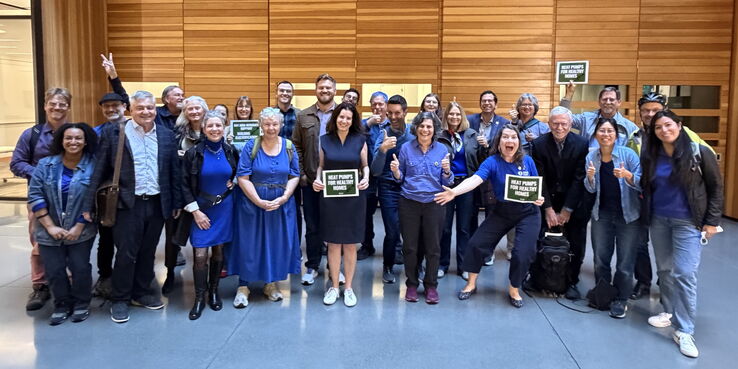
On November 4, after an all-day hearing within earshot of the Valkyries parade, the Bay Area Air District board voted 16–1, with one abstention, to move its zero-emission water heating rule forward with a broad set of amendments. Rule 9-6, first passed in 2023, phases out sales of smaller water heaters that emit nitrogen oxides (NOx) in homes. No one will have to replace working equipment. Together with Rule 9-4, the zero-emission furnace rule set to take effect in 2029, Rule 9-6 will cut as much health-harming NOx pollution as all of the region’s passenger vehicles emit, preventing up to 85 deaths a year and 15,000 asthma cases. These rules are one of the most significant milestones for public health and the climate in the Bay Area this century.
Environmental advocates celebrated the vote, which may seem odd given that directors functionally voted for a package that delays the water heater rule by a year and adds broad exemptions. But SPUR and its partners view it as a successful end to a predictable and fairly technical process.
The two-year path to the amended rule
When the Air District passed both zero-emission heating rules in 2023, it built in a uniquely stringent amendment process to make sure exemptions would be available to the households that need them. That process ended on November 4, with an amendment package that starts implementation on January 1, 2028, and that is expected to allow roughly half of new water heater installations to proceed without meeting the zero-emission requirements during the initial years. The exemptions are broad, but a wide range of environmental groups, community-based organizations, and electrification advocates supported them as the most effective way to phase out polluting water heaters in the region. They directly reflect recommendations from SPUR and its allies and its allies in the Bay Area Clean Air (BACA) coalition.
Unlike other Air District regulations, Rules 9-4 and 9-6 were passed with the expectation that some market barriers would still need to be addressed through amendments. Although zero-NOx technology was available, staff recognized that the market was still developing and that many residents would likely face barriers to adoption when the water heater rule was scheduled to take effect in 2027. The rules therefore included a formal review process to assess market readiness and develop amendments to address remaining barriers before implementation. From 2023 to 2026, SPUR and our partners in the Bay Area Clean Air (BACA) coalition helped turn an ambitious clean-air regulation into a more practical and equitable policy. Our research and advocacy helped shape key exemptions, including protections for households earning up to 80% of the area median income.
The result is a rule that offers broad exemptions to residents, reflecting market conditions that fell short of the most optimistic scenarios. After the Inflation Reduction Act passed in 2022, environmental and climate advocates expected stronger financial incentives for heat pump adoption. However, the Trump administration’s rollback of tax credits and — more importantly — California’s budget constraints and failure to expand funding for heat pump incentives weakened that outlook. Even so, SPUR found that Bay Area funding for heat pump incentives has increased more than 800% since 2021, although it remains insufficient to reach all households.
Cost is not the only barrier to heat pump adoption. Some homes also face physical and electrical constraints, including outdated wiring, limited electrical capacity, and insufficient space for new equipment. However, these challenges do not always require costly electrical upgrades. Research by Power Efficient Design and advocacy by SPUR and the Panel Optimization Work and Energy Reassessments (POWER) group helped shape exemptions that recognize the growing range of options for installing heat pumps without upgrading a home's electrical system. As a result, homes with electrical panels rated at 100 amps or more are not automatically exempt. Homeowners have many ways to electrify on their existing panel and service. For example, many newer 120-volt heat pump water heaters can simply plug into a wall outlet, avoiding the need for additional electrical capacity.
Broad Exemptions Will Allow Half of Households to Avoid the Zero-Emission Water Heater Requirement
Type of exemption | Who qualifies | Exemption limits |
Low income | Homeowner at or below 80% of area median income or enrolled in a qualifying low-income program | None |
Housing cost burden | Homeowner whose mortgage plus property taxes equal 28% or more of household income | None |
Small space | Home has a closet smaller than 700 cubic feet that can’t be vented or a ceiling under 6 feet (7.2 feet in a garage) | One time per address |
Electrical constraints | A contractor certifies that the electrical panel is under 100 amps, there is no open breaker space, there is knob and tube wiring in the home, or a circuit would need 50+ feet of conduit | One time per address |
Special buildings | Homes with combined water and space heating systems, residential buildings with five or more units, deed-restricted affordable housing, nonprofit housing co-ops | Equipment manufactured after 2033 must be zero-pollution |
High-demand businesses | Restaurants, laundries, dry cleaners, healthcare, and assisted living facilities that need 160°F water | Equipment manufactured after 2033 must be zero-pollution |
Emergency loaner | Any household may work with a contractor to install a temporary gas unit in an emergency | Gas unit must be removed within 12 months |
Source: Final Rule 9-6 Amendment Package, October 2026
The rule amendments thread the needle between offering flexibility to residents who need it and remaining broad enough to transform the Bay Area’s heat pump market. Even with 50 percent of households exempted, the rules could multiply the number of heat pump water heaters sold in the Bay Area by 1,500% (only 3% of residential water heaters sold in the Bay Area in 2024 were heat pumps). That increase would transform the market, spurring supply chain and workforce development and lowering costs for households that make the transition in the future.
Why passage of the amendments is more than just a technical milestone
The Rule 9-6 amendments are a real accomplishment in inclusive and equitable policy design. But the excitement about their passage has as much to do with the rules surviving the amendment process. In her book Short Circuiting Policy: Interest Groups and the Battle Over Clean Energy and Climate Policy in the American States, Leah Stokes describes two periods that progressive environmental policies move through: the “fog of enactment” and “policy retrenchment.” Novel, complex, or technical climate laws are often poorly understood at first, allowing them to pass before opponents see the long-term effect on their profits. Once the consequences become clear during implementation, well-funded opponents organize across state lines, through networks of organizations, to dismantle or stall clean energy and clean air policy.
The Air District rules face serious retrenchment risk. The review process after adoption gave opponents an opening to attack them, and their final compliance date (2033 under the new Rule 9-6 amendments) gives opponents lots of time to organize.
The “fog of enactment” around the Air District rules lifted in 2025 and 2026, when opposition campaigns emerged, some with ties to fossil fuel interests. Some of these campaigns spread misinformation about project costs and how often electrical panel upgrades are needed (rarely, for a heat pump water heater). SPUR and advocate partners knew this threat was real. In 2025, the South Coast Air Quality Management District voted 7 to 5 against zero-emission appliance rules after opponents mounted a major campaign in the final months before the vote.
What’s next
The Air District is preparing to launch a public education campaign on the water heater rules and to set up the exemption and waiver process. Through an online portal, residents can complete an exemption application form that requires minimal documentation; upon submission, the resident will be issued a waiver that allows them to purchase gas-powered equipment, despite its polluting properties. In 2027, the Air District will work with contractors and distributors to ensure this system works and that there’s broad awareness of the waiver platform and application process.
In 2026 and 2027, the Air District will also move forward with amendments to the furnace rule, which will have an even larger impact on overall NOx and greenhouse gas emissions. The transition to heat pump heating and cooling systems presents different challenges depending on a household’s existing equipment. For households without air conditioning or with relatively new systems, switching to a heat pump can be significantly more expensive than replacing a gas furnace. Heat pumps also use more electricity than heat pump water heaters and may require more advanced strategies to avoid electrical upgrades. However, households with aging air conditioners may find switching to a heat pump much more affordable because a single system can replace both their furnace and air conditioner.