
Like most big cities throughout the country, San Francisco is heavily reliant on federal support to plan for, respond to, and recover from disasters. Since early 2025, the Trump administration has limited federal disaster funding, withheld hazard mitigation grants, and launched a campaign to overhaul the Federal Emergency Management Agency (FEMA), aiming to shift disaster costs to state and local governments. Costs that will be difficult to absorb, given already constrained municipal and state budgets.
This year, California faces a $2.9 billion budget shortfall and San Francisco faces a $300 million shortfall. (The city’s 2-year deficit is $937 million.) San Francisco’s fiscal challenges stem from multiple factors: reduced federal support (from H.R. 1, the “One, Big, Beautiful Bill,”) for programs such as Medi-Cal that require local backfilling; a slow post–COVID-19 recovery that has depressed property, business, sales, and hotel tax revenues; and rising personnel and service costs. In response, Mayor Lurie has asked city departments to make significant personnel cuts.
Major emergencies, such as the COVID-19 pandemic and the 1989 Loma Prieta earthquake, cause lasting social and economic disruption. San Francisco must prepare for the possibility of future disasters in which robust federal assistance is unavailable.
Federal Disaster Assistance: A Critical Funding Source for San Francisco
The U.S. federal disaster response system was developed over several decades, beginning with the Disaster Relief Act of 1974, the creation of FEMA in 1979, and the Stafford Act in 1988. Originally a standalone agency, FEMA was later placed under the U.S. Department of Homeland Security (DHS) after the September 11 attacks. Failures exposed during 2005’s Hurricane Katrina prompted major reforms, including the Post-Katrina Emergency Management Reform Act (2006) and the Disaster Recovery Reform Act (2018), which strengthened FEMA’s authority and expanded federal investment in hazard mitigation through programs such as Building Resilient Infrastructure and Communities. In 2025, the Trump Administration cancelled the BRIC program and put other hazard mitigation grant programs on hold.
Federal Policies Shaping the U.S. Disaster Response and Recovery System
Over time, federal disaster policy has evolved from a primarily reactive response system to one that increasingly prioritizes pre-disaster mitigation and resilience, especially in the wake of Hurricane Katrina, which exposed failures in coordination, communication, and preparedness across federal, state, and local agencies, triggered widespread criticism of FEMA, and prompted major reforms to federal disaster assistance programs.
Federal Policy | Impacts | |
1974 | Disaster Relief Act | Created the presidential disaster declaration process and standardized federal disaster assistance. |
1979 | Federal Emergency Management Agency | Consolidated multiple federal emergency management functions into one independent agency. |
1988 | Robert T. Stafford Disaster Relief and Emergency Assistance Act | Created FEMA’s Public Assistance and Individual Assistance programs and established the Hazard Mitigation Grant Program. |
2002 | Homeland Security Act | Created the Department of Homeland Security and moved FEMA under it, resulting in a loss of federal authority for FEMA and prioritization of national security and terrorism preparedness. |
2006 | Post-Katrina Emergency Management Reform Act | Strengthened FEMA’s authority within DHS, improved coordination, and created regional offices. |
2018 | Disaster Recovery Reform Act | Shifted federal policy toward pre-disaster mitigation and resilience, emphasizing proactive risk reduction rather than primarily reactive post-disaster recovery. |
Source: SPUR analysis
Under current U.S. disaster policy, when a major emergency such as the 2025 Los Angeles wildfires occurs, the president can issue a major disaster declaration, unlocking federal assistance through FEMA and other agencies. FEMA supports response and recovery through programs for Public Assistance (to governments and nonprofits) and Individual Assistance (to households), which help communities with temporary housing, debris removal, restoration of essential services, and rebuilding of damaged infrastructure.
To qualify for a declaration under the Stafford Act, disaster damage must exceed a federal per-capita indicator — the ratio of a disaster’s monetary damage to the impacted state’s population –– that measures whether state and local governments can reasonably cover costs on their own. Once approved, the federal government typically covers at least 75% of eligible disaster-related costs. State and local match funds typically cover the other 25%, with the state generally covering the majority.
The two largest-scale emergencies in recent decades illustrate the scale of federal financial support that has helped San Francisco respond and recover in the past:
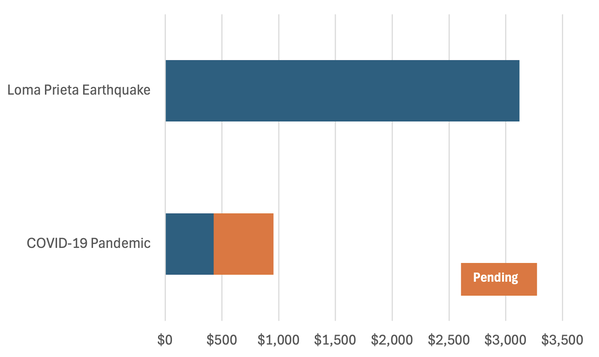
The Loma Prieta earthquake (1989) killed 63 people, damaged more than 18,000 homes, and caused an estimated $7 billion in damage across the Bay Area. Much of the damage in San Francisco was to public infrastructure, including City Hall, the Hall of Justice, cultural institutions, and public health and emergency response facilities. Repair and replacement of these buildings continue to this day, funded by an estimated $1.4 billion in FEMA reimbursements, now worth $3.1 billion in today’s dollars. Local match funds have been funded through voter-approved general obligation bonds, such as the Earthquake Safety and Emergency Response bond.
The COVID-19 pandemic contributed to more than 1,000 deaths in San Francisco by 2023 and caused significant social, economic, and financial impacts. To minimize casualties and broader public impacts, the city spent more than $900 million to provide vaccine and public health services, quarantine housing options for those without homes, childcare services given school closures, and more. The city has applied for $877 million ($954 million in today’s dollars) in FEMA reimbursements for these costs and has received $392 million, with more in the pipeline. FEMA reimbursements for this emergency ranged from 75% to 100%, depending on eligible costs, with required local matching funds provided by state disaster relief funds and appropriations from the city’s General Fund. Impacts on the city’s General Fund have been exacerbated by FEMA’s slow reimbursement and are a significant factor in the city’s projected budget shortfalls.
FEMA and Other Federal Reimbursements for the COVID-19 Pandemic and the Loma Prieta Earthquake, in Millions
San Francisco received more than $4 billion from FEMA and other federal agencies to respond to and recover from the Loma Prieta earthquake and the COVID-19 pandemic.
Source: SPUR analysis of financial information reported by the San Francisco Controller’s Office.
Note: Dollars escalated to today’s dollar values.
Beyond these two major events, San Francisco has also submitted and received FEMA disaster cost reimbursements for smaller disasters, such as the 2013 Rim Fire.
The Rim Fire (2013) in Tuolumne County burned 250,000 acres of forest, lasted 69 days, and destroyed 100 structures. The SF Public Utilities Commission owns drinking water infrastructure outside of the city’s limits that was damaged in the fire. Repair and replacement of this city-owned infrastructure totaled $26 million, paid in part with $8 million in FEMA Public Assistance funds, according to data gathered from the SF Controller’s Office. Local matching funds were provided by insurance reimbursements, state disaster relief grants, and other sources. This event was originally denied a federal disaster declaration because it did not exceed the required per-capita indicator threshold. However, it was ultimately approved after appeals from then-California Governor Jerry Brown, who argued that damage costs were higher than initially estimated.
These examples illustrate the critical financial role the federal government has played in providing the funds needed to respond to and recover from disasters.
An Uncertain Future for Federal Disaster Assistance
Since early 2025, the Trump administration has disrupted federal disaster assistance through increased delays and denials especially for blue states, workforce reductions resulting in the loss of about 2,000 FEMA employees, and an internal policy requiring all expenses greater than $100,000 to be approved by the Secretary of Homeland Security. The latter has created a $17 billion backlog in disbursements for local and state governments. Proposed reforms aim to further limit the federal government’s role.
In January 2025, Trump established the FEMA Review Council by executive order to evaluate FEMA’s performance and recommend changes to federal disaster policy. This report was scheduled for release in early 2026, but it has been withheld. However, some of its recommendations were leaked to the media:
- Raise the disaster declaration threshold. Doing so would mean smaller disasters may no longer qualify for federal support. Without the official report, it is unclear how high the council seeks to increase the threshold; however, one proposal outlined in a memo sent to FEMA by a Trump appointee in April 2025 suggests a fourfold increase of the current statewide per-capita indicator (PCI). The Rim Fire’s statewide per-capita impact of $1.46 per person barely exceeded the then-statewide PCI threshold of $1.39 per person. If the PCI had been four times higher ($1.39 x 4 = $5.56), San Francisco would not have received the $8 million in FEMA relief to address the fire’s $26 million in infrastructure damage.
- Further cut FEMA staff: Proposed cuts of 50% (or more than 12,000 positions) could further slow damage assessments, reimbursements, and technical assistance, delaying disaster recovery timelines. States and local jurisdictions front the money for disaster response and recovery. When reimbursements are slowed, cities may need to advance other budget cuts to pay bills. For example, San Francisco is still awaiting processing of more than $400 million in FEMA claims from the COVID-19 pandemic and was not fully reimbursed by FEMA for costs incurred as a result of the Loma Prieta earthquake until a decade after the event.
Other internal proposals reported within the Trump administration include a cap on the minimum federal cost share (reimbursement). While current law sets a 75% federal minimum, presidents have historically increased the share to 90% or 100% for limited periods after catastrophic disasters. Internal proposals from Trump’s administration, such as the previously cited memo to FEMA, suggest capping the federal share at 75% with no flexibility to increase it. Such a cap would have reduced federal funds available for San Francisco’s COVID-19 response by tens of millions of dollars, likely increasing the city’s current budget deficit.
Amid proposals for FEMA’s future, Congress introduced the Fixing Emergency Management for Americans (FEMA) Act of 2025. The act aims to reform disaster assistance programs and restore FEMA’s status as an independent agency. Even before Trump’s second term in office, many disaster experts and disaster-impacted communities were calling for FEMA reforms to improve federal disaster assistance. With more than 40 co-sponsors, the 2025 bipartisan FEMA Act focuses on improving FEMA’s role in disaster response and recovery rather than scaling it back.
Role of San Francisco’s Department of Emergency Management and Impacts of Federal Funding Losses
The federal government has not only provided critical support to help local governments recover after major emergencies, but also to prepare for them.
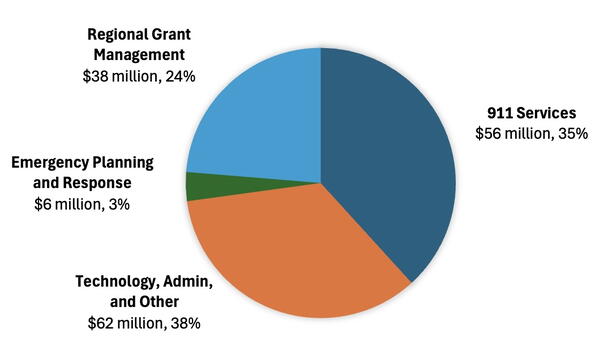
San Francisco’s Department of Emergency Management (DEM), created in 2006, leads the city’s preparation for and response to emergencies. In the past year, DEM coordinated responses to the July 2025 tsunami advisory, the December 2025 PG&E substation fire that left a third of the city without power, and multiple winter storms. It also managed emergency planning for Super Bowl LX. The department has a budget of $161 million and roughly 300 staff.
The department provides a variety of emergency services, including
- 911 Services: DEM operates the city’s combined 911 emergency response service, including centralized dispatch for emergency services from the police, fire, and other departments.
- Emergency Planning and Response: DEM’s Division of Emergency Services leads emergency planning training and exercises for hazards such as earthquakes, cyberattacks, pandemics, and floods. It operates the city’s emergency operations center during disasters, coordinating response across city departments and agencies.
- Regional Grant Management (Urban Area Security Initiative): DEM acts as the fiscal agent and regional manager and coordinator of Homeland Security-related federal emergency grants to city departments and Bay Area cities and counties.
- Technology, Administration, and Other Services: DEM operates the city’s emergency communications system and other technology used by many city departments and provides administrative support and other services, including coordination of citywide street-response services.
The Department of Emergency Management Budget
The department provides emergency services, ranging from 911 call response to planning and managing major disasters and large planned events.
Source: SPUR analysis of the city’s adopted budget for FY 2025–26 by service area.
Like other cities, San Francisco relies heavily on annual federal funding for critical emergency services, primarily from the U.S. Department of Homeland Security, FEMA’s parent agency. DHS’s Urban Areas Security Initiative (UASI), created after the September 11 attacks, provides funding to improve emergency coordination among local, state, and federal responders in high-risk urban areas. Since 2003, the Bay Area has received UASI funds, averaging more than $20 million annually and exceeding $34 million in recent years. San Francisco serves as the region’s fiscal agent for UASI, with DEM managing allocations to city departments and other Bay Area jurisdictions. These funds support emergency response equipment, technology, training, planning exercises, and other preparedness activities.
As recently as fiscal year 2023–24, the UASI program provided about $4 million annually to support DEM. While Congress has continued to appropriate funds for UASI, the Trump administration has halted their distribution. As a result, San Francisco has received no new UASI allocations since fiscal year 2023–24 and has relied on remaining balances from prior grants to maintain staffing. Those funds are now exhausted. To sustain core functions, DEM has proposed shifting several federally funded positions to the city’s General Fund while cutting others. The shift would cost the city about $800,000 — a significant challenge as the city works to close a projected $937 million two-year budget deficit. Taken together, staffing levels for these services (UASI and DES) have declined from 43 in fiscal year 2024–25 to a proposed level of 29 in fiscal year 2026–27, a 33% reduction in two years.
How Can San Francisco Respond to the Loss of Federal Aid?
Federal pullbacks are already undermining San Francisco’s routine emergency management, and proposed shifts in the federal government’s disaster management role could further strain already overburdened local and state budgets. In the face of these challenges, San Francisco, the Bay Area, and the state must work together to develop new strategies to manage disaster risks — strategies that will also be valuable in addressing the rising cost of disasters due to climate change due to climate change.
Some key areas for action:
Building stronger financial reserves for disaster recovery. San Francisco has established rainy-day reserves to manage financial losses during recessions and other reserves to manage other known risks, such as the likely loss of federal aid for health and safety-net services. This new risk –– of significantly higher local costs to recover from a future major disaster –– likely warrants a new reserve approach. Notably, the loss of federal funds needed to recover from a major future disaster, such as the Loma Prieta earthquake or the COVID-19 pandemic, would exceed the city’s current $505 million rainy-day reserves, leaving no balance to weather the recession they were designed to help manage. Therefore, San Francisco should explore mechanisms to manage post-disaster local costs. Pre-authorizing recovery bonds, selectively insuring key public assets, and pursuing public-private financing tools would enable the rapid deployment of funds after a disaster.
Strengthening the state’s role in disaster recovery. If the federal role contracts further, the State of California will need to play a larger coordinating and financial role to fill the gap. Local governments should work with the California Governor’s Office of Emergency Services to explore expanding programs under the California Disaster Assistance Act or developing new statewide recovery financing mechanisms. As one example, local funding options are authorized and, in many cases, limited by state law. San Francisco should develop a legislative strategy to loosen appropriate state restrictions during a disaster, including reducing the voter-approval requirement for disaster mitigation and recovery bonds, expanding eligible uses of general obligation bonds, and broadening other local tax, fee, and funding authorizations. The state should also continue to reform and stabilize insurance markets, as insurance is a critical financial backstop for public entities and individuals in the face of disasters.
Strengthening local and regional coordination. Major disasters in the Bay Area will require coordinated regional response and recovery, yet jurisdictions often plan as if they will operate independently. As regional coordination programs, like UASI, face reductions, local governments must align preparedness plans and explore more formal cooperation and financing structures.
Expanding investments in mitigation and resilience. The more prepared jurisdictions are for climate and earthquake hazards, the less damage and disruption will occur, and mitigating risks is far more cost-effective than cleaning up after a disaster strikes. A report from the National Institute of Building Sciences states that for every $1 invested in mitigation, the country saves $13 in future disaster costs. In June, San Francisco voters will consider one public investment: the Earthquake Safety and Emergency Response general obligation bond. In 2024, they and other California voters approved another investment: the state’s $10 billion climate bond.
San Francisco can do its part by ensuring that all major capital projects are evaluated through a mitigation and climate adaptation lens, identifying opportunities to incorporate resilience measures whenever infrastructure is being designed or upgraded.
Historical city financial figures in this report were drawn from review and analysis of external financial audits and adopted budgets from prior years. They were prepared with the assistance of staff in the Controller’s Office and the Department of Emergency Management. Those documents are available on the Controller’s Office report web portal.
Learn about FEMA’s role in hazard mitigation and climate adaptation in our previous article.