The latest tech boom has stretched the Bay Area’s income inequality gap to its widest level in decades. Can we figure out how to ensure that this growth is created by, and benefits, all workers and families?
SPUR strongly supports the urban village strategy. The comments on the evolving implementation framework center around the question of whether the framework will be effective.
On May 22, SPUR Transportation Policy Director Ratna Amin received the Woman of the Year award from the Women in Transportation Seminar San Francisco Chapter. Her remarks at the event, reprinted below, focused on the need for gender balance in the transportation planning and policy profession.
SPUR strongly supports the direction articulated in the Draft 2018 Business Plan for California high-speed rail, and offers additional comments for achieving the CA HSRA's vision for the future.
Adopted in 2011, San Jose’s ambitious Envision 2040 plan included goals of bringing more than 10,000 new homes and nearly 50,000 jobs to downtown San Jose. Every year, SPUR reports on the progress we’re making as a city to realize these goals. This year, we’re seeing three positive trends, as well as major decisions on the horizon.
St. James Park has long been a center of civic pride for San Jose, but lately the park has battled a reputation for being unsafe and unpleasant. In 2016, the city hosted a national competition and selected CMG Landscape Architecture to reimagine the design and programming of the park. At a recent SPUR forum, CMG and other partners shared the progress made since then.
According to a recent analysis of data from the Alameda County Assessor’s Office and the City of Oakland, there are approximately 4,000 vacant parcels in Oakland. In a move that could prompt owners of these properties to build on them — and in the process generate revenue for purposes including homeless services — Oakland is considering imposing a tax on vacant properties.
Pamela Anderson-Brulé is a founder and the president of Anderson Brulé Architects, Inc. Her career has been dedicated to creating a holistic architectural design process to help achieve her clients’ vision for how they live, work, play and thrive. She believes that truly exceptional architecture balances the human, social, economic and environmental needs of individuals and sustains the community in which it is created.
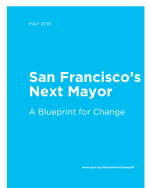
By any measure, the previous decade has been a period of dramatic change and growth for San Francisco. But for many, this unprecedented prosperity has failed to address — and has even contributed to — the many challenges the city still faces. SPUR offer a platform of specific policy goals and practical solutions for the next mayor and the city for the years ahead.
Construction costs are a growing barrier to building new housing in California. Today, experts don’t agree on the exact reasons for California’s soaring costs, which often leads to policy fights based on ideology, not facts. A new research series from the Terner Center for Housing Innovation aims to add data to the debate. At a recent SPUR forum, panelists discussed the research to date.
SPUR writes to express support for the San Francisco Public Utilities Commission's proposed rate and fee changes, specifically the staff proposal to reduce or eliminate fees affecting low-income ratepayers. We also support implementing a stormwater charge for currently unmetered properties.
Uber’s recent announcement that it is adding new travel modes to its platform caught the public transportation sector flat footed. It’s time for Bay Area transportation leaders to start setting a vision for mobility-as-a-service, an approach that makes many transportation choices available through a single platform and payment system. For many reasons, we need government — not the private sector — to take the lead.
The adoption of autonomous vehicles on a grand scale is not inevitable, and their predicted benefits have not yet been proven. As we plan for the transportation system of the future, we should set goals that we will accomplish with AVs or without them. The following are effective strategies to manage traffic and make it easier to get around — even if AVs never arrive.
SPUR supports AB 2865, which would allow the SFCTA to continue to explore using high-occupancy toll lanes to alleviate congestion on the I-280 extension and US-101 corridors.