
What the Measure Would Do
The measure proposes a nine-year special parcel tax, starting July 1, 2027, that would generate approximately $34 million annually.
The tax would be based on property type:
- Single-family homes — $192 per parcel annually
- Multiple residential units — $131 per unit annually
- Non-residential properties — annual rate of $224.00 multiplied by the total number of single-family residential unit equivalents (determined by the frontage size and square footage)
By law, funds generated by this tax could be spent only on the uses designated in the measure and voted on by residents. Revenue would support five priority areas that are typically covered by the General Purpose Fund:
- 911 Response and Fire Services — Improving emergency response times, keeping fire stations open, and providing emergency medical services
- Crime Prevention — Addressing violent crime, gun violence, investigations, and community-based policing
- Homelessness Solutions — Providing temporary shelter, transitional housing, mental health services, and housing connections
- Cleanliness — Removing illegal dumping, litter, graffiti, and debris from public spaces
- Administrative Support — Covering IT systems, audits, financial monitoring, and overhead costs
The mayor and the City Council would allocate the funds among these services during the budget process.
The Backstory
Oakland, like many cities, faces major structural budget shortfalls due to sluggish real estate markets, decreased foot traffic in downtown districts, and declines in tourism and retail sales tax revenues.
To pass a balanced budget in fiscal years 2025–27, Oakland ramped up business tax collection and parking enforcement, declared a fiscal emergency (which unlocked restricted funds and moved them into the General Purpose Fund), and implemented hiring and spending freezes — all part of Oakland’s multi-year plan to stabilize finances, restore reliable services, and regain access to bond markets.1 The City Council assumed the passage of a voter-adopted tax proposal in 2026, acknowledging that an additional ongoing solution would be needed to achieve structural balance and safeguard city services.
Some positive results are emerging. In December 2025, the city successfully sold $334 million in bonds to fund capital projects, including road paving, public facility restoration, and affordable housing investments.2 This accomplishment signals increased confidence in the city’s financial management position and practices.
Oakland’s heavy reliance on special parcel taxes to fund city services is a direct consequence of Proposition 13. When California voters passed Prop. 13 in 1978, local government revenues plummeted by 60%, forcing Oakland and other California cities to find alternative revenue streams to cover rising personnel, pension, and operational costs. Over the decades, Oakland voters have responded generously, approving many special taxes to fund the services that general revenues could no longer reliably support.3
Compared with other California cities of similar size and service levels, Oakland already collects the highest per-capita tax revenue, at $2,086 per resident as of FY 2022–23, more than double Sacramento’s $923.4
Per-Capita Tax Revenue, Oakland and Peers, Fiscal Year 2022–23
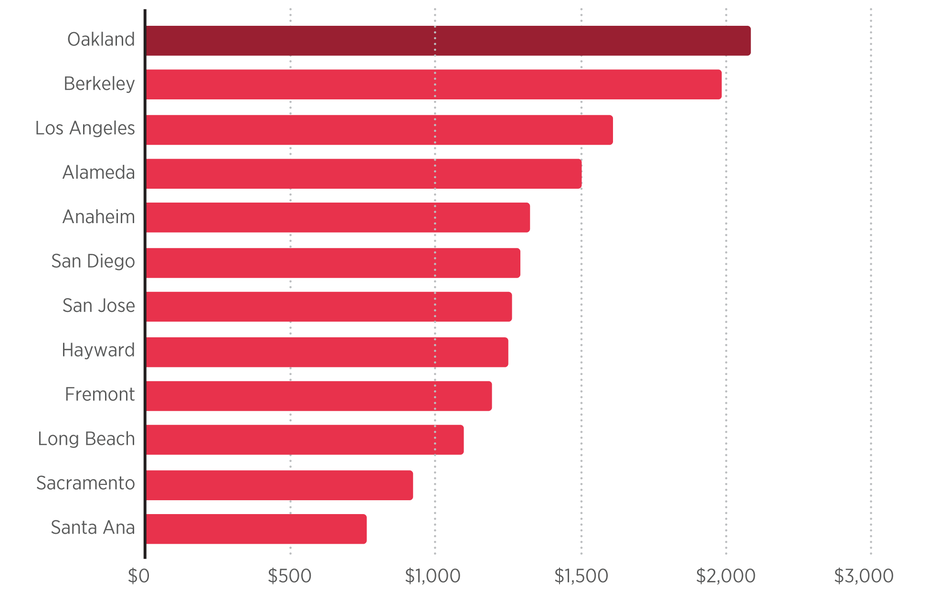
Source: N. Neditch, K. Boyd, and M. Skelly, Balancing Oakland’s Budget: Nine Recommendations for Closing the City’s Structural Deficit to Move Toward Fiscal Solvency and Economic Growth, 2025, SPUR, https://www.spur.org/publications/spur-report/2025-05-14/balancing-oaklands-budget.
Because of the timing of this measure, most Oakland property owners wouldn’t see a higher tax bill. The existing Pension Override ad valorem tax, which has long funded the city’s legacy pension obligations, is winding down. The rate has already been cut sharply and is expected to fall by as much as 94%, dropping the average single-family cost from $437 to roughly $27 annually. When that reduction is weighed against the new $192 flat parcel tax, the majority of single-family homeowners would pay less in combined property taxes than they do today.5 City staff evaluated more than a dozen ways to close the roughly $40 million annual gap in the General Purpose Fund. Most options would have faced legal complications or yielded only modest revenue, well short of the targetA parcel tax structured by property type emerged as the most legally viable and revenue-certain path forward.
The proposed parcel tax was placed on the ballot through a signature-gathering campaign led by Service Employees International Union 1021. It requires a simple majority (50% plus one vote) to pass.
Equity Impacts
The parcel tax includes low-income and senior exemptions to avoid disproportionately burdening low-income homeowners. Prior to the initial imposition of the tax, the City Council would adopt a further exemption for “distressed homeowners,” such as those subject to a notice of default or at risk of foreclosure. Due to the timing of this measure, most Oakland property owners wouldn’t see a higher tax bill because the existing Pension Override ad valorem tax, which has long funded the city’s legacy pension obligations, is winding down.
The measure would help maintain city services and protect programs serving vulnerable communities. Without its revenues, cuts would need to be made to General Purpose Fund services such as public safety, crime prevention, homeless services, street cleanliness, and other programs that disproportionately impact low-income residents and communities of color.
Pros
- The measure is part of a long-term plan to stabilize the budget and close the structural deficit without relying on one-time revenues.
- It would provide a stable, dedicated funding stream of $34 million annually to improve emergency response times, street cleanliness, and homelessness services, which have deteriorated during the budget crisis years.
- Most Oakland property owners wouldn’t see a higher tax bill because the existing Pension Override ad valorem tax is set to sunset.
- The nine-year term gives the city some planning horizon to grow the economy and city revenues in more sustainable ways.
Cons
- The tax rate would not reflect the value of residential units or owners’ income. Regressive taxes unfairly burden those with less income, in this case, middle-income homeowners.
- Reliance on this measure’s passage was baked into the assumptions for the fiscal years 2025–27 budget. If the measure fails, the city faces another mid-year crisis. This kind of budget dependency on a future vote is a governance concern.
- Oakland property owners are already carrying a significant tax load.