Many of the Bay Area’s biggest transit agencies are in dire financial need. With federal COVID-19 relief funding exhausted and emergency state support running low, agencies such as BART, Muni, Caltrain, and AC Transit are projecting cumulative annual deficits of nearly $1 billion and devastating service cuts starting in early 2027. That’s unless voters approve two funding measures: the Regional Transit Measure (Measure RTM in Alameda, Contra Costa, San Francisco, San Mateo, and Santa Clara counties) and the Stronger Muni For All Measure (Proposition H in San Francisco).
But are new taxes really the only way to address transit’s operating needs? Some tax opponents have suggested that other transit funding designated for capital projects could be “flexed” or shifted to fill operating deficits. SPUR investigated that idea and determined that flexing money from capital to operations isn’t a viable response to the immediate funding crisis. Here’s why.
How Is Transit Funded?
Before considering how, or if, transit capital funding could be flexed to support operations, it’s important to understand how transit gets its resources. Generalizing about transit funding is inherently difficult because they systems and processes through which transit receives money are complicated. Most large transit agencies receive money from many different sources and layers of government and manage dozens if not hundreds of individual grants and funds at any given moment. The details, rules, and exceptions are often critical in determining both whether specific funds can actually be repurposed for operational support and who has the authority to decide to flex funds.
At the highest level, Bay Area transit receives funding from five broad sources: (1) the federal government; (2) the State of California; (3) “local government,” such as cities, counties or a special district or tolling authority; (4) the transit district itself, through taxes it imposes directly; and (5) earned or “self-generated” funding from the agency’s own ticket sales, parking fees, advertising, or other income streams.
Revenue streams from these sources can come to transit agencies either on a predictable, formula basis or through specific grants, which the agencies apply to “operating” and “capital” budgets. The operating budget typically covers the cost of providing service, conducting basic maintenance, and running the agency. The capital budget typically covers major facility maintenance and fleet replacement efforts, as well as expansion projects such as new infrastructure and vehicles.
According to data reported to the Federal National Transit Database, the four Bay Area transit agencies with the greatest financial need —BART, Muni, Caltrain, and AC Transit — account for more than 85% of all transit trips in the Bay Area. In 2024 (the latest year for which complete data are available), these agencies reported collective expenditures of more than $3 billion on operations and more than $1 billion on capital maintenance and expansion.
2024 Combined Operating and Capital Expenditures of AC Transit, BART, Muni, and Caltrain
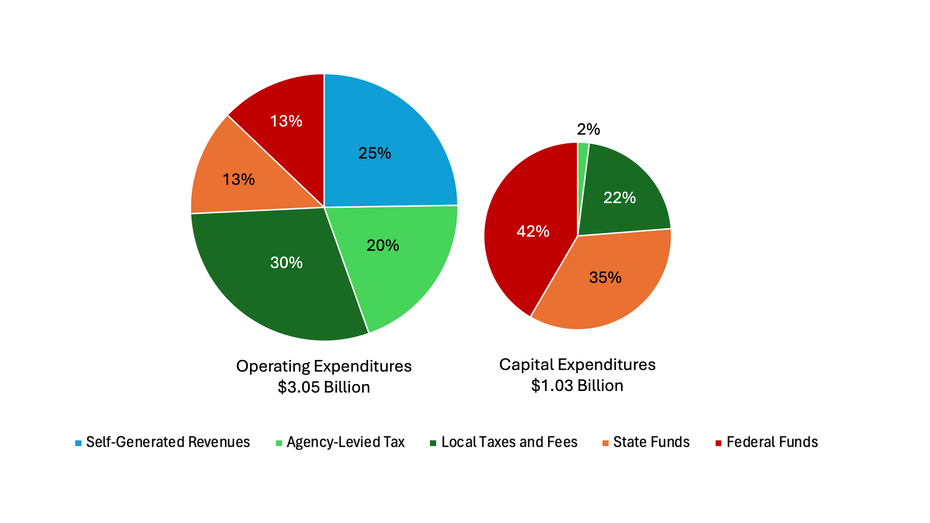
Source: SPUR analysis of agency-reported 2024 data in the Federal National Transit Database.
Tellingly, the types of funding that support transit operations differ from those that support capital expenditures. Specifically, transit operations are primarily paid for by “local” sources, including local taxes, taxes levied directly by transit districts, and fares and other revenues that transit agencies earn; collectively, these sources pay for the majority (74%) of the four agencies’ operating expenses. These sources tend to have the fewest restrictions attached to them, and transit agencies usually have greater flexibility in determining how to apply them.
Most capital expenditures are paid with state and federal funds (77%), with much of the rest (22%) paid with local taxes not directly controlled by the transit agency. These sources of funding are typically not fully under the control of transit agency boards. As discussed below, they’re more likely to be project-based grants or otherwise have specific rules governing their allowable use. That means that, in most cases, there’s no simple way for a transit agency to repurpose capital funds for operations.
How Does Transit Funding Flow?
Perhaps even more important than the underlying source of funding in determining its use is the manner in which it “flows” into the coffers of a transit agency. In general, the funding entity, not the transit agency, sets the terms of how money can be used, and most funding originating outside of a transit agency comes with significant restrictions or procedural requirements related to any potential “flexing” of funds. Agencies that receive federal transit formula funding, for example, are subject to many regulatory requirements, including provisions related to procurement, civil rights, and other areas of federal law, as well as restrictions that severely limit the extent to which funds can be used for operations (one reason most federal transit money tends to be used for capital purposes).
In addition to formula funds, transit agencies receive money through grants that support specific projects. Grant funding sources tend to be much more targeted and narrow in their permitted uses and are often tied to specific projects and programs. While grant awards can be quite large — billions of dollars in the case of some federal and state awards — they also tend to involve detailed, multi-year funding agreements that impose strict legal conditions and requirements on use. With relatively few exceptions, these types of grant funds cannot be “flexed” for other purposes. Large grant agreements at the federal and state levels often also require a commitment of matching funds — locally sourced money that will balance out the funding plan for a project or program. These matching requirements can drive local policymakers to reserve tranches of local funds as a means of growing the overall pool of funding for transit, but at the cost of further reducing the available pool of more flexible local funding that could be used for operations.
Can Transit Flex Its Way Out of a Deficit?
Even given the general challenges associated with flexing transit money for operations, doing so is possible in some instances. So, in the face of a severe crisis, why isn’t Bay Area transit flexing more?
Flexing at scale presumes redistribution — not regionalism
Whether at the local or regional scale, transit is geographically specific. For riders, local officials, and taxpayers alike, where money is invested in transit matters. A bus route in San José is not interchangeable with one in San Francisco any more than a sewer system or a park would be. This simple reality explains why much transit tends to be funded locally (at the county level) and why so much process and effort is required to craft regional transit funding measures, where shared priorities and obligations must be defined and agreed to.
SB 63, the legislation that authorized the Regional Transit Measure, was a regional solution that was carefully developed to ensure consensus among policy makers on how money collected across the five participating counties would be used fairly to support transit and benefit all. Conversely, the notion of flexing any significant amount of transit money from large individual capital projects (which are generally tied to very specific geographies) and redistributing it to transit operations elsewhere is fundamentally redistributive and generally presumes a movement of funding collected in one area to services in another. At best, this kind of approach is likely to be politically contentious and require significant negotiation and time to achieve. At worst, such approaches represent a betrayal of past promises to voters and taxpayers and may trigger protracted legal fights.
The amount of funding available to “flex” doesn’t come close to solving the problem.
Second, the scale of the problem greatly exceeds the pool of funding that could realistically be flexed, even under the most optimistic and permissive assumptions. BART, Muni, AC Transit, and Caltrain aren’t facing a one-time problem — each of these agencies is in the midst of a protracted financial crisis and is projecting deficits for many years. The agencies could cancel major capital projects or significantly defer system maintenance to flex some dollars over to operations, but these approaches are largely one-time fixes. Maintenance can be deferred only for so long before new costs and consequences are incurred. Similarly, any funds that can be repurposed by canceling and cannibalizing capital projects are likely to be limited to the local funding elements only and are a one-time source that will quickly be exhausted. Even if agencies could scrape together enough funding to cover operator shortfalls in the first year, for example, deficits would remain for subsequent years while the resources to flex would be exhausted. In short, even under the most optimistic assumptions, flexing is at best a near-term fix that would still leave transit needing new funding within the next few years.
There’s no procedurally or politically viable option to flex funding at the scale needed to prevent cuts in 2027.
Third, with transit operators needing to make service cuts as soon as January 2027, large-scale flexing of capital dollars to operating funds is not procedurally or politically realistic. The funds that a transit agency board fully controls and can “self-flex” are limited. Significant flexing of most funding requires the consent of another entity — in some cases a policy change or vote at the Metropolitan Transportation Commission, but in many other cases true flexing of funds would require a change to state or federal legislation. Although such changes are theoretically possible, they’re procedurally and politically difficult and, from a practical standpoint, cannot plausibly be accomplished within the timeframe needed to prevent major service cuts.
Sometimes the costs of flexing aren’t worth the benefits.
Finally, even in the face of enormous deficits, not all flexing of capital funds is prudent or advisable. If agencies did not reserve some flexible local funding as matching funds for significant, multi-year grants, they would have to forgo competitive state and federal funds. Policymakers must consider whether moving a few hundred million dollars in local funding is worth the potential resulting loss of billions of state and federal dollars. Similarly, opportunities to move money away from maintenance and toward operations, at a large scale or for a prolonged period, can create maintenance backlogs, potentially reducing system reliability, customer satisfaction, and ridership while increasing long-term costs. BART recently experienced a spate of maintenance issues that left services canceled and customers frustrated. Muni has also experienced its share of significant maintenance-related “meltdowns” over the past two decades. Long-term flexing of funding away from maintenance risks repeating and worsening these types of incidents.
Where Does Flexing Fit?
While flexing funding from capital uses to operations is difficult, the strategy has important uses. In fact, transit agencies, the Metropolitan Transportation Commission, and the State of California have spent the last several years quietly using a variety of flexing-type approaches to help manage transit deficits. For example, in 2023, the state legislature passed Senate Bill 125, a budget trailer bill that provided an additional infusion of funding into the Transit and Intercity Rail Capital Program and the Zero Emissions Transit Capital Fund, both of which were then made eligible to flex to transit operations in addition to capital. This type of strategy has been essential to transit’s survival, but it has mainly helped defer fiscal disaster.
The only practical near-term resolution to transit’s fiscal crisis is sustained new revenues. At the local level, passage of the Regional Transit Measure and the Stronger Muni for All measure in San Francisco is the only realistic and timely way to avoid severe service cuts. In the longer term, the State of California should evaluate its approach to supporting transit operations and evolve and expand its existing funding programs in a way that best supports its vision for transit.