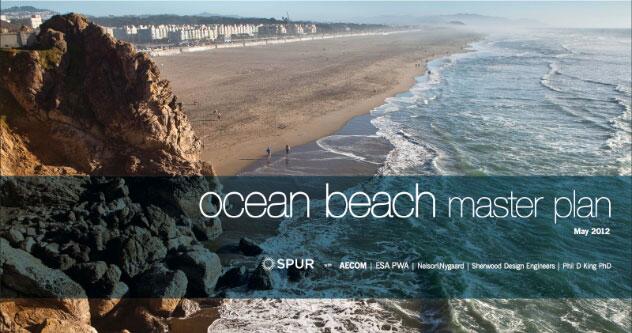
Ocean Beach Master Plan
Read the Ocean Beach Master Plan >>
Ocean Beach is one of the gems of the San Francisco landscape, but faces significant challenges. For the past two years, SPUR has led an extensive interagency and public process to develop the Ocean Beach Master Plan, a comprehensive vision to address sea level rise, protect infrastructure, restore coastal ecosystems and improve public access.
Report: Ocean Beach Master Plan
A more sustainable future on San Francisco’s coast
Article: Taking the Long View at Ocean Beach
Article: Planning for a Changing Coastline
RECENT NEWS
-
Thursday, March 28, 2013By Shannon Fiala & Shilpi Chhotray
Fleishhacker Pool with sand dunes, 1925. Photo credit: San Francisco History Center, San Francisco Public Library.
The Coastal Management Framework (CMF) is a new project that sets the stage for implementation of the Ocean Beach Master Plan’s (OBMP) approach to coastal management through the year 2050 in the context of severe erosion and climate-induced sea level rise. The OBMP presents a series of recommendations designed to improve and restore conditions at Ocean Beach- including managed retreat, beach nourishment, and innovative approaches to protecting threatened infrastructure while maintaining recreational access and ecological functions. The Framework will include interim protection strategies in anticipation of extreme weather events, as well as a long-term strategy for adapting to sea level rise, and it will lay the foundation for an interagency coastal management agreement among the three major responsible agencies, San Francisco Public Utilities Commission (SFPUC), Golden Gate National Recreation Area (GGNRA) and the United States Army Corps of Engineers (USACE).
SPUR has been working closely with SFPUC and GGNRA staff to scope this project. In January, SPUR hired a team of coastal engineering consultants led by Bob Battalio at ESA PWA and Dilip Trivedi at Moffatt & Nichol. Other team members include AGS, Inc. and Jacobs Engineering, as well as coastal plant ecologist, Peter Baye. On January 31st, 2013, SPUR kicked off the CMF project with participants from the SFPUC, GGNRA, USACE, San Francisco Department of Public Works (DPW), and the consultant team.
Interim Planning
The team’s first task will create a near-term (1-10 year) approach to coastal management. Over the next few months, the consultant team will work with SFPUC, GGNRA and USACE to investigate best practices and case studies for innovative coastal protection strategies, emphasizing options that are reversible, minimally impactful, and compatible with Ocean Beach Master Plan recommendations. The interim approach will build on recent successes using softer approaches to coastal protection, including the use of temporary sandbags and the placement of large quantities of excess sand from the north end of the beach.The team will also identify key triggers phasing of coastal protection measures at Ocean Beach.
Over a longer time scale, the team will develop an approach to cleaning up debris and rubble south of Sloat Boulevard, as well as a managed retreat approach for gradually closing the Great Highway south of Sloat, allowing for the coastline to recede and for new restoration and recreational opportunities. This process will require careful coordination with the California Coastal Commission, as well as OBMP stakeholders, in determining the best strategy.
Coastal Engineering Feasibility Studies
The next task will result in the production of two studies, a Coastal Vulnerability Analysis Study, and a Coastal Engineering Feasibility Study, to test and develop the concepts outlined in the OBMP. The first is an expanded analysis of existing and projected coastal hazards through erosion and flooding, taking account of the complex dynamic processes that shape the coast... The second study will analyze the vulnerability of coastal infrastructure and will develop a suite of protection measures, such as managed retreat, sand placed through beach nourishment, dynamic cobble berms and low-profile structures. This effort will develop a “multi-objective” approach to coastal protection, meaning that it will address ecological, recreational, and aesthetic considerations along with engineering and cost imperatives.Coastal Protection In-Situ Pilot Studies
The team will also recommend and design pilot studies of coastal protection measures at Ocean Beach, studying the performance and behavior of different interventions in the unique and challenging conditions there. The interplay of the underlying geology, existing and placed sand, exposed fill, and innovative tools like dynamic cobble berms needs to be better understood to support an adaptive approach to coastal management at Ocean Beach, and these studies would provide critical information.Interagency Coastal Management Agreement
Ultimately, SPUR and its partners will produce a Coastal Management Framework Report that will provide the basis of an agreement among the SFPUC, Army Corps, and GGNRA. This agreement would include a 40-year Coastal Protection Strategy, including a strategy for Capital Planning to fund these construction projects and a strategy for moving these projects through the environmental review and permitting process.Moving Forward
Throughout this process, SPUR will coordinate the work of the team and agency partners, continue its public outreach efforts, and steward the Ocean Beach Master Plan vision. Keep an eye on our blog, Facebook, and Twitter (add links) for additional updates on OBMP’s implementation studies, including more detailed posts on the Transportation and Joint Open Space Planning projects! -
Thursday, February 7, 2013By Shilpi Chhotray
Ocean Beach looking northwest and the Great Highway’s southbound lanes, closed for sand maintenance. In the next phase, SPUR will investigate the traffic and transportation impacts of permanently closing the Great Highway south of Sloat Boulevard, as well as innovative strategies for managing coastal erosion. Photo courtesy Flickr user Robert B. Livingston
For the past two years, SPUR has led an extensive interagency and public process for the development of the Ocean Beach Master Plan. This work represents the first move SPUR and San Francisco have made to directly address sea level rise. Now we are beginning the first steps to implement the plan, which presents recommendations for the management and protection of San Francisco’s Ocean Beach through the year 2050. The master plan lays out an ambitious and proactive vision to adapt to rising seas, protect infrastructure, restore coastal ecosystems and improve public access. The vision was developed through the participation of a wide range of public agencies, advocates, and citizens over an 18-month period.
Read the complete Master Plan >>
Immediate Successes
The Ocean Beach Master Plan is already achieving tangible benefits and improved partnership among public agencies. In August and September of 2012, the Golden Gate National Recreation Area (GGNRA) partnered with the San Francisco Public Utilities Commission (SFPUC) to truck 73,000 cubic yards of excess sand from the north end of Ocean Beach to the south, tackling two problems at once: the record accumulation of sand at the north end, and severe erosion at the south end. The results — a “sacrificial” dune protecting the beach and covering unsightly rubble — hint at the potential of large-scale beach nourishment, a key ingredient in the Ocean Beach Master Plan vision.This year, the San Francisco Department of Public Works (DPW) is repaving the Great Highway from end to end. As key a partner on the master plan, DPW was well aware of the plan’s proposals to improve pedestrian and bicycle access to Ocean Beach. DPW Director Mohammed Nuru directed his staff to add recommended planted medians and improved crossings to the repaving project, which will improve safety and access while improving environmental performance and aesthetics.
SPUR Leads Implementation Studies
The Ocean Beach Master Plan is a vision document. Although it is already shaping actions on the ground, it doesn’t yet have the force of law or policy. SPUR is now engaged in efforts to implement the vision, helping to translate plan recommendations into implementable projects, develop more detailed technical analysis, and prepare for environmental and regulatory review. We have been awarded funds from the California State Coastal Conservancy, the San Francisco Public Utilities Commission and the National Park Service to conduct implementation studies. These will include a transportation analysis, a coastal management framework and open space planning.
Transportation Study
Implementing the Ocean Beach Master Plan vision will require significant reconfiguration of roadways, including the closure of the Great Highway south of Sloat Boulevard, the re-routing of traffic behind the San Francisco Zoo via Sloat and Skyline, and the redesign of Sloat Boulevard into a multi-modal coastal gateway. This project will conduct detailed transportation analysis, including an existing conditions study, the development of roadway configurations based on Ocean Beach Master Plan recommendations, and modeling the effects of the proposed changes on the city’s transportation system.SPUR is working closely with SF Municipal Transportation Agency and SF Planning Department staff to scope this project and ensure it will meet the city’s technical requirements.
Coastal Management Framework
The Framework will test and further develop the master plan’s approach to coastal management, which includes a combination of managed retreat, beach nourishment and coastal armoring, all designed to protect threatened infrastructure while also supporting coastal access, recreation and ecological functions. This study will include interim protection strategies, as well as defining triggers and actions as sea-level rise sets in. It will lay the foundation of an interagency agreement for adaptive coastal management actions by the three major responsible agencies (SFPUC, GGNRA and the United States Army Corps of Engineers).SPUR is working closely with SFPUC and GGNRA staff to scope this project and hire a coastal engineering consulting team.
Listen to SPUR's Ben Grant in KQED's piece on managed retreat: "San Francisco: A Test Case for Coping with Rising Seas."
Joint Open Space Planning
This project will coordinate collaboration between local and federal partners in managing Ocean Beach as a recreational and ecological resource. The study will include open space schematic design and programming studies, as well as pilot studies and the installation of temporary amenities. It will lay the foundation of an interagency agreement for open space management actions by the two major responsible agencies, GGNRA and the SF Department of Recreation and Parks).Stay tuned for more updates on the implementation of the Ocean Beach Master Plan!
-
Wednesday, February 6, 2013BY SHILPI CHHOTRAY, OCEAN BEACH INTERN
King Tide at Ocean Beach, looking south towards the Sloat Blvd parking lot on Christmas Eve 2011. Flickr user poe.
California’s changing coastline is urging resource managers to plan for the immediate and long-term impacts of climate change on their local ecosystems and infrastructure. With no single lead agency planning for climate change, collaboration among governmental agencies, NGO’s, academic institutions, and communities is integral to plan for coastal adaptation measures. The Bay area is home to several citizen-based organizations and agencies working towards these efforts. SPUR’s Ocean Beach staff works closely with many of these groups on sea level rise planning for Ocean Beach to facilitate communication and coordination while keeping the long view in focus.
Last month, Ocean Beach staff attended the 3rd Biennial Ocean Climate Summit, hosted by NOAA’s Gulf of the Farallones National Marine Sanctuary Program. The Summit gathers participants to collaboratively sustain the North-central coast and ocean ecosystem health. The conference garnered participation from 130 individuals across various fields to discuss the impacts of climate change and ocean acidification, as well as education and outreach efforts to inspire action within the community.
Science-based planning for resource managers
During the forum, we learned how to engage diverse audiences about climate change and ocean acidification, promote action, and advocate nature-based ‘climate smart’ conservation. One of the highlights was the beta launch of the Our Coast- Our Future Decision Support Tool, which models vulnerabilities from sea level rise and storm hazards for impactful decision-making. The science-based tool is useful for resource managers and local governments to anticipate coastal climate change impacts.
Getting the public involved
Another area of focus was framing complex topics like sea level rise and ocean acidification for non-scientific audiences. For instance, The California Academy of Sciences (CAS) has an entire program area dedicated to message framing for ocean acidification. It turns out, a simple example of linking the Ph level in lemonade to ocean acidification draws in CAS visitors effectively and also prompts them to think about solutions for healthy oceans. Learn about “Framed” Ocean Acidification Messaging.
A citizen supported project that utilizes the power of social media, the California King Tide Initiative encourages members of the public to upload photos of king tides, the highest seasonal tides on the California coast. The documentation is used to demonstrate how sea level rise impacts private property, public infrastructure, and wildlife habitat.SPUR presents the Ocean Beach implementation studies!
The Summit is a great way to connect information, resources, and people across disciplines to work collaboratively, so we took the opportunity to share a poster on the Ocean Beach Master Plan implementation studies. These studies highlight SPUR’s proactive approach in planning for sea level rise and include a Transportation Analysis, a Coastal Management Framework, and Joint Open Space Planning. -
Tuesday, December 18, 2012Shannon Fiala
This semester at the University of California at Berkeley’s Department of Landscape Architecture and Environmental Planning (LAEP), the Landscape Project Design studio (LA 203) examined Ocean Beach as their study site. Lead by Alma Du Solier, Principal at AECOM, fourteen Master of Landscape Architecture (MLA) students chose one of the six key moves of the Ocean Beach Master Plan (OBMP) and designed one small pedestrian node and a walkway that incorporated a strategy/element for passive energy harvesting to provide off-the-grid illumination. We would like to showcase these students’ work as examples of innovative ideas for addressing the complex issues facing Ocean Beach. However, **please note** these ideas do not represent the views of SPUR or OBMP stakeholders. Moving from south to north along Ocean Beach, each student provided a brief summary of their design concept, which precedes images of their work.
Steven Lee - Key Move 1+2“The rerouting of the Great Highway at Sloat Boulevard makes it possible to re-imagine the southern end of Ocean Beach as a more socially and ecologically beneficial landscape. Based on the concept of shifted orientations, this project proposes a new public plaza and a pier that would extend half a mile into the ocean and overlook a dynamic sand island that would gradually erode away to counteract coastal erosion.”
Image credit: Steven Lee
Annie Hansel - Key Move 2
“My project is a reaction to the rapid erosion that is taking place in the south reach of Ocean Beach where the Lake Merced Tunnel and other sewer pipes are at risk of exposure in the near future. The infrastructure embedded in the portion of the coast in front of the Fleishhacker Building is strategically reinforced from above with steel sheet piles and concrete staples, allowing nature to run its course and gradually reveal the fixed landscape over time. The form of the site responds to current erosion trends and view sheds, and highlights the juxtaposition of the fluid landscape and the anchored infrastructure.”
Image credit: Annie Hansel
Robin Kim - Key Move 2
“Using the Fleishhacker Pool House as the focal entry to the beach, my project combines infrastructure and eroding forces to reveal change through procession in space. New structures and pathways combined with the retrofitting of the pool house provide amenities for various users and allows flexibility in an ever-changing landscape.”
Image credit: Robin Kim
Katelyn Walker - Key Move 4
“Following Ocean Beach Master Plan key move four to "restore the dunes in the middle reach," this design looks at how people and infrastructure will be integrated into this new landscape without negatively impacting the ecology of the restored dunes. Primary paths to the beach, located at key intersections such as Judah Street, maintain their position in the new shifting native dunes through the use of sand fences, while secondary paths can be easily picked up and moved as the dunes change. A boardwalk promenade in the back dunes parallels the Great Highway and allows sand, plants, and animals to move underneath.”
Image credit: Katelyn Walker
Angela Delorenzo - Key Move 4+5
“My project looks into the boundaries between the urban area and the beach area represented by the seawall and the current man-made dune system. My analysis was based on understanding which are the key elements that persist to provide wilderness sense and recreational services.”

Image credit: Angela Delorenzo
Jenika Florence - Key Move 5
“This multidimensional gateway provides a new entryway experience to both Golden Gate Park and Ocean Beach at the intersection of the Great Highway and John F Kennedy Drive. Framing the Great Highway, new gathering spaces inspired by the park and the beach provide recreational amenities.”
Image credit: Jenika Florence
For larger versions of these images, please click here.
-
Monday, October 1, 2012By Shannon Fiala, Ocean Beach Master Plan Assistant Program Manager
The City of San Francisco and the National Parks Service recently partnered to fight erosion by placing sand at the southern end of Ocean Beach. Image courtesy of the San Francisco Department of Public Works.
Over the past two months, the National Park Service, Public Utilities Commission and Department of Public Works collaborated to move more than 73,300 cubic yards of sand from the north to the south end of Ocean Beach to provide protection against erosion. This process stabilizes the coast temporarily and provides useful data about coastal erosion rates. In addition to reducing the need for more engineered erosion protection measures, such as large piles of boulders, the Ocean Beach Sand Management Project also restores public access on the north end of the beach, where sand had built up, blocking the promenade and stairwells.
Why does sand erode in some places and accrete in others? Sand accumulates at the northern end of the beach through a complex interplay of natural sediment dynamics and management practices. Among other things, United States Army Corps of Engineers annually dredges the Golden Gate Marine Shipping Channel through an offshore sandbar and places the dredged sand in two sites, where it is picked up by ocean currents and eventually deposited on Ocean Beach. The effects are especially notable during the spring, when shifting winds and currents deposit significant amounts of sand and create large sand mounds in the north. This system is part of a pattern of sediment circulation that moves sand from the Golden Gate to about the middle of Ocean Beach, gradually pushing it northward. (See a video of this process in action.)
While the northern end of Ocean Beach has been widening due to these natural and manmade factors, the southern end of Ocean Beach experiences a net loss of sediment as circulation patterns move sand southward. Winter storms will probably cause additional erosion near Sloat Boulevard. Unchecked, this erosion is likely to have environmental consequences and damage city infrastructure, including San Francisco’s wastewater treatment system.
Going forward, the Army Corps of Engineers plans to eliminate the need to move sand by truck and will deposit dredged sand directly where erosion is worst. The Corps will move four times this year’s volume of sand from the Marine Shipping Channel and pump it directly onto the beach near the intersection of Great Highway and Sloat Boulevard. This beach nourishment project is fundamental to recommendations SPUR has made in the Ocean Beach Master Plan. It is also part of the Coastal Regional Sediment Management Plan, a new interagency effort between the Army Corps and the California Natural Resources Agency. That process will study sediment management options from Baker Beach in San Francisco to Shelter Cove in Pacifica, including beach nourishment, artificial reefs and managed retreat.
As SPUR and our partners continue to plan for climate change and sea level rise at Ocean Beach, these kinds of nimble, adaptive multi-agency efforts will become increasingly important. Projects like these help bridge the gap until SPUR’s Ocean Beach Master Plan recommendations can be implemented. -
Thursday, July 5, 2012By Benjamin Grant, Public Realm and Urban Design Program Manager
New highway medians will help make access to Ocean Beach safer for pedestrians crossing the vast expanse of the Great Highway. Photo courtesy flickr user dannebrogSome important improvements that SPUR recommended in the Ocean Beach Master Plan will happen right away, thanks to quick work by the San Francisco Department of Public Works (DPW) and the Recreation and Park Commission. This winter DPW will construct a planted median in the center of the Great Highway from Lincoln Way to Balboa Street as part of a previously scheduled project to repave the roadway. DPW acting director Mohammed Nuru, who sits on the Ocean Beach Master Plan Steering Committee, noticed that the long-range vision for Ocean Beach included street medians among its many suggested improvements. Rather than delay the repaving project while the long-term roadway proposals are analyzed, Nuru suggested that a median could be integrated into the current effort, provided it didn't change the configuration of the road, which would trigger a complex review process.
The project will install landscaped medians where today they exist only in paint. It will improve pedestrian safety and access to the beach by providing shorter crossings and pedestrian refuges, as well as clarifying rights of way on large swaths of currently unmarked pavement. It will also improve the aesthetics of the highway, as well as its environmental performance, by providing much-needed greenery and increasing permeable surfaces for stormwater infiltration in what is now a large, undifferentiated slab of asphalt. A selection of rugged native plants suitable for the beachfront’s challenging climate is under development.
The only concern that emerged about the project was ensuring that the Great Highway could continue to accommodate major events such as the Nike Marathon and Bay to Breakers races. A review of the proposal with Recreation and Parks Department event managers allayed those fears. The project went before the Recreation and Parks Commission Capital Committee in early June and the full Commission on June 21. Installation is set to begin as part of the larger repaving project this winter.
Read the staff report on the project >>
-
Tuesday, June 26, 2012
At last, the final Ocean Beach Master Plan document is ready for viewing and download! Many thanks to everyone who participated in this groundbreaking effort, including community members, advocates and public agencies. Check back here for updates on our implementation efforts.
The viewer below allows easy zooming and page-turning to make this very large document readable. Click the "Expand" button below in order to see it at full-screen size. Then zoom in using the scroll bar (white circle) at the top left.
You can also download the whole document >> [70MB, 210 pages]
Unfortunately, we lack the funds to provide hard copies of the full document. If you would like one, stay tuned. We will be arranging a print-on-demand service where you can purchase a copy.
-
Tuesday, April 17, 2012
The Ocean Beach Master Plan continues to be developed. Please check back here for the final document. In the meantime, you can download the draft version:
Draft Ocean Beach Master Plan Document >> [pdf download - warning: file is 75 MB]
-
Friday, March 16, 2012
The Final Ocean Beach Master Plan will be available for public review soon. Thanks again to all who have provided input on the Draft Ocean Beach Master Plan. We will take this feedback into account as we refine the final document over the next week.
For those of you that missed our recent Lunchtime Forum on unveiling the Ocean Beach Master Plan, here is the video on the Ocean Beach vision:
Ocean Beach Vision from SPUR on Vimeo.
-
Friday, February 17, 2012
Ocean 海灘總體規劃建議草案
在過去的一年,三藩市規劃及城市研究協會(The San Francisco Planning and Urban
Research Association, SPUR) 正與公共機構、社區人士、權益關注者和其他持份者一同
工作,為Ocean 海灘總體規劃建議草案提供建議。這份總體規劃建議的目標旨在應對
Ocean 海灘一系列複雜的問題,當中包括基建、消閑娛樂、開放空間、瀕危的動植物、
以及在將來的可持續性等。在一系列讓公眾參與的研討會中,每一個備受關注的領域都已
被清楚解釋和作出討論。
最終建議包括以下六項重要舉措:
重要舉措 1 改變位於動物園後Great 高速公路在Sloat 大街和Skyline 街之間的路線
重要舉措 2 引入多用途海岸保護/修復/入口系統
重要舉措 3 為管理設施的用地而減少Great高速公路的寬度
重要舉措 4 中段海灘沙丘的收復
重要舉措 5 為金門公園通往海灘提供更好的連接
重要舉措6 改善Balboa 街以北的自行車道及行人道
要閱讀整個Ocean 海灘的總體規劃,可瀏覽網頁: http://www.spur.org/ocean-beach。
歡迎公眾提供意見,如果想知道如何去提出您的意見,可到網頁
http://www.spur.org/ocean-beach 查看相關的指示。請將您的意見在2 月29 日之前提
交。
Resources
San Francisco plans expensive ‘managed retreat’ from rising seas Grist, 02/04/13
Ocean Beach Master Plan Envisions Big Changes SF Public Press, 02/04/13
San Francisco a Test Case for Coping with Rising Seas KQED, 02/01/13
New plan crafted to limit Ocean Beach erosion SF Chronicle, 11/02/12
Ocean Beach sand management project wraps up ABC Local News, 09/20/12
Shifting Sands: San Francisco Begins Huge Erosion-Control Project KQED, 08/22/12
Sand Mangement Project to partly close Great Highway OB Bulletin, 08/19/12
Great Highway lane work delayed SF Chronicle, 08/09/12
Mayor Lee Celebrates SPUR Ocean Beach Master Plan SF Mayor’s Office, 07/26/12
Turning the Tide at Ocean Beach KQED News, 07/26/12
Shifting sand to be transported elsewhere in San Francisco SF Examiner, 07/23/12
Ocean Beach sand plan could help curb erosion south of Sloat OB Bulletin 07/20/12
Ocean Beach master plan maps $300M project SF Business Journal, 06/22/12
Stay or go? Communities are eyeing a retreat from sea NBC News, 06/02/12
San Francisco's Coast and the Rising Sea KQED, 04/10/12
San Francisco's Battle With Mother Nature Planetizen, 03/28/12
Coastal Erosion in SF Prompts Planning and Debate KQED, 03/26/12
Both Coasts Watch Closely as SF Faces Erosion The New York Times, 03/24/12
Makeover could mean changes on Great Highway SF Examiner, 11/12/11
OBMP Envisions Big Changes for Great Highway KQED, 11/07/11
Erosion expected to strip economic value of Ocean Beach OB Bulletin, 09/13/11
Erosion problems threaten the future of Ocean Beach ABC Local News, 09/05/11
State panel rejects city's repairs to Ocean Beach SF Chronicle, 07/15/11
Violent Pacific storms of 2010 worst on record SF Chronicle, 07/14/11
Public urged to help decide fixes for Ocean Beach erosion Sunset Beacon, 02/01/11
Forces of Nature are Working to Destroy Ocean Beach The Bay Citizen, 01/25/11
On the Brink of an Ocean Beach Master Plan OB Bulletin, 09/21/10
Is It Worth It to Save Oceanfront Development? The New York Times, 09/13/10
Experts Call for Long-Term Fix for Beach Erosion Sunset Beacon, 11/01/10
Ocean Beach due for an overhaul SF Examiner, 07/08/08
California Climate Change Publications California Climate Change Portal
The Impacts of Sea-Level Rise on the California Coast Pacific Institute
Coastal Regional Sediment Management Project USACE, CA Resources Agency
FEMA California Coastal Analysis and Mapping Project (CCAMP) FEMA
Our Coast Our Future (OCOF) GFNMS, PRBO, USGS
Western Shoreline Plan (Local Coastal Program) SF Planning
Ocean Beach Task Force Summary (2005) Ocean Beach Task Force
Great Highway- Reports, Presentations, and Fact Sheets SFDPW
South Ocean Beach - Shore Management Discussion Bob Battalio, PE