Water treatment is one of the most essential components of infrastructure in any city. In order to make high-density city life viable, people had to learn how to manage water - to keep the drinking water pure, to treat the sewage, to prevent flooding. But the old arts of water management are being reinvented today, as the sustainability movement focuses its attention on this long-forgotten dimension of urban infrastructure. In San Francisco, much of our combined sewer system - so-called because it treats both sewage and stormwater - is between 70 and 100 years old. Many parts of the system need to be repaired or replaced. This presents a rare opportunity: for the first time since the Clean Water Act in 1972, San Francisco has the opportunity to consider what kind of wastewater infrastructure will best serve the city in the long run.
The San Francisco Public Utilities Commission's Sewer System Master Plan will guide large capital investments in our stormwater and wastewater infrastructure for the next 30 years. The multiyear planning process includes several opportunities for the public to review and comment on the plan. This article includes SPUR's analysis of the wastewater plan - and our recommendations for how to evaluate the document when it is published by the SFPUC this fall.
BACKGROUND
For two years, the SFPUC has been drafting a 30-year Master Plan for San Francisco's wastewater system. The master plan seeks to increase reliability and sustainability of our wastewater system by upgrading aging pipes and facilities, minimizing sewer overflows, and addressing specific neighborhood and environmental justice concerns such as odor and flooding. The previous master plan, adopted in 1974, focused on increasing the capacity of the City's system by building the new Oceanside plant, adding secondary treatment, and other changes designed to meet the higher standards embodied in the new Clean Water Act.
The theme of the forthcoming plan is sustainability, both in operations and outcomes. It focuses on better asset management, an integrated watershed-management approach to address stormwater issues, low-impact design, water reuse and renewable power. The plan is likely to contain several alternatives, with one preferred by the SFPUC. Once the draft plan is released, it will be subject to an environmental review; the final program will be adopted once that review is complete. The plan will be paid for primarily by increases in sewer rates.
Ratepayer sensitivity to increased charges has been a key element in the SFPUC's evaluation and selection of plan alternatives. While SPUR understands the need to keep rates reasonable, we also know that a reliable, sustainable system is a non-negotiable requirement for the city.
Based on our 2006 paper Integrated Stormwater Management: Adding an ecological component to San Francisco's streets, SPUR has drafted a set of criteria with which to evaluate the reliability and sustainability measures in the master plan. SPUR views these criteria as key elements that must remain in the final master plan as the draft is modified and alternatives are selected. These criteria will direct our attention to areas for further inquiry and concern, should they be missing or receive insufficient consideration in the draft master plan.
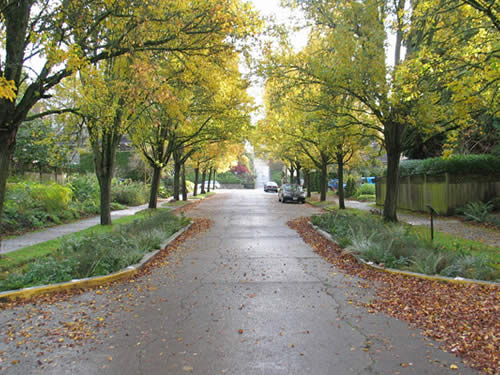 One of the main benefits of low-impact development is that it localizes stormwater retention instead of relying on a system of expensive, high-maintenance pipes to transport water to remote treatment facilities. But LID can also beautify streetscapes. This photo shows the results of a sewer system overhaul on a neighborhood street in Portland, Oregon. Photo courtesy of Kevin Robert Perry, City of Portland, Bureau of Environmental Services.
SPUR'S GOALS FOR THE PLAN
1. Minimize sewer overflows and flooding. Protecting human health and environmental quality should be the No. 1 criteria for any public investment in our sewers, which are, first and foremost, a public health service. Public health hazards from sewer system overflows and breakdowns include exposure to pathogens through street flooding, and from recreational contact at waterways and beaches. Overflows also can cause harmful discharges of untreated toxics, oil and debris to Bay and ocean waters, and fish and wildlife advisories for bacterial contamination. Minimizing the number and volume of annual system overflows - currently about 10 per year - should be the highest priority for the master plan. Minimizing public nuisances and environmental justice concerns related to the sewer system's facilities, such as noise and odors, also is important.
2. Maximize low-impact development tools to retain and reuse stormwater, and to benefit environmental restoration. The master plan should strongly commit to low-impact design strategies for stormwater management to reduce or slow down the volume of stormwater entering the collection system, and to filter pollutants. LID is not just for new development projects: It refers to a set of tools that can be applied in redevelopment, greening or restoration at a range of scales, from the lot to the neighborhood to the watershed. LID can increase the efficiency of wastewater treatment facilities by withholding cleaner rainwater from mixing with raw sewage. LID also can help to protect receiving waters from sewer overflows, while reducing local flooding and treating stormwater in place, and even while collecting it for beneficial reuse. Environmental benefits of LID can include landscape beautification, the restoration of streams covered by pavement or converted to culverts, the creation of habitat for native plants and animals, replenishing depleted groundwater supplies, and offsetting the demand for piped, treated water.
Proven LID tools that could be included in designs for parks and streets include constructed wetlands, street trees, bioswales, bioretention planters and rain gardens, and permeable paving. A 2005 study by San Francisco's Urban Forest Council found that street trees prevented approximately 13 million cubic feet of water from entering the sewer system annually, or about 1,000 gallons per tree. LID tools that can be incorporated in the built environment include green roofs, disconnected downspouts and cisterns. In Portland, Oregon, a program to control combined sewer overflows begun in 1995 disconnected about 4,400 downspouts per year through 2006, which permanently removed approximately 1 billion gallons of rainwater from the sewer system each year. When connected to cisterns or smaller rain barrels - several of which can be linked together through spillover hoses - downspouts can provide a source of water for landscaping, toilet flushing, laundry or other outdoor uses during drier times.
Each of these tools has a range of benefits and costs, so their selection must be appropriate for the community and underlying hydrology in which they are installed. For example, many of San Francisco's eastern neighborhoods are built atop steep slopes, impermeable soils and high water tables, warranting LID tools that retain or reuse stormwater, rather than those designed to permit water to infiltrate the ground.
Our hope is that LID techniques will be implemented at a large enough scale to serve as core elements of the Plan. This means that the SFPUC will need to develop different strategies in different watersheds within the city, based on soil type, groundwater, topography, and lot coverage patterns. The SFPUC already has estimated some of the costs of various LID tools and their benefits in the reduction of combined sewer overflows, as well as where they would be most beneficial in San Francisco. Each major improvement project should be evaluated for the degree to which LID can solve drainage problems. If it can't be the primary solution, then a percentage of the project's budget should be devoted to LID, either at the project site or within the same drainage basin.
3. Establish seismic reliability. The plan should set ambitious targets for seismic stability, the level of service provided, and the time in which service can be restored following a major earthquake event. Pipe- and facility-specific engineering criteria, which will be developed for each improvement project, need to support these targets. With many of our treatment plants vulnerable, and tunnels in the collection system approaching the end of their useful life at 70 to 100 years old, establishing seismic reliability is a major priority for this master plan.
To bolster system reliability even in a non-disaster scenario, the master plan should consider how to add flexibility or redundancy to the system, such as LID tools for stormwater, and should consider decentralizing liquid treatment, including recycled water facilities. Such approaches should be subject to a rigorous cost-benefit analysis that accounts for environmental services and reliability benefits, not just the up-front capital costs.
4. Maximize the beneficial reuse of resources extracted from wastewater, including biofuels, biosolids and reclaimed water. The plan should outline and invest in ways to make the wastewater system more sustainable by minimizing its use of energy, and maximizing the resources that can be captured and reused from wastewater. Three key resources include:
A. BIOFUELS. Treating wastewater is one of the most energy intensive activities in the city. The methane and carbon dioxide recaptured from the sewage-digestion process currently meets about 30 percent of the treatment plant's energy needs. The master plan should elaborate ways to increase renewable alternatives - such as solar panels and methods for converting food and grease waste to usable energy - to meet the remaining 70 percent. The SFPUC already runs a program to collect and filter used cooking oil from restaurants, which supplies City vehicles with biodiesel and continually improves the performance of sewers by reducing clogging.The collected grease can also be used as a source of on-site energy generation for wastewater treatment and can deliver surplus power back to the grid. The SFPUC can explore ways to expand this program and to store energy on site. For example, at King County, Washington's South Treatment Plant, cleaned digester gas is captured in an onsite fuel cell power plant that produces a net energy savings, even including the cell's operational and regular repair costs. The plant also can sell energy it does not use back to Puget Sound Energy.
B. BIOSOLIDS. The solid byproducts of treated wastewater, or biosolids, are the product of sewage sludge that meets stringent federal regulations and quality standards. Biosolids can be applied to land as fertilizer, and in some places it also can benefit forestry operations and mine reclamation. San Francisco's biosolids, approximately 80,000 tons per year, are only partially utilized for fertilizer, with the rest sent to landfills. The SFPUC should seek to develop additional uses or customers for this wastewater byproduct, and the master plan could describe ways for the City to enter into partnerships or contracts with other jurisdictions to put our biosolids to beneficial reuse.
C. RECLAIMED OR RECYCLED WATER. Not only can rainwater be intercepted and reused on site through LID tools, but wastewater also can be treated to a relatively high standard and pumped into a recycled water system. Federal and California regulations allow recycled water to be used for almost anything except drinking, so treated wastewater could be used for irrigation, industrial use, firefighting, recreation, toilet flushing, laundry and groundwater recharging. The SFPUC recently has developed a recycled water master plan for San Francisco, and the sewer system master plan should dovetail with this plan - to recommend ways to reconfigure or build more reclaimed water facilities and infrastructure, and to identify and assess users and end points. The city also can benefit from reducing the demand for potable water from its Tuolumne River supply, a system that is concurrently undergoing its own multibillion-dollar seismic retrofit and capacity upgrade process. In an effort that San Francisco might aspire to emulate, the city of Los Angeles puts 60 million gallons per day of recycled water to beneficial reuse in its parks, golf courses and zoo. San Francisco's master plan should set quantitative goals for the production and use of recycled water. It also should consider a decentralized approach to recycled water development projects. Rainwater, gray water and stormwater harvesting should be a new way of doing business.
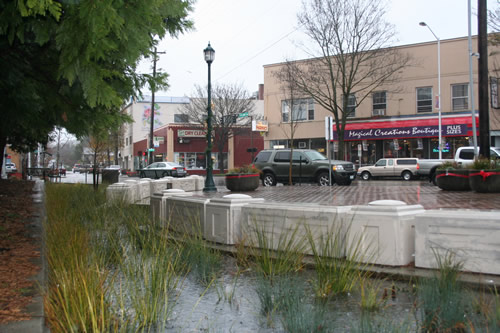 Rain gardens, planted with native reeds, lend a touch of natural beauty to this otherwise banal commercial parking lot. Photo courtesy of Nevue Ngan Associates.
5. Design the system to respond to a range of climate change scenarios. The master plan must model a range of scenarios for climate change and rising sea levels, and must develop a flexible set of mitigation strategies to be implemented in its earliest years. Seawater intrusion, or backflow into the collection system due to sea level rise, must be prevented, both at nearshore effluent outfalls and at combined sewer overflow outfalls. Estimates of sea level rise in San Francisco range from three feet to 23 feet within 100 years. Global warming may also change the timing and volume of storms in San Francisco. Pipe, storage box, force main and pump capacity may need to be altered or added to deal with these changes. The master plan must take climate change scenarios seriously and heed the precautionary principle by adopting a conservative, protective approach. It will be much more expensive to address flooding, backups, and system capacity and adaptability later, and it will be too late to prevent problems if we wait until the next long-range master plan.
6. Adopt a rate structure that reflects the contribution of stormwater to the system. Although funding options have not yet been specified, we assume that the primary funding source for the master plan will be sewer rate increases. As SPUR has suggested before, the SFPUC should consider restructuring the sewer rate structure to include a stormwater treatment charge proportional to the amount of impervious surface on the ratepayer's site. This would provide an incentive for property owners to manage the water that falls on their property in a sustainable manner. When a property owner installs a LID a green roof or cistern, or reduces the amount of impervious concrete or asphalt, he or she could petition for a reduction in the monthly sewer bill. The master plan should recommend a rate structure that creates the right incentives for property owners and creates clear ways to reduce water bills by reducing stormwater impact on the system.
7. Collaborate with other City departments to achieve multiple benefits from investments. The SFPUC should identify ways to work with other City departments, such as the Department of Public Works and the Recreation and Park Department, to implement elements of the master plan. Two areas for collaboration include stormwater design guidelines for streets and parks, and uses for recycled water, such as landscaping and streetsweeping. The Recreation and Park Department can play an important role in making parks “zero runoff” sites that act as amenities as well as infrastructure. The DPW can consider LID tools such as permeable pavement in appropriate watersheds and explore the possibility of using community-benefit districts (where property owners voluntarily levy extra fees on themselves to pay for extra neighborhood services) to provide enhanced maintenance for street trees or green medians. The DPW also will have the responsibility of ensuring that street enhancements, such as landscaped median strips, meet basic stormwater criteria developed in conjunction with the SFPUC and the Planning Department. The SFPUC and the Planning Department also can work together to raise public awareness and resources to help people comply with San Francisco law, which establishes fines for paving over front yards and requires lots to have a minimum of 20 percent unpaved landscape area in front setbacks.
8. Set ambitious, quantifiable performance measures. The master plan must contain a suite of performance measures for the SFPUC and the public to assess program efficiency and effectiveness, and to know if key outcomes are being achieved. Performance measures make agencies accountable to the public and help long-term programs stay on track. At a minimum, the sewer system master plan should have quantitative performance targets in the areas of sustainability, seismic reliability, human health and safety, beneficial reuse of resources, water quality, management of nuisances and complaints, and financial accountability and transparency. Performance should be reported annually or biannually throughout the 30-year life of the master plan, and program activities should be adjusted accordingly.
This is a rare opportunity for us to reconsider the right way to build our urban infrastructure. We are committed to making sure that San Francisco takes full advantage of this opportunity. During the review processes in 2008 and 2009, SPUR will host several public forums and discussions to present information on the plans and desired outcomes to inform public comments.
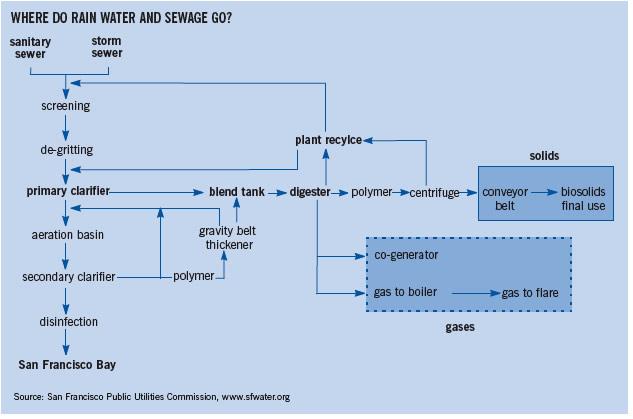 This diagram shows how liquids and solids are processed in San Francisco's combined sewer system. The screening and grit removal stages remove debris from stormwater before it is separated from solids, which move on in a parallel process ending in usable biosolids and methane gas that can be converted into electricity and hot water. Rain water undergoes a third level of clarification and disinfection before it is either recycled back into the system or discharged into the Bay.
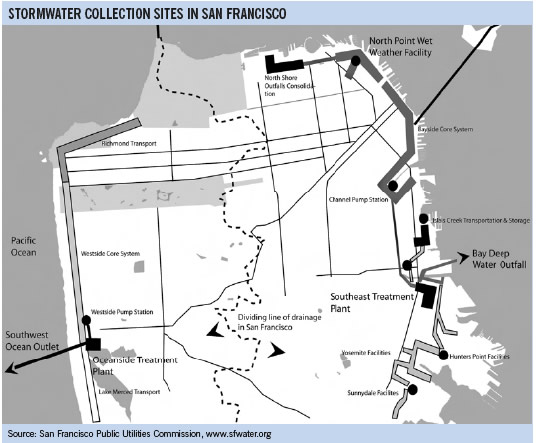 This system map shows the City's major wastewater control facilities. The Southeast Water Pollution Control Plant near Third Street and Evans Avenue treats sewage from the eastern side of the City. The Oceanside plant located near the zoo treats sewage from the western side.