
Photo by Michael Waldrep
Photo by Michael Waldrep
This article is excerpted from the SPUR report Public Harvest. Read the complete report at spur.org/publicharvest >>
Urban agriculture has captured the imagination of many San Franciscans in recent years. Two dozen gardens and farms have sprouted across the city since 2008, and in 2011 the city changed its zoning code to permit urban agriculture in all neighborhoods. Interest in urban agriculture stems from its numerous benefits. City farming and gardening provides San Franciscans with vibrant greenspaces and recreation, education about fresh food and the effort it takes to produce it, cost savings and ecological benefits for the city, sites that help build community, and a potential source of modest economic development. But the city will not fully capture these benefits unless it takes advantage of the growing interest and energy behind the issue.
The demand for more space to grow food is strong. Surveys since 2005 have consistently demonstrated long waiting lists at many of the city’s community gardens. In most cases, residents must wait more than two years to get access to a plot. The launch of more than 20 new urban agriculture projects in the past four years is another indication that the current amount of land dedicated to urban agriculture is insufficient.
The challenge ahead is matching residents’ interest with public resources. Private land and private funding alone are not sufficient to meet the demands for urban agriculture space in our dense city. In our report, Public Harvest (spur.org/publicharvest), excerpted here, we argue that the city must improve its existing programs and expand the availability of public land, funding and institutional support.
Currently, at least seven city agencies provide monetary support, and 11 agencies provide land to city gardeners and farmers. Though well intentioned, their support is largely uncoordinated, understaffed and, as a result, inefficient. While city funding for urban agriculture has increased during the past five years, it has decreased from a peak a decade earlier and is in the middle range when compared to other large American cities.

Photo by Eli Zigas
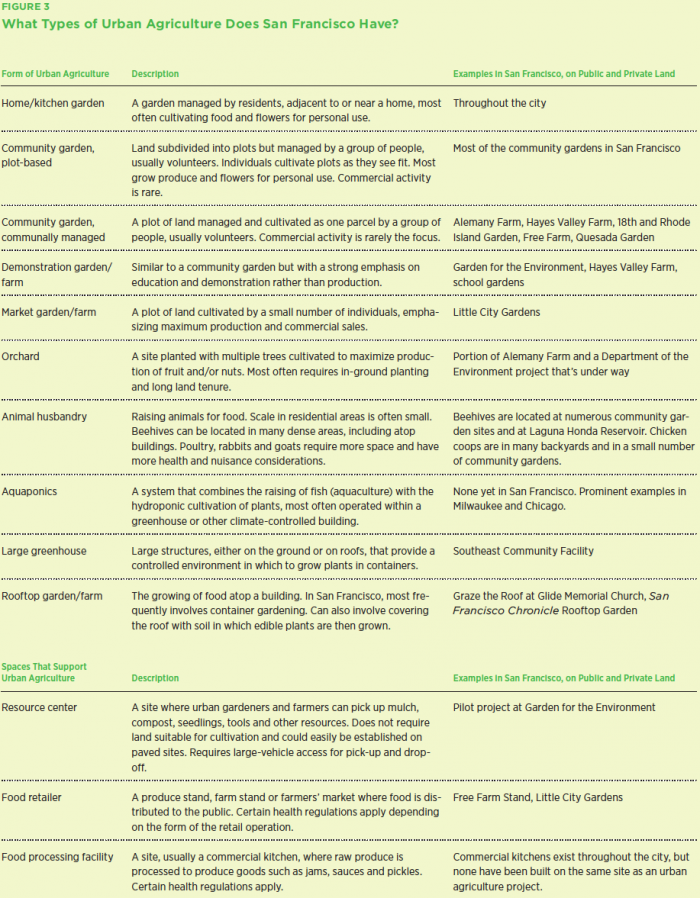
Urban agriculture is the growing of food through intensive plant cultivation and animal husbandry in and around cities. Urban agriculture takes many forms, including community gardens, city farms, greenhouses, rooftop beehives, school gardens and backyard chicken coops. In our report, we focus most of our attention on community gardens and city farms. SPUR supports urban agriculture because it provides multiple benefits to San Franciscans and the city as a whole. Key benefits include:
Connecting city residents to the broader food system
Most food is grown outside of urban areas, which results in a disconnection between city residents and the broader food system that supports their communities. Urban gardening and farming can close this gap. Community gardens, school gardens, market farms and even the local beehive provide opportunities for education and appreciation of food systems.
Providing greenspace and recreation
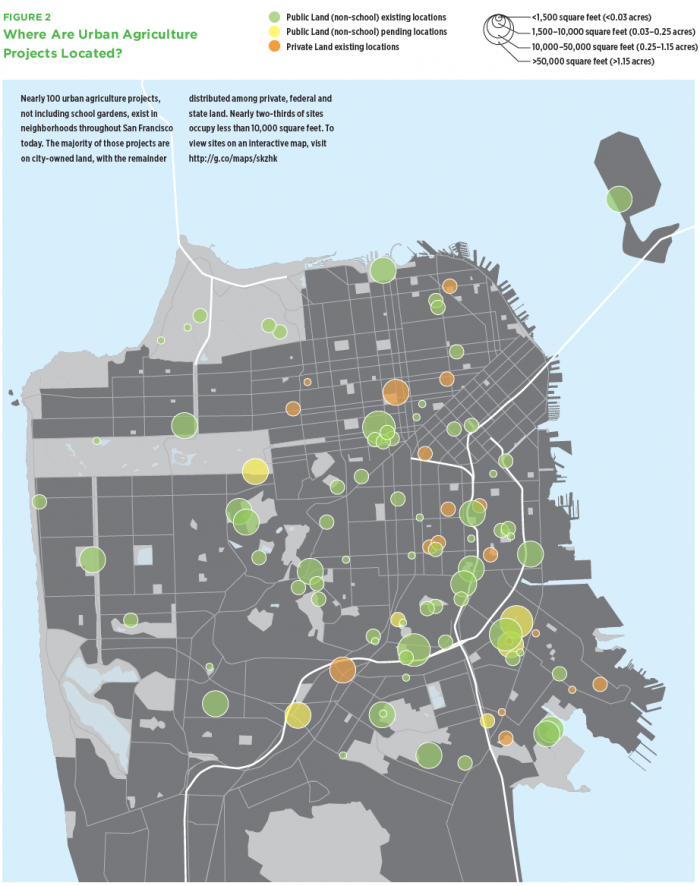
The city has nearly 100 gardens and farms on both public and private land (not including school gardens) that are enjoyed by thousands of residents. In the past few years, multiple urban agriculture projects have transformed vacant or neglected lots into vibrant spaces.
Saving public agencies money
Gardens and urban farms on public land can reduce the city’s landscaping, weeding and maintenance expenses for those sites. Community groups that begin managing previously vacant lots can also help prevent these sites from becoming informal dump sites, saving the Department of Public Works an estimated $4,100 per year at each site.[1]
Providing ecological benefits and green infrastructure
Gardens and farms absorb rainwater, cool down hot urban environments, and provide habitat for birds and insects. These ecological benefits reduce stress on the city’s sewage system, lower energy demand on hot days and support biodiversity. Studies indicate that a roof planted with vegetation can reduce stormwater runoff by 40 to 80 percent, helping decrease the likelihood of sewage discharges into the ocean and bay. The insulating effect of soil atop a roof can reduce building energy costs by 6 percent annually.
Building community
Almost any garden or farm coordinator can tell a story of how their project has helped knit together a group of people in a way that few other urban spaces do, and researchers have documented the increase in social cohesion that urban agriculture projects often provide.
Offering food access, public health and economic development potential
Urban agriculture in San Francisco also has the potential to contribute to the city’s efforts to enhance food access, improve public health and create jobs. Food access is the availability of fresh, healthy food within a neighborhood. While several studies show that, compared to a grocery store, urban agriculture can provide only a small amount of the nutritional needs of neighborhoods that don’t have good access to fresh produce[2], but urban agriculture can be an important supplemental tactic within a comprehensive food-access strategy. For individual gardeners, the harvested produce can provide substantial access to fresh, nutritious food at low cost. For a neighborhood, gardens and farms can provide education on nutrition and healthy eating. [3]
From an economic development perspective, the potential of commercial urban farming remains unclear. In the Bay Area, numerous businesses are testing various models for achieving profitability. A study in Vancouver found that urban farm owners were earning an average of $8.64 per hour in their first year of operation and expected earnings to increase as the businesses matured.[4]
Urban agriculture projects clearly do, however, provide job-training opportunities. The longest-running job-training program connected with agriculture on city-owned land is the Garden Project at the San Francisco County Jail in San Bruno, begun in 1992, which teaches farming and landscaping skills to 200 at-risk youth and ex-offenders each year.

Alemany Farm is on land owned by the Recreation and Parks Department. Photo by Richard Kay.
Existing urban farming businesses have not operated long enough to determine whether they offer longterm jobs. Until a commercial model of urban farming in a dense city proves to be viable and scalable, the economic development impact of urban agriculture in cities such as San Francisco will remain small.
SPUR does not support expanding urban agriculture with the goal of producing a substantial portion of the food that San Franciscans eat. In a city as densely populated as San Francisco, we cannot feasibly feed ourselves from what we grow within city limits.[5] However, an increase in the visibility and practice of urban agriculture will encourage San Francisco residents to consider the benefits and needs of a regional agricultural economy that can provide a substantial portion of the food the city eats.
In short, the benefit of urban agriculture in San Francisco lies not in its potential to feed the city but rather in its ability to educate consumers about fresh, healthy food and the effort it takes to produce it; offer vibrant greenspaces and recreation; provide savings and ecological benefits to the city; help build community; and, potentially, serve as a new source of modest economic development.

Within San Francisco, 11 city agencies, two state agencies and three federal agencies own land with urban agriculture projects. Some sites are managed by agencies or organizations other than the owners of the sites. This list does not represent the great number of sites owned by the San Francisco Unified School District, as it only includes those few that are accessible to the general public.

SPUR’s research focuses on the use of public land for urban agriculture because that land is relatively plentiful and because policymakers control it. Privately owned land suitable for agriculture is scarce and expensive in dense San Francisco. Yards adjacent to homes or apartments are usually small and, for the renters who constitute the majority of city residents, often inaccessible. The high value of land makes San Francisco’s private land market quite different from other cities experiencing a surge of interest in urban agriculture, such as Detroit, Milwaukee and Chicago.
Public land, in contrast, abounds throughout the city and can be made available through policy. City agencies control 19 percent of San Francisco’s land.[6] The city began moving in the direction of promoting urban agriculture in the 2011 draft of the Recreation and Open Space Element of the General Plan. The city’s task ahead is to direct agencies to make land, resources and institutional support available to urban agriculture projects.
More than 70 projects of many different types, excluding school gardens, currently operate on public land, ranging from the 120-square-foot container garden at the Mission branch library to the nearly 3-acre Alemany Farm. At least 11 city agencies, two state agencies and three federal agencies host urban agriculture projects on their properties within the city. Figures 1 and 2 (on pp.6-7) provide a summary of sites on public land in San Francisco. A complete list of gardens is available in our report at spur.org/publicharvest
San Francisco has close to 90 schoolyards with edible plantings which provide an invaluable educational opportunity to teach students about food, biology and nutrition. The gardens on school campuses, however, are less accessible to the general public than many other gardens on public land.


Though there are nearly 100 urban agriculture spaces on public and private land in the city — not including home or school gardens — many San Franciscans are still looking for a place where they can grow food. Though this demand for land is hard to gauge, a mix of indicators demonstrate a broad interest in finding space.
A 2011 survey of existing community gardens conducted by the Department of the Environment revealed that all the plot-based gardens that responded had waiting lists.[9] The wait times ranged from two months to 18 years, with two-thirds of the gardens reporting a wait list of two years or more. San Francisco’s waiting lists, which include at least 550 people, likely underrepresent actual demand.
Another indicator of demand for community gardens comes from a needs assessment conducted by the Recreation and Parks Department (RPD) in 2004.[10] The survey of 1,000 San Franciscans indicated that community gardens were the third most frequently desired recreation facility and fell in the top tier of facilities that residents consider most important.
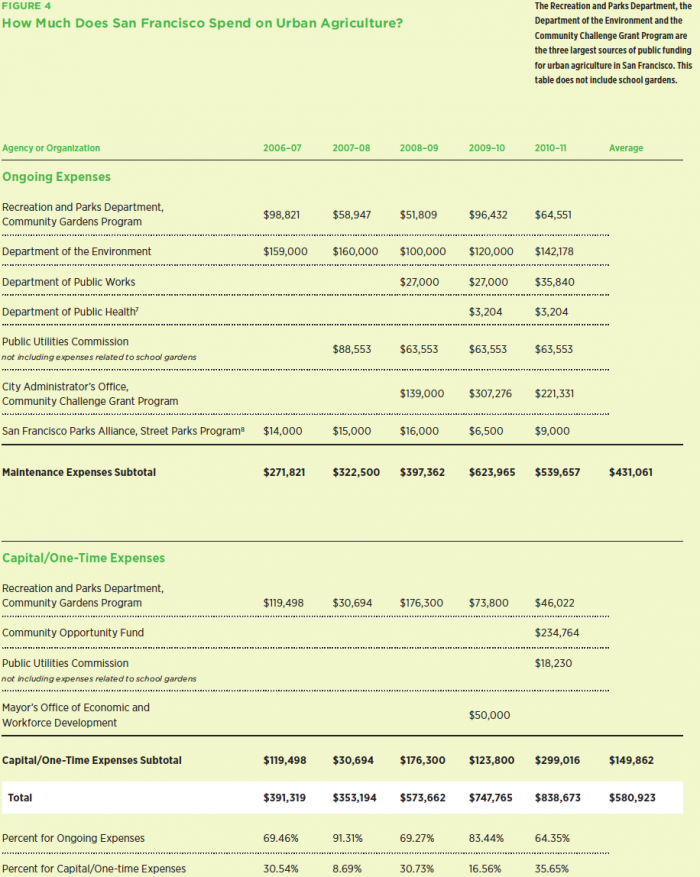
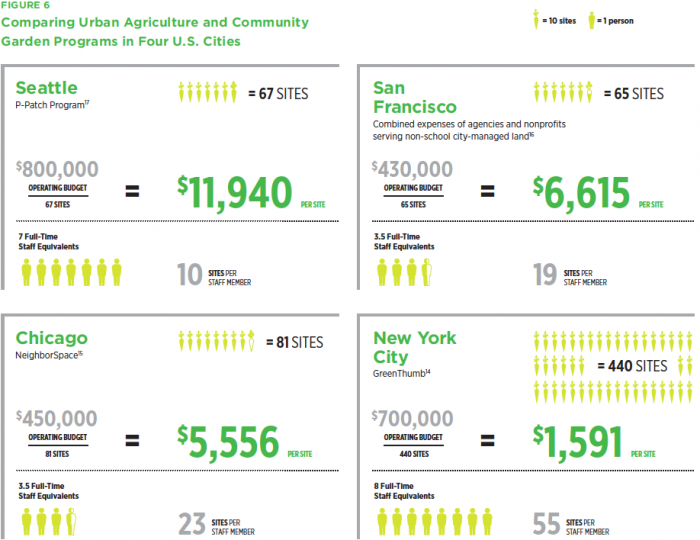
In the past five years, not including funding for school gardens, city agencies have spent an average of $581,000 per year on urban agriculture, including maintenance and administration of community gardens, educational programming and capital expenses for new sites. Funding by agency is detailed in Figure 4. In San Francisco (unlike New York, Chicago and Seattle), no agency dedicates a full-time staff person to community gardening or urban agriculture. The combined partial staff time of numerous individuals in city agencies and city-funded nonprofits equals approximately 3.5 full-time employees.[11]
The RPD, which manages the largest community gardens program, consistently spends the most of all agencies.[12] Funding for the Community Gardens Program, which averages approximately $150,000 per year, has not changed substantially in more than a decade. One notable exception is that in 2010, the RPD appropriated $235,000 from the Community Opportunity Fund for the installation of one new garden.
In the past three years, the Community Challenge Grant Program has provided an average of $220,000 to non-school projects with some urban agriculture component.[13] The Department of the Environment and the Public Utilities Commission (PUC) also contribute significant funds toward urban agriculture.
Figure 5: How Has Funding Changed in Recent Years?

Funding for urban agriculture on cityowned land has increased steadily during the past five years. The funding, spread among at least seven agencies and one nonprofit, goes primarily to pay for ongoing expenses, such as staff time, maintenance and programming.
The combined level of annual funding for urban agriculture in San Francisco is in the middle of the spectrum when compared on a spending-per-site basis with several other large U.S. cities with active community garden programs.
San Francisco’s current level of funding for community gardens nearly matches that of the early 1990s. At that time, the city partially funded the nonprofit San Francisco League of Urban Gardeners (SLUG). In 1994, SLUG’s budget was $500,000, roughly $750,000 in today’s dollars. By 1997, the organization reported a $2 million budget, with half of the revenue from city grants. Adjusted for inflation, the city was providing $1.4 million to SLUG, approximately 50 percent more than the city’s total funding for urban agriculture in 2010–11.[18] Following management issues and a political scandal, SLUG disbanded in 2004.19 Since then, public funding for community gardening and urban agriculture has declined to only a fraction of the previous peak levels.

After SLUG shut its doors, the city’s support for urban agriculture was dispersed across the patchwork of city agencies and nonprofits detailed in Figure 4 (page 10). Today, these organizations coordinate only loosely. This has led to an ad hoc approach to citywide support for urban agriculture.__
The RPD’s Community Gardens Program is the most prominent urban agriculture program within a city agency. It manages 35 sites throughout the city, serving approximately 1,000 gardeners. The Community Gardens Program is managed by one staff member at the RPD whose time is split between community gardens and other RPD capital projects. While the program supports many existing gardeners, it has difficulty meeting demand for more garden space. No new community gardens have been built on RPD land since 2007, and the last major renovation of a garden was in 2008.
Individuals or community groups interested in creating new community gardens on RPD land must demonstrate community support for the project, design a site plan, secure funding and receive approval from the Recreation and Parks Commission. For many individuals and community groups, this can be a complex, expensive and daunting process, even with the support of RPD staff.
In contrast, the Street Parks Program, administered jointly by the Department of Public Works (DPW) and the San Francisco Parks Alliance, has proven to be a very effective model for activating new communitymanaged spaces on land owned by DPW in the city such as unfinished streets, medians or other rights of way. Residents have created 145 new open spaces since the program began in 2004, with 100 of those projects launched just in the past three years.20 Only a small fraction of the street parks — approximately 15 sites — have edible plants. But, as a process for facilitating community activation of publicly owned land, the Street Parks model could be applied to an initiative that focuses on urban agriculture.
Beyond the Street Parks Program and the RPD Community Gardens Program, various city agencies have supported urban agriculture on an ad hoc basis. The Mayor’s Office of Economic and Workforce Development, for example, provided a $50,000 grant that launched Hayes Valley Farm in 2010. At around the same time, the Department of Public Health began supporting Growing Home Community Garden, also in Hayes Valley. While all of these projects have attracted considerable community support, to get off the ground each required committed project sponsors who had the time and ability to navigate city bureaucracy without an existing framework. This model can be effective, but it is difficult to replicate or expand.
SPUR’s recommendations focus on ensuring that more San Franciscans have access to space where they can grow food. From the perspective of a resident, this means the city would make it easier to find gardening space and resources. From the city’s perspective, it means a more efficient and streamlined approach to providing support and public land to residents and community groups that want to start projects. Specific indicators that the city has gotten better at capturing the benefits of urban agriculture would include:
Residents waiting no more than a year for access to a community garden plot or communally managed garden space
New urban agriculture projects launched on public land where residents demonstrate desire for the projects
The creation of a “one-stop shop,” which would provide information, resources and technical assistance for urban agriculture in the city, including a single application for starting a new project; this would be run either by a city agency or a nonprofit
More efficient use of public funds dedicated to urban agriculture, including lower costs for creating new sites and less duplication among city agencies
For San Francisco to better capture the benefits of urban agriculture, SPUR recommends a series of changes to provide more land, resources and institutional support to city gardeners and farmers.
1. Within the next year, the mayor should determine whether a city agency or nonprofit partner best serves as the main institutional support for urban agriculture.
The city’s current support of urban agriculture is broad but uncoordinated and inefficient. There is no “one-stop shop” for urban agriculture. The city would be better served by an agency or nonprofit organization that provides site management, site maintenance, technical assistance, interagency coordination and fundraising support for community projects.
Changing priorities or reorganizing various agency programs under one roof could position a city agency as the main institutional support for urban agriculture. This would likely require consolidating funding for urban agriculture that is currently split among many departments. In the next year, the mayor must determine whether the city can best support residents’ gardening and farming efforts by consolidating its funding and coordination into one agency or by passing that funding on to a nonprofit partner.
2. The Recreation and Parks Department should review its estimates for building and renovating community gardens with an emphasis on reducing initial capital costs.
Building a new garden or urban farm on RPD property costs more than similar projects on other public land. With changes in design and procurement, the RPD could significantly reduce the cost of building new urban agriculture sites.
3. The Public Utilities Commission, Department of the Environment and San Francisco Unified School District should continue supporting urban agriculture education with demonstration gardens, school gardens and educational outreach.
Education is critical to the success of urban agriculture, especially because people who move to San Francisco from other parts of the country and world often don’t know how to grow food in the city’s Mediterranean climate. Demonstration gardens, whether they are on school campuses or at local parks, provide one opportunity for residents to learn how to grow their own food. The school district, with the support of the Green Schoolyard Alliance, has already installed edible plants in close to 90 schoolyards. The school district capital bond that was approved by voters in 2011 provides funding for the expansion of this program. Additionally, the Department of the Environment and the PUC both support urban agriculture education by grants to educational nonprofit organizations in the community.
4. The Public Utilities Commission should include urban agriculture as a stormwater management strategy.
In the next few years, the PUC will be developing a framework for stormwater management that supports “low-impact design” projects which reduce stress on the sewage system during heavy rains. Urban agriculture is one form of low-impact design, because it allows water to seep into the ground rather than into the city’s sewers and because it can reuse collected stormwater better than many other types of land uses. New York City’s water department recently awarded grants to a number of urban agriculture projects, including some rooftop gardens, because they help mitigate stormwater runoff.21 The San Francisco PUC should learn from New York’s experience and examine the value of funding urban agriculture as green infrastructure.
5. City agencies managing land should adopt the Street Parks Program model for activating urban agriculture sites.
As discussed earlier, the Street Parks Program has helped community groups activate scores of new open spaces at a low cost to the city. All city agencies that offer land for urban agriculture should look to the Street Parks process as a model. Going forward, city agencies should consider adopting a simple common application for community groups interested in utilizing public land.
6. The Recreation and Parks Department and other city agencies managing existing community gardens should ensure that these spaces are fully utilized.
The Department of the Environment surveyed the 35 existing urban agriculture and community garden sites managed by the RPD in 2011. While most gardens were being fully utilized, of the gardens visited by staff, one in five had plots that were untended. Furthermore, 12 RPD community garden coordinators, representing one-third of the RPD sites, did not respond to the survey. With a high demand for community garden plots, it is important that the RPD and all city agencies work with community garden coordinators to maximize the use of existing urban agriculture sites.
7. City agencies, especially the Recreation and Parks Department and Public Utilities Commission, should provide more land to community gardeners and urban farmers, including existing public greenspaces that are underutilized.
There is no one type of land best suited for urban agriculture. Nor is there one type of urban agriculture best suited for public land. Instead, the city should focus on promoting a diversity of sites and, by extension, a diversity of urban agriculture types to capture the range of benefits that urban agriculture can provide while also meeting the broad demand for gardening and farming space.
In 2010, numerous city agencies identified land that was potentially suitable for urban agriculture in response to the Mayor’s Executive Directive on Healthy and Sustainable Food in 2009.22 Subsequently, both the RPD and the PUC have identified additional sites. City agencies that have identified land should actively seek out community partners to activate those spaces.[23]
8. The mayor should direct the Department of Public Works, in coordination with the Real Estate Division, to survey city-owned buildings to determine which rooftops are most suitable for urban agriculture projects and should direct the relevant agencies to begin pilot projects on some of those sites.
Rooftops are a relatively untapped resource for urban agriculture. City-owned buildings that have suitable structural support and rooftop access could be excellent sites for new urban agriculture projects. Existing rooftop container gardens that could serve as a model include those at Glide Memorial Church and the San Francisco Chronicle Building. After the Department of Public Works, working with the Real Estate Division, has identified publicly owned buildings with suitable roofs, the mayor should direct the agencies that manage those buildings to find a partner agency or organization and begin pilot rooftop urban agriculture projects.
9. The Recreation and Parks Department should notify all residents currently on waiting lists about potential sites and available funding for new urban agriculture projects.
The hundreds of residents currently on waiting lists for a community garden plot are some of the people most likely to have an interest in starting a new garden. The RPD should notify all of these residents about the potential sites that have been identified by city agencies and about funding opportunities through the Community Challenge Grant and Com- munity Opportunity Fund. This kind of outreach and coordination could help jump-start many projects and reduce the size of the waiting lists.
10. The San Francisco Unified School District should continue exploring the feasibility of using school campuses as locations for community gardens and urban agriculture sites.
The San Francisco Unified School District (SFUSD) has close to 90 school gardens with edible plants and is continuing to expand the number with funding from capital bonds. Currently, those gardens are used by students, teachers and parents affiliated with that school and are inaccessible to the general public because of safety and logistical concerns. Two exceptions are the June Jordan School for Equity and Aptos Middle School, which work with the nonprofit Urban Sprouts to make some of their garden plots available to community members connected to students at the school. In 2010, as part of a pilot project to turn schools into “community hubs,” the SFUSD and the city began making a small number of school playgrounds regularly available to the general public outside of school hours. The SFUSD should consider including urban agriculture in any future community hub model.[24]
11. The Planning Department and Planning Commission should encourage urban agriculture as a community benefit when evaluating and approving large development projects.
The San Francisco Planning Commission and Board of Supervisors recently approved two large development projects, Treasure Island and Park Merced, both of which include substantial urban agriculture components. Similarly, the master plan for the renovation of the Sunnydale public housing site in Visitacion Valley includes a community garden and orchard. Because urban agriculture most often requires dedicated open space, having these gardens and farms built into the master plans and development agreements for the sites ensures that nearby residents will have access to these types of community resources. The San Francisco Planning Department and Planning Commission should continue to encourage urban agriculture sites within development plans.

The plans for the redevelopment of Treasure Island include a 20+ acre urban agriculture park in the center of the island.
Some larger-scale urban agriculture projects are scheduled to begin construction in the next five years. Leading the pack is a 20- to 25-acre organic farm and open space “agriculture park” on Treasure Island, which received approval in 2011. Envisioned as an economically self-sustaining farm with an educational component, it would be, by far, the largest piece of agricultural land in San Francisco. Plans for Treasure Island also include community gardens managed by residents, though the details of these features have not been set. If construction moves according to schedule, these new sites should begin operation by 2015. Both the farm and the gardens will be on public land administered by the Treasure Island Development Authority.
The redevelopment of Park Merced also includes prominent urban agriculture spaces. The plans, which the Board of Supervisors also approved in 2011, include a 2-acre commercial organic farm and about an acre of community gardens. Unlike Treasure Island, the farm and gardens on Park Merced will be on private land managed by a private property manager. According to current construction estimates, the farm may not be operational until 2020.
The development teams behind Treasure Island and Park Merced wanted to include a type of open space that provided something more than just a nice view or a space for recreation, that met project sustainability goals and that afforded residents a connection with food production. A challenge for the Treasure Island Development Authority and for Stellar Management at Park Merced will be finding operators that can maintain the economic self-sufficiency of the farm sites while also ensuring that the farms remain an open-space amenity for residents.
Urban agriculture will also be included in the redevelopment of the Sunnydale neighborhood in Visitacion Valley. Part of the HOPE SF initiative to rebuild and improve public housing in San Francisco, the master plan (produced by Mercy Housing and the Related Companies of California) includes a half-acre community garden and orchards covering another half acre. In contrast to Treasure Island and Park Merced, urban agriculture features were included in the design at Sunnydale based on the community’s desire for access to fresh, healthy food; for greenspace; and for job training or employment opportunities. The project is still in the planning phases and is years from completion.
San Francisco has the necessary ingredients to expand urban agriculture within the city. Public agencies own significant amounts of land and existing projects have provided models of best practices. Increased funding would help catalyze more projects, but current funding, especially if used more efficiently, could launch new urban agriculture sites. Numerous city agencies, though not yet coordinated, have shown an interest in supporting gardening and farming. On top of this, residents have consistently demonstrated a strong desire to grow more food within our forty-nine square miles.
The city must find ways to match this interest in order for us all to reap the many benefits of urban agriculture.
This article is excerpted from the SPUR report Public Harvest. Read the complete report at spur.org/publicharvest >>
--
Source notes:
Source for Figures 4 and 5: Budget figures from various agencies as submitted to the Office of Supervisor David Chiu and from SPUR research.
Source for Figures 1 and 2: Inventory of urban agriculture sites based on data from: Recreation and Parks Department, Community Gardens Program, http://sfrecpark.org/CommunityGardensMap.aspx; “San Francisco Community Gardens,” San Francisco Garden
Resource Organization, accessed November 2011, http://www.sfgro.org/sfgardens.php; Correspondence with Marvin Yee, Recreation and Parks Department; Jean Koch, Presidio Trust; and Julia Brashares, San Francisco Parks Alliance; and additional SPUR research.
--
Endnotes:
1. Correspondence with Greg Crump, Department of Public Works, January 2012.
2. Kobi Ackerman, “The Potential for Urban Agriculture in New York City,” 50–58; and Domenic Vitiello and Michael Nairn, “Urban Agriculture Research and Practice in Greater Philadelphia: Harvest Reports,” accessed November 2011, https://sites.google.com/site/urbanagriculturephiladelphia/home.
3. A 2004 survey of community gardeners in Seattle revealed that, at some of the larger sites, more than 50 percent of participants met the majority of their produce needs from their harvest during half the year. “About the P-Patch Program,” Department of Neighborhood Services, Seattle, accessed February 2012, http://www.seattle.gov/neighborhoods/ppatch/aboutPpatch.htm.
4. Marc Shutzbank, “Vegetable Vancouver 2010: An Urban Farming Census,” 2011, http://www. cityfarmer.org/UF2010.pdf; accessed via “Census and Economics of Vancouver Urban Farms,” City Farmer News, November 28, 2011, http://www.cityfarmer.info/2011/11/28/census-and-economicsof-vancouver%…. Figures are in Canadian dollars, which, at the time of the study, were roughly equivalent to U.S. dollars.
5. Kevin Bayuk, “Garden City Part I – Calculations,” October 2010, http://www.permaculture-sf.org/ blog-sandbox/86-main-blog/238-arden-city-parti-calculations.html.
6. Calculation excludes rights-of-way, such as streets and sidewalks, and is based on data from the Real Estate Division, Department of Administrative Services, City and County of San Francisco, accessed November 2011, http://gispubweb.sfgov.org/ website/realestate/realestateq5.asp.
7. Funding listed is for the edible gardens at the Laguna Honda Hospital. The Department of Public Health funds other urban agriculture programming, but SPUR was unable to obtain those figures prior to publication.
8. Figures provided by the San Francisco Parks Alliance represent a small percentage of overall Street Parks Program expenditures.
9. San Francisco Department of the Environment, Draft 2011 Urban Agriculture Resource Gaps and Analysis, http://sfenvironment.net/buildings-environments/urban-agriculture.
10. Leon Yunger, “Recreation Assessment Report: San Francisco Recreation and Park Department,” August 2004, http://sf-recpark.org/ftp/uploadedfiles/wcm_recpark/Notice/SFRP_Summary….
11. This figure includes only paid employees and does not account for volunteer time.
12. One exception is fiscal year 2009–10, when the Community Challenge Grant allotted more funding toward urban agriculture projects than the RPD did.
13. SPUR analysis of Community Challenge Grants from fiscal years 2008–11, accessed December 2011, http://sfgsa.org/index.aspx?page=4272. Source for illustration on p. 12 in The Urbanist, please see footnotes 14-17 in “Public Harvest” (spur.org/publicharvest)
18. San Francisco League of Urban Gardeners, “Development:1997 Financials,” SLUG Update, Winter1998: 22.
19. Mary Beth Pudup, “It’s Not Easy Being Green: The Birth, Death, Demise, Rise and Otherwise Continuing History of Community Gardening in San Francisco,” Association of American Geographers Annual Meeting, April 15, 2010; Ilene Lelchuk, “City Confirms Workers’ Charges: SLUG Employees Were Coerced to Vote for Newsom,” San Francisco Chronicle, September 10, 2004; and City and County of San Francisco, Office of the Controller, Office of the City Attorney: the San Francisco League of Urban Gardeners Mismanaged Grant and Contract Funds from the City (Audit Number 03005), July 22, 2004.
20. Correspondence with Julia Brashares, San Francisco Parks Alliance, September 2011
21. Nevin Cohen, “Urban Agriculture as Stormwater Infrastructure,” June 24, 2011, http://www.urbanfoodpolicy. com/2011/06/urban-agriculture-as-stormwater.html.
22. Paula Jones, Summary Report of the Executive Directive on Healthy and Sustainable Food 09-03, (San Francisco Department of Public Health, December 2010), Appendix F: 46-51, http://www.sfgov3.org/Modules/ShowDocument.aspx?documentid=503.
23. For general guidelines about what types of projects fit best within certain types of spaces, see “Matching Urban Ag Uses With Available Sites.” in the full SPUR report: spur.org/publicharvest.