

Staff Profile: Lawrence Li, 15-Year Spurrito
News / This year, SPUR is celebrating staff members — a.k.a. “Spurritos”— who have served the organization for 10 years or more. This month we profile Strategy and Operations Director Lawrence Li, who keeps the SPUR Urban Center in San Francisco — and our remote work across the Bay Area — humming seamlessly despite global pandemics and other unforeseen disruptions.

What’s Next for Guadalupe River Park and San José?
News / Since 2018, one of SPUR’s top priorities has been research and planning for San José's Guadalupe River Park. The initial phase of this work culminated in January with a virtual exhibition. We are now excited to announce our plans to move forward with policy ideas for the river park and other areas in and around downtown San José, supported by essential funding from the Knight Foundation.

Proposed Ballot Measure Takes Aim at San Francisco’s Housing Shortage
News / One of the root causes of San Francisco’s high housing costs is the city’s ongoing failure to build enough housing, a problem that’s been compounding for decades. A measure that SPUR and others are proposing for San Francisco’s November ballot would take two approaches to building more affordable housing: streamlining the permitting process and deepening the bench of construction workers.

With a New Policy for Growth Near Transit, MTC Can Center Equity and Sustainability
News / The Metropolitan Transportation Commission has put forth a promising proposal for a new regional transit-oriented communities policy that would support new housing at all income levels, new jobs, sustainable access to transit, and protection from displacement in transit-rich areas. In crafting the final policy, MTC’s commissioners must not only maintain the ambition of the current proposal but leverage the agency’s funding authority to ensure that the policy is implemented.

Supporting San José Through the Pandemic — and Beyond
News / During the early days of COVID-19, San José's Al Fresco program closed some streets and opened parking lots to allow businesses to operate outside. SPUR advocated for the program, and we believe it’s worth extending beyond the pandemic. We’re pleased to announce that, through investment made by the Knight Foundation, we will continue to support the development of an ongoing Al Fresco program that's feasible in public and private outdoor spaces.

The Bay Area Parking Census
SPUR Report / For decades, parking in the Bay Area has been both ubiquitous and uncounted. Now SPUR and the Mineta Transportation Institute have produced the San Francisco Bay Area Parking Census, the most detailed assessment of parking infrastructure ever produced for the region. The census helps fill data gaps about parking to inform policy reforms and will help policymakers make better decisions for the future of Bay Area cities.

Staff Profile: Noah Christman, 11-year Spurrito
News / This year, SPUR is celebrating staff members — a.k.a. “Spurritos”— who have served the organization for 10 years or more. First up is a face that will be familiar to anyone who attends our Digital Discourse events. Public Programming Director Noah Christman started at SPUR as a programming intern in February 2011. Since then, he has spearheaded more than 1,800 programs and 37 exhibitions.

Governor’s Proposed Budget Includes Focus on Housing as a Climate Strategy
News / For the second year in a row, California will have a sizable budget surplus — and a host of critical needs to be funded. Governor Newsom’s proposed budget spending plan continues to include significant investments in affordable housing and solutions to homelessness. SPUR is especially pleased to see a strategy that makes an explicit link between locating housing in urban areas and reducing climate change, a key idea in our Civic Vision for Growth.
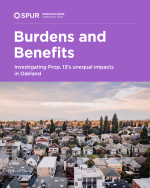
Burdens and Benefits
Research / California’s Proposition 13 is one of the most studied property taxes in the country, but how does it affect the lives of residents in Bay Area cities? SPUR’s research brief Burdens and Benefits explores how the law impacts homeowners in Oakland, with a look at who receives the largest benefits from the state’s unique property tax law and who shoulders the burdens from its constraints on revenues.

SPUR and Others to Pilot New Technology for Making Healthy Food More Affordable
News / California has reached a milestone in its effort to make healthy, California-grown food more affordable for low-income residents. The California Department of Social Services has awarded contracts to SPUR and two other nonprofits for pilot projects that will test new technology for providing healthy food incentives.

Can San Francisco Schools Help Drive Demand for Fair, Healthy, Sustainable Food?
News / Every year the San Francisco Unified School District spends more than $12 million on food — a significant opportunity to drive demand for food that positively impacts people, the planet and animals. In 2016, the district adopted the Good Food Purchasing Policy, which sets standards for fair, healthy and sustainable food. The district has now met requirements in four of the five categories, setting a solid example for other institutions to follow.
Op-Ed: Health Care Plans Must Embrace Food- and Nutrition-Based Medical Interventions
News / From the SF Examiner: At the end of 2021, California received permission to pilot new approaches to providing healthcare for those who rely on Medi-Cal. The onus is now on local health plans to implement pilot strategies. One option they should consider is medically supportive food and nutrition. Recent SPUR research makes a strong case for these interventions, which include produce prescriptions, food pharmacies, healthy groceries and medically tailored meals.
Op-Ed: California Is 60 Years Behind on Its Climate Goals. We Can’t Catch Up Without Green Buildings.
News / From the SF Chronicle: At the rate carbon emission reduction is currently going, California will be 60 years late in meeting its 2050 climate goals — too late to prevent extreme climate change. Governor Newsom and the state legislature have taken bold moves to phase out fossil fuels from transportation, but we need a similarly ambitious commitment on decarbonizing buildings.

How Reviving a Forgotten California Law Can Make Commuting More Sustainable
News / Free employee parking is a valuable job perk, but there’s one serious downside: It encourages commuting by car and hinders efforts to promote sustainable alternatives. One tool for countering this effect is parking cash out: offering the cash equivalent of a parking space to employees who don't drive to work. California passed a parking cash out law in 1992, but 30 years in, Santa Monica is still the only place in the state that requires employers to comply. Here's how the state can revitalize this underused tool to reach its long-term climate goals.
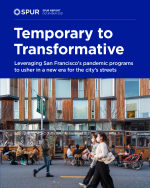
Temporary to Transformative
SPUR Report / During the COVID-19 pandemic, cities across the country piloted shared public spaces and slow streets. In a matter of weeks, these temporary changes transformed city streets in ways that would otherwise have taken years. The crisis injected the planning process with a sense of urgency and a willingness to experiment. How can San Francisco and other cities make these changes permanent? This report captures lessons learned and offers 18 recommendations for how to build on what's been started.
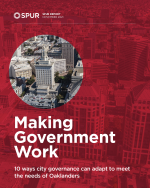
Making Government Work
SPUR Report / Many of the challenges Oakland faces are worsened by its unusual government structure, which makes it harder for the mayor, city council and other officials to do their jobs well. SPUR’s latest report diagnoses the problem and offers 10 recommendations for how the city can adapt its governance structure to better serve Oaklanders.

San José City Council Should Embrace a New Vision for Coyote Valley
News / San José is on the cusp of deepening its commitment to growing up, rather than out. The city has a unique and critical opportunity to concentrate growth within its existing urbanized areas rather than sprawling further. But it will miss a critical opportunity unless the City Council accepts the recommendations of the Planning Department and the Envision San José 2040 General Plan Four Year Review Task Force related to Coyote Valley.

Bridging the Gap
SPUR Report / The Bay Area’s current system for collecting unpaid bridge tolls hurts hundreds of thousands of people across the region. This system disproportionately harms lower-income and working people by relying on punitive tools like fines, fees and car registration holds to promote toll payment. SPUR recommends steps to reduce the harms caused by the unpaid tolls system and begin to move toward an equitable tolling system.
Integrating Food Into Healthcare
Policy Brief / California is in the midst of overhauling its Medicaid program to better serve the 12 million low-income residents who rely on it for health care. This report explores the state’s capacity to provide one key aspect of the plan: medically supportive food and nutrition interventions such as food pharmacies, produce prescriptions, healthy groceries and medically tailored meals designed to prevent, reverse and treat chronic health conditions.

Does the Bay Area Have the Water It Needs to Grow?
News / Gov. Gavin Newsom has declared a drought emergency, salmon are on the brink of extinction and rivers are choked with toxic algae because too much water is diverted for farms and cities. Does the Bay Area really have enough water to continue to grow? We found that the answer is yes — if the region adopts comprehensive water efficiency measures and smart land-use planning.